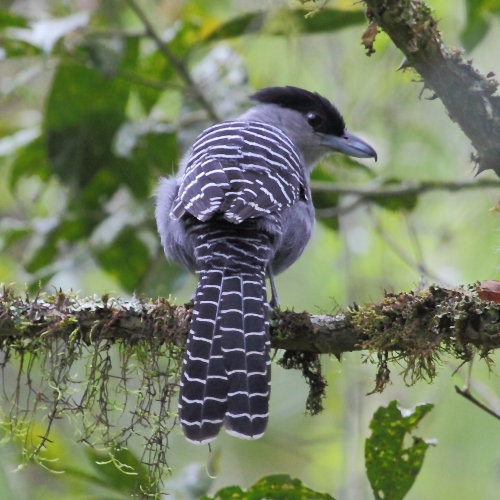
Variable Antshrike
Thamnophilus caerulescens
Order: Passeriformes / Family: Thamnophilidae

Wikimedia Commons
About the Variable Antshrike
The Variable Antshrike (Thamnophilus caerulescens) is an intriguing bird species belonging to the Thamnophilidae family. It is predominantly found in the diverse ecosystems of South America, particularly in countries such as Brazil, Argentina, Paraguay, and Bolivia. These birds play a crucial role in the ecological balance of their habitats by controlling insect populations. Their presence often indicates a healthy forest ecosystem, as they thrive in the understory and forest edges. Their adaptability allows them to inhabit various environments, from humid tropical forests to drier scrublands. During the breeding season, which varies by region, these antshrikes exhibit a fascinating array of behaviors. Males become particularly vocal and territorial, using complex calls to establish and defend their territory. This territoriality ensures a suitable habitat for raising young. As insectivores, Variable Antshrikes help maintain the balance of arthropod populations, indirectly benefiting plant health by reducing herbivore pressure. In the non-breeding season, the antshrike's behavior shifts slightly. While still maintaining territories, they may show greater flexibility in habitat choice. Mixed-species flocks sometimes include Variable Antshrikes, showcasing their adaptability and social interactions with other bird species. Their ability to adjust to changing environments highlights their ecological significance and their role as indicators of habitat health. Monitoring these birds can provide valuable insights into the impacts of habitat degradation and climate change.
The Variable Antshrike belongs to the family Thamnophilidae, within the order Passeriformes. These birds typically live average 4-5 years, maximum recorded 8 years..
How to Identify a Variable Antshrike
The Variable Antshrike exhibits a range of plumage variations, which can make identification challenging. Adult males typically display a striking contrast of black and gray plumage, with a distinctive white wing bar. Females and juveniles, however, present a more cryptic appearance with browns and grays dominating their coloration. Females often show a cinnamon hue on their underparts, which can be a key identification marker. Juveniles resemble females but may have even more subdued coloration. One must be cautious not to confuse the Variable Antshrike with similar species such as the Barred Antshrike. However, the Variable lacks the pronounced barring found in its relative. In flight, the Variable Antshrike presents a compact silhouette, characterized by short, rounded wings and a slightly elongated tail. When perched, these birds often adopt a horizontal posture, blending seamlessly with their environment. Observers should pay attention to their characteristic tail flicks, a behavior that can aid in identification.
Having trouble telling birds apart? Upload a photo to our bird identification tool for an instant species match.
Variable Antshrike Habitat and Range
Preferred Habitat
Variable Antshrikes are versatile in their habitat preferences, occupying a range of environments from lowland tropical forests to montane woodlands. They are commonly found in forest edges, secondary growth, and scrubby areas, where dense vegetation offers ample insect prey. In terms of elevation, these birds inhabit regions from sea level up to around 2,500 meters. Seasonal shifts can influence their habitat use, as they may move to slightly different areas within their range depending on food availability. While they are primarily forest dwellers, Variable Antshrikes can occasionally be found in more urban environments, particularly in areas where natural vegetation has been preserved.
Geographic Range
The Variable Antshrike's distribution spans much of South America, with populations in Brazil, Argentina, Paraguay, and Bolivia. They are year-round residents in these regions, with no significant migratory behavior observed. Within this range, population densities vary, with higher concentrations often found in areas with dense understory vegetation. In Brazil, they are commonly seen in the Atlantic Forest and the Cerrado biomes. The Pampas region of Argentina also hosts significant populations, where their adaptability to different habitats is evident. The presence of these birds in a variety of landscapes underscores their ecological resilience.
Want to know which birds visit your area? Browse our backyard birds by location guides for region-specific species lists.
What Does the Variable Antshrike Eat?
The diet of the Variable Antshrike consists primarily of insects and other small arthropods. Their foraging strategy involves gleaning prey from foliage, branches, and sometimes the ground. They demonstrate a preference for ants, beetles, and caterpillars, though their diet can diversify with the availability of prey. During the breeding season, their feeding intensity increases to support their young. These birds often follow army ant swarms to capitalize on the insects flushed out by the ants. This opportunistic feeding behavior illustrates their adaptability and crucial role in controlling insect populations. They feed primarily during the day, with peaks in activity during the early morning and late afternoon.
Variable Antshrike Behavior and Social Structure
Variable Antshrikes display a complex social structure, primarily operating in monogamous pairs. Territorial behavior is a prominent aspect of their lifestyle, with males actively defending their territory through vocalizations and displays. Courtship involves males performing subtle displays to attract females, often incorporating their distinct calls. While they are predominantly solitary or seen in pairs, these birds occasionally join mixed-species flocks, especially during the non-breeding season. Their response to predators includes both vocal alarms and physical displays, such as tail flicking and wing flicking, to warn conspecifics. Daily activity patterns reveal that they are most active during dawn and dusk, aligning their foraging with insect activity peaks.
Variable Antshrike Nesting and Reproduction
Variable Antshrikes construct cup-shaped nests using materials such as twigs, leaves, and fibers, which they skillfully weave together. These nests are typically situated in dense shrubs or low trees, providing both concealment and protection. The clutch size usually ranges from two to three eggs, which both parents incubate over a period of about 14 to 16 days. After hatching, both the male and female share responsibilities in feeding and caring for the chicks. The fledging period lasts approximately 12 to 14 days, after which the young remain dependent on the parents for a short while. Each year, they typically produce one brood, though favorable conditions might encourage a second.
Variable Antshrike Sounds and Vocalizations
The Variable Antshrike's primary song is a series of rapid, melodious whistles, often described as a 'chi-chi-chi-chu' pattern. This song is delivered with a clear, ringing quality, serving both as a territorial call and a communication tool with mates. Calls include sharp, short notes used in alarm situations or when communicating with partners. These birds engage in a lively dawn chorus, where the males' vocalizations dominate the soundscape, marking the beginning of daily activities. Their vocal repertoire is diverse, allowing them to interact effectively within their environment.
Interesting Facts About the Variable Antshrike
- 1The Variable Antshrike is one of the few bird species that can thrive in both humid forests and arid scrublands.
- 2Despite their name, Variable Antshrikes do not exhibit significant plumage variation within a single population.
- 3These birds are often seen participating in mixed-species flocks, a behavior that enhances foraging success.
- 4The male Variable Antshrike's song can travel over 100 meters, serving as an effective territorial marker.
- 5Researchers have documented that Variable Antshrikes use up to 20 different vocalizations in their communication.
- 6The Variable Antshrike's adaptability makes it a vital indicator species for assessing habitat health.
- 7Unlike many birds, Variable Antshrikes do not undergo significant seasonal migrations, remaining residents year-round.
Variable Antshrike Conservation Status
Currently, the Variable Antshrike holds a status of Least Concern on the IUCN Red List, with populations considered stable. However, habitat destruction and fragmentation pose ongoing threats, particularly in regions experiencing rapid deforestation. Conservation efforts focus on habitat preservation and restoration, particularly in biodiversity-rich regions like the Atlantic Forest. Historical data indicate that despite local population declines, the species has shown resilience in adapting to altered landscapes. Continued monitoring and habitat protection remain critical to ensuring their long-term survival.