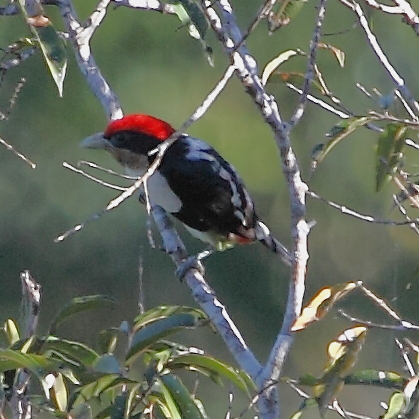
Versicolored Barbet
Eubucco versicolor
Order: Piciformes / Family: Capitonidae

Wikimedia Commons
About the Versicolored Barbet
The Versicolored Barbet, Eubucco versicolor, is a strikingly colorful bird endemic to the montane forests of the Andes in South America. This species stands out due to its vivid plumage, which combines brilliant greens, blues, reds, and yellows, making it a visual delight for birdwatchers. Belonging to the family Capitonidae, this bird plays a crucial role in its ecosystem, primarily through seed dispersal and pollination. Its presence in the ecosystem helps maintain the health and diversity of the forest. The Versicolored Barbet occupies a key ecological niche. Its diet predominantly consists of fruits and insects, contributing to the control of insect populations and aiding in the propagation of fruiting plants. The species can often be found in subtropical or tropical moist montane forests, thriving particularly in areas with dense tree cover and abundant food sources. The Versicolored Barbet exhibits seasonal behaviors that align with the availability of its food sources. During the breeding season, which typically coincides with the rainy months, barbet activity increases as they engage in courtship and nesting. These birds are non-migratory and primarily sedentary, although local movements may occur in response to food availability. The Versicolored Barbet's presence in the Andean forests of Colombia, Ecuador, Peru, and Bolivia underscores its importance in these regions. It is a species of interest to ornithologists and conservationists alike, due to both its ecological role and its vibrant aesthetic appeal.
The Versicolored Barbet belongs to the family Capitonidae, within the order Piciformes. These birds typically live around 6-8 years in the wild, with some individuals reaching 10 years..
How to Identify a Versicolored Barbet
The Versicolored Barbet is easily identifiable by its vivid plumage. Adult males typically exhibit a striking combination of green, blue, red, and yellow feathers. The head is a mix of red and blue, with a distinctive red crown and blue cheeks. The throat and chest are often a bright yellow, transitioning to a green back and wings. Females, while similarly colorful, tend to have more subdued shades, particularly on the head, which may feature more green than red. Juveniles resemble females but with even duller coloration, lacking the full vibrancy of adults. Despite these differences, both males and females share the same robust body shape and short, stout bill typical of barbets. In flight, the Versicolored Barbet displays a rapid, direct flight pattern, characterized by quick wing beats. When perched, it often adopts an upright posture, allowing observers to appreciate its full range of colors. While confusion with other species is possible, particularly with related barbets, the unique combination of color patterns and the distinct geographical range generally aids in accurate identification.
Having trouble telling birds apart? Upload a photo to our bird identification tool for an instant species match.
Versicolored Barbet Habitat and Range
Preferred Habitat
Versicolored Barbets are primarily found in subtropical and tropical moist montane forests. They thrive at elevations ranging from 1,000 to 3,000 meters, favoring dense forest canopies where fruiting trees are abundant. These birds are predominantly associated with the Andean regions of Colombia, Ecuador, Peru, and Bolivia. Within these habitats, they may also be found in secondary forests and edges, adapting to areas with sufficient tree cover and food availability. Seasonal shifts in habitat use are minimal, as the birds remain largely within their preferred elevation range year-round. While not commonly associated with urban environments, they may occasionally venture into gardens or orchards near forested areas in search of fruit.
Geographic Range
The Versicolored Barbet is endemic to the Andean region of South America, with its range spanning Colombia, Ecuador, Peru, and Bolivia. It does not undertake long-distance migrations, preferring to remain within its established territories throughout the year. Its range is largely limited to elevations between 1,000 and 3,000 meters, where suitable montane forest habitats exist. Within this range, population density may vary, with hotspots typically located in areas featuring high fruit availability and minimal disturbance. The species is more commonly encountered in protected areas and national parks, where conservation efforts help maintain suitable habitats.
Want to know which birds visit your area? Browse our backyard birds by location guides for region-specific species lists.
What Does the Versicolored Barbet Eat?
The diet of the Versicolored Barbet primarily consists of fruits, including figs, berries, and other soft-fleshed fruits. It forages by perching on branches and plucking fruits with its strong, curved bill. In addition to fruits, it consumes a variety of insects, providing a secondary food source that complements its diet. The barbet's feeding activity peaks during the early morning and late afternoon, aligning with periods when fruits are most readily available. Seasonal variations in diet occur as different fruiting species come into season, prompting the barbet to adjust its foraging locations accordingly. The bird plays a significant role in seed dispersal, aiding the regeneration of plant species within its habitat.
Versicolored Barbet Behavior and Social Structure
Versicolored Barbets exhibit a solitary or paired social structure, often seen alone or in small family groups. They are territorial birds, defending their feeding and nesting areas from intruders. Courtship displays involve vocalizations and mutual preening, strengthening pair bonds. During the breeding season, males may exhibit more pronounced territorial behaviors, including chasing rivals. The species does not typically form large flocks but may occasionally join mixed-species foraging groups, particularly when food sources are abundant. Their response to predators includes retreating into dense foliage or flying to higher branches for safety. Daily activity patterns involve active foraging during cooler morning and late afternoon hours, while midday is often spent resting in shade.
Versicolored Barbet Nesting and Reproduction
The Versicolored Barbet nests in tree cavities, which it excavates using its strong bill. Preferred nesting sites include dead trees or branches, often at varying heights depending on available trees. The female lays a clutch of 2 to 4 white eggs, which both parents incubate over a period of about 14 to 17 days. Following hatching, both male and female barbets participate in feeding and caring for the chicks. The fledging period lasts approximately 30 days, during which the young remain in the nest, receiving frequent meals from their parents. Typically, the species raises one brood per year, with nesting activity peaking during the rainy season when food resources are plentiful.
Versicolored Barbet Sounds and Vocalizations
The Versicolored Barbet's vocalizations include a series of resonant, melodious notes that form its primary song. The song consists of repeated higher-pitched phrases, with a rhythm that can be likened to a bouncing ball. Additionally, the bird produces a variety of call notes, ranging from short, sharp chips to more complex, warbling sounds. Alarm calls are generally harsher, serving to alert nearby birds of potential threats. The dawn chorus, a notable feature of barbet vocal behavior, showcases their singing prowess, as males establish their territories and attract mates. The Versicolored Barbet's song, while distinctive, may be compared to the calls of other frugivorous birds in the area.
Interesting Facts About the Versicolored Barbet
- 1The Versicolored Barbet belongs to a family known for their vibrant plumage, with 89% of its species exhibiting multiple bright colors.
- 2This barbet's strong, chisel-like bill allows it to excavate nest cavities in hardwood, a feat that's vital for reproduction.
- 3It's one of the few bird species that contribute to the pollination of some tropical plant species, thanks to its fruit-based diet.
- 4Despite its striking appearance, the Versicolored Barbet often remains elusive due to its preference for dense forest canopies.
- 5The barbet's song is considered one of the more melodious among the barbets, often described as a series of soft, fluting notes.
- 6Versicolored Barbets are known to be monogamous, often forming lifelong pair bonds and jointly caring for their young.
- 7Their role as seed dispersers makes them integral to maintaining the ecological balance of their forest habitats.
Versicolored Barbet Conservation Status
The Versicolored Barbet is currently listed as Least Concern by the IUCN, with stable population trends across its range. However, habitat degradation poses an ongoing threat, particularly due to deforestation for agriculture and logging. Conservation efforts focus on habitat protection and restoration, with several populations residing within protected areas and national parks. Historical population changes reflect habitat loss, underscoring the importance of continued conservation measures. While the species is not currently endangered, proactive measures are necessary to ensure its long-term survival amidst growing environmental pressures.