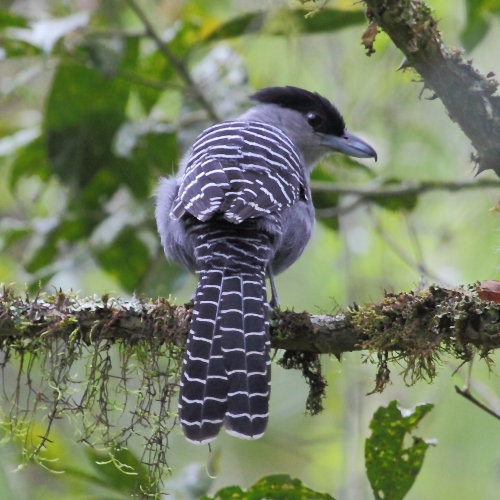
White-breasted Antbird
Rhegmatorhina hoffmannsi
Order: Passeriformes / Family: Thamnophilidae

Wikimedia Commons
About the White-breasted Antbird
The White-breasted Antbird, Rhegmatorhina hoffmannsi, is a captivating member of the Thamnophilidae family, found primarily in the Amazon Basin. It plays a crucial role in its ecosystem as an insectivore, controlling insect populations and maintaining the balance of its rich habitat. This bird is most commonly observed in the understory of terra firme forests, which are non-flooded areas of the Amazon, as well as in seasonally flooded forests known as várzea. These habitats provide the dense foliage and abundant insect life that the antbird requires for survival. The White-breasted Antbird is endemic to Brazil, with a range that includes the central and western parts of the Amazon Basin, notably in states like Amazonas and Pará. It remains within these regions all year, showcasing a non-migratory lifestyle typical of many rainforest species. This bird is particularly interesting for its specialized foraging technique, often following swarms of army ants to capture fleeing insects. During the rainy season, its activity increases as insect populations surge, providing ample food resources. The White-breasted Antbird's ecological significance extends beyond its role as a predator; it also serves as a bioindicator, helping scientists assess the health of the rainforest environment. Its presence or absence can indicate changes in habitat quality, making it a valuable species for conservationists monitoring the effects of deforestation and climate change. The dense Amazon rainforest, with its towering canopy and intricate layers, provides an ideal backdrop for the antbird's life. Here, in a world teeming with biodiversity, the White-breasted Antbird exemplifies the intricate relationships that sustain the delicate balance of tropical ecosystems.
The White-breasted Antbird belongs to the family Thamnophilidae, within the order Passeriformes. These birds typically live average 5 years, with a maximum recorded of 8 years..
How to Identify a White-breasted Antbird
The White-breasted Antbird is a small, elusive bird, measuring about 14 cm in length. Its most distinguishing feature is the bright white plumage on the chest and belly, which contrasts sharply with the darker brown and black feathers on its back and wings. The male and female are similar in appearance, though the female may exhibit slightly duller tones. Juveniles, however, often display a more muted coloration, lacking the pure white chest of adults. This species could be confused with other antbirds, yet its distinctive white breast sets it apart. In flight, the antbird shows a somewhat rounded silhouette with a short tail and broad wings, though it primarily flits within the dense undergrowth, rarely taking long flights. When perched, it often adopts a horizontal posture, clinging to branches or vines just above the forest floor. Observers should note the bird's active movements as it forages, which, combined with its vocalizations, aid in identification.
Having trouble telling birds apart? Upload a photo to our bird identification tool for an instant species match.
White-breasted Antbird Habitat and Range
Preferred Habitat
The White-breasted Antbird inhabits the dense, humid forests of the Amazon, favoring terra firme and várzea environments. These forests offer plenty of cover and a rich supply of insects. It typically resides at elevations below 500 meters, reflecting its preference for lowland tropical forests. Unlike some other species, it shows little adaptation to urban or disturbed areas, remaining true to its forest home throughout the year. Seasonal habitat shifts are minimal, as the bird remains within its Amazonian range year-round, taking advantage of the consistent climate and resources available in its native habitat.
Geographic Range
The range of the White-breasted Antbird is restricted to the Amazon Basin, primarily within Brazil. It is found in regions such as Amazonas, Pará, and Rondônia. The bird's distribution does not extend beyond the boundaries of the Amazon rainforest, as it is highly adapted to this specific environment. This antbird does not undertake long-distance migrations, residing in its breeding and wintering grounds throughout the year. Within its range, population densities can fluctuate based on habitat quality and the availability of food resources, but it generally maintains a stable presence in the core areas of suitable forest.
Want to know which birds visit your area? Browse our backyard birds by location guides for region-specific species lists.
What Does the White-breasted Antbird Eat?
Primarily an insectivore, the White-breasted Antbird feeds on a variety of arthropods, including ants, beetles, spiders, and caterpillars. It is known for following swarms of army ants, benefiting from the insects flushed out by the ant's activity. This foraging strategy allows the antbird to exploit a reliable food source, particularly during the wet season when insect activity peaks. The bird typically forages in the lower strata of the forest, deftly picking insects from leaves and branches. Its diet may vary slightly with seasonal changes in prey availability, but it remains predominantly focused on forest insects.
White-breasted Antbird Behavior and Social Structure
White-breasted Antbirds exhibit solitary or pair-based behavior, often seen alone or in pairs rather than in large flocks. They are territorial, defending their patch of forest from intruders with a combination of vocalizations and physical displays. Courtship involves subtle displays and calls, with both partners participating in territory defense. Their response to predators includes remaining motionless to avoid detection or quickly retreating into dense foliage. The antbird is most active during the early morning and late afternoon, aligning with peak insect activity. Its daily routine revolves around foraging, with brief periods of rest during the hottest part of the day.
White-breasted Antbird Nesting and Reproduction
Nesting occurs in the dense understory, where the White-breasted Antbird constructs a cup-shaped nest using leaves, twigs, and plant fibers. These nests are typically placed low in shrubs or small trees. The clutch size is usually two eggs, which are incubated by both parents for about 16 days. After hatching, the chicks remain in the nest for another 10-13 days before fledging. Both parents share feeding and brooding duties, ensuring the young are well-protected and fed. The species typically raises one brood per year, although this can vary with environmental conditions.
White-breasted Antbird Sounds and Vocalizations
The White-breasted Antbird's song is a series of clear, melodious whistles, often delivered in a descending pattern. Call notes are sharp and piercing, used to communicate between pairs or signal alarm. In the early morning, their song is a prominent part of the dawn chorus, marking the territory and reinforcing pair bonds. Their calls may resemble those of other forest birds, but the distinctive rhythm and quality of their song help distinguish them.
Interesting Facts About the White-breasted Antbird
- 1The White-breasted Antbird often follows ant swarms, capturing prey stirred up by the ants.
- 2Despite its name, the White-breasted Antbird is rarely observed outside dense, tropical forests.
- 3This antbird species is endemic to Brazil, found exclusively within the Amazon rainforest.
- 4Their song is a key component of the dawn chorus in their native forest habitat.
- 5White-breasted Antbirds play a crucial role in controlling insect populations in their ecosystem.
- 6They exhibit a marked preference for lowland forests, avoiding higher elevations.
- 7Due to their secretive nature, they are more often heard than seen in their dense habitat.
White-breasted Antbird Conservation Status
Currently, the White-breasted Antbird is classified as Least Concern by the IUCN, with stable population trends. However, the primary threat to its survival is habitat loss due to deforestation in the Amazon. Conservation efforts focus on protecting large areas of intact rainforest and promoting sustainable land-use practices. Historically, the species has maintained a stable presence in its range, but ongoing deforestation poses a significant risk to its future.