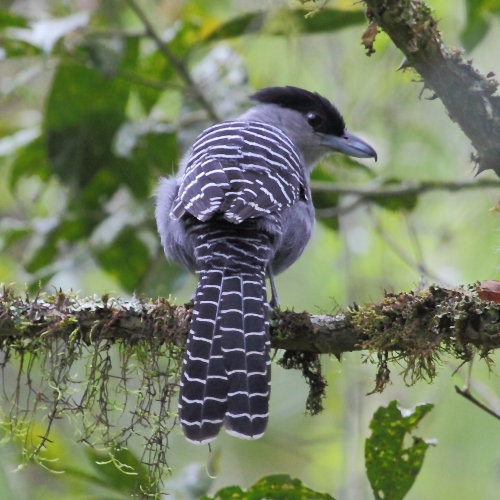
White-cheeked Antbird
Gymnopithys leucaspis
Order: Passeriformes / Family: Thamnophilidae

Wikimedia Commons
About the White-cheeked Antbird
The White-cheeked Antbird (Gymnopithys leucaspis) inhabits the understory of tropical rainforests in northwestern South America. This bird is a member of the Thamnophilidae family, which includes the diverse group known as antbirds. Characterized by a robust, compact body and a notable white cheek patch, the White-cheeked Antbird is a key part of the avian community in its range, often participating in mixed-species flocks. It occupies a niche that is crucial for maintaining the ecological balance by controlling insect populations.
Geographically, the White-cheeked Antbird is found in countries such as Colombia, Ecuador, and Peru. It thrives in humid lowland forests and prefers regions with dense foliage that provide cover and abundant food sources. The seasons influence its behavior, as this antbird is often seen following army ant swarms, particularly during the wet season when these swarms are more active. By trailing these swarms, the White-cheeked Antbird takes advantage of the insects flushed out by the ants, thus obtaining a reliable food source.
The presence of the White-cheeked Antbird is significant for the health of its ecosystem. By preying on insects, it helps regulate insect populations, preventing potential outbreaks that could harm plant life. Additionally, its role in mixed-species flocks fosters biodiversity and helps maintain the dynamic balance of forest ecosystems. Observing this bird offers insights into the complex interactions and dependencies among tropical forest species, underscoring its ecological importance.
The White-cheeked Antbird belongs to the family Thamnophilidae, within the order Passeriformes. These birds typically live average 3-5 years, with a max recorded at 7 years..
How to Identify a White-cheeked Antbird
The White-cheeked Antbird is a medium-sized bird, measuring approximately 15 centimeters in length. Its most distinguishing feature is the stark white patch on its cheeks, which stands out against its predominantly dark plumage. Adult males and females appear similar, both sporting a sleek, blackish-brown body with a contrasting white face. Juvenile individuals can be identified by their slightly duller plumage but retain the characteristic white cheek.
In the field, distinguishing the White-cheeked Antbird from similar species can be challenging due to its preference for dense undergrowth. However, its distinct vocalizations and unique face pattern aid in identification. Similar species, such as the Bicolored Antbird, might confuse observers, but the White-cheeked Antbird's white cheek patch provides a reliable distinguishing mark.
The flight silhouette of the White-cheeked Antbird is compact, with rounded wings and a short tail, although it is more often observed hopping and flitting through the underbrush than in flight. When perched, this bird adopts an alert posture, with its head held high, showcasing its distinctive facial markings.
Having trouble telling birds apart? Upload a photo to our bird identification tool for an instant species match.
White-cheeked Antbird Habitat and Range
Preferred Habitat
The White-cheeked Antbird primarily inhabits tropical lowland forests. It favors areas with thick undergrowth, which provide ample cover and food sources. These habitats are typically located at elevations ranging from sea level up to about 1,200 meters. Within this range, the bird's presence is most noticeable in areas where army ant swarms are active, as the bird follows these swarms to feed on displaced insects.
Seasonal habitat shifts in the White-cheeked Antbird are minimal, as it tends to remain within the forest year-round. In urban areas, sightings are rare; the bird's preference for dense, undisturbed forest makes it uncommon in developed or heavily trafficked regions. The White-cheeked Antbird is a true forest specialist, relying on the complex structure and resources of these environments for survival.
Geographic Range
The White-cheeked Antbird's range is confined to the neotropical regions of northwestern South America. It breeds and resides primarily in Colombia, Ecuador, and parts of northern Peru. Within these countries, its distribution is closely tied to the availability of suitable lowland rainforest habitat.
There is no significant migratory movement observed in this species. Instead, the White-cheeked Antbird is considered a resident bird, maintaining its territory within these forests throughout the year. Population density tends to be higher in regions where army ant swarms occur frequently, as these provide a consistent food source. Hotspots for the bird include the Chocó biogeographic region, known for its high biodiversity and endemic species.
Want to know which birds visit your area? Browse our backyard birds by location guides for region-specific species lists.
What Does the White-cheeked Antbird Eat?
The diet of the White-cheeked Antbird primarily consists of insects and arthropods. This bird is a classic example of an ant-follower, relying heavily on the activity of army ant swarms to flush out prey. As the ants move through the forest floor, they disturb various insects, which the antbird then captures. Its diet includes a variety of small invertebrates, such as beetles, spiders, and caterpillars.
Seasonal changes do not significantly alter the diet composition, though the abundance of prey items may vary with weather patterns affecting ant swarm activity. The White-cheeked Antbird employs a foraging technique known as 'sallying,' where it makes short flights or hops from a perch to snatch prey from the air or ground. Its feeding schedule aligns with the activity patterns of the ants, often most active during the early morning and late afternoon.
White-cheeked Antbird Behavior and Social Structure
The White-cheeked Antbird exhibits interesting social and territorial behaviors. It is typically found in pairs or small family groups when not following army ant swarms. During these times, it often associates with other ant-following species, forming mixed-species flocks that enhance foraging success.
Territorial behavior is evident, with pairs maintaining and defending small territories within the forest understory. Courtship displays involve vocalizations and mutual preening, strengthening pair bonds. During the breeding season, pairs become more secretive, focusing on nesting and raising young.
The White-cheeked Antbird's response to predators includes remaining motionless or retreating into denser foliage. Its daily activity patterns are crepuscular, with peaks during the cooler morning and evening hours when army ant activity is high.
White-cheeked Antbird Nesting and Reproduction
White-cheeked Antbirds construct their nests in the low vegetation of the forest understory. The nests are typically cup-shaped, crafted from leaves, twigs, and plant fibers. They are built at a height of around one meter off the ground, often well-hidden among dense foliage.
A typical clutch consists of two eggs, which are incubated by both parents for approximately 14 days. After hatching, the young remain in the nest for another 12 to 15 days before fledging. During this period, both parents actively participate in feeding and caring for the chicks.
The species usually raises one brood per year, with breeding timing linked to the seasonal availability of food resources, ensuring the chicks are reared when insect prey is most plentiful.
White-cheeked Antbird Sounds and Vocalizations
The White-cheeked Antbird's song is a series of sharp, repetitive notes delivered at a rapid pace. This primary song is used for communication between mates and to establish territory boundaries. Its pitch is relatively high and the quality is described as piercing, carrying efficiently through the dense forest understory.
Call notes include short, harsh 'chik' sounds, used for contact between individuals within a pair or family group. Alarm calls are louder and more urgent, serving to alert other birds of potential predators. During the dawn chorus, the White-cheeked Antbird's vocalizations contribute to the cacophony of sounds typical of tropical forests.
Interesting Facts About the White-cheeked Antbird
- 1The White-cheeked Antbird is a specialist ant-follower, meaning it relies heavily on army ant swarms for its diet.
- 2Unlike many birds, the White-cheeked Antbird does not migrate, remaining in its tropical forest home year-round.
- 3This species is part of the diverse antbird family, which includes over 200 species across Central and South America.
- 4The White-cheeked Antbird's distinctive vocalizations help it maintain territory in dense forest environments.
- 5Its white cheek patches are not just for show; they help individuals recognize each other in the dim forest understory.
- 6Pairs of White-cheeked Antbirds often duet, coordinating their calls to reinforce pair bonds and deter rivals.
- 7The White-cheeked Antbird's presence is considered an indicator of healthy, unfragmented tropical forest ecosystems.
White-cheeked Antbird Conservation Status
The White-cheeked Antbird is currently classified as Least Concern by the IUCN. However, habitat destruction due to logging and agricultural expansion poses significant threats to its population. The bird's reliance on intact, undisturbed forests makes it vulnerable to deforestation, which reduces available habitat and food sources. Conservation efforts focus on preserving large tracts of rainforest through protected areas and sustainable land management practices. While the total population is currently stable, ongoing habitat loss could lead to declines if not addressed. Historical data suggest the species has maintained stable numbers, but continued vigilance is necessary to ensure its long-term survival.