
White-crowned Manakin
Pipra pipra
Order: Passeriformes / Family: Pipridae

Wikimedia Commons
About the White-crowned Manakin
The White-crowned Manakin, scientifically known as Pipra pipra, is a small, vibrant bird belonging to the family Pipridae. This species is renowned for its distinct appearance and elaborate courtship displays. Found predominantly in the lowland rainforests of South America, the White-crowned Manakin occupies regions extending from the Guianas through the Amazon Basin, including countries such as Brazil, Venezuela, Colombia, and Peru. Its habitat preference leans towards humid tropical forests, where it thrives in the dense understory. Ecologically, the White-crowned Manakin plays a critical role as both a seed disperser and a pollinator. Its diet consists largely of small fruits and berries, which it ingests whole, subsequently aiding in the distribution of seeds. During the breeding season, which varies across its range due to differing rainfall patterns, the male White-crowned Manakin exhibits fascinating courtship rituals. These involve acrobatic movements and a series of mechanical sounds produced by specialized wing feathers. The species is well adapted to its environment and demonstrates a remarkable resilience to habitat changes, although deforestation remains a concern. As a non-migratory bird, the White-crowned Manakin does not partake in long-distance travel, instead remaining within its preferred habitat year-round. This consistency in location allows for the maintenance of stable populations, although localized declines have been noted in areas experiencing significant habitat loss. Overall, the White-crowned Manakin represents an integral component of the tropical ecosystem, contributing to both the ecological balance and the biodiversity of its environment.
The White-crowned Manakin belongs to the family Pipridae, within the order Passeriformes. These birds typically live average 6 years, with a maximum recorded of 9 years.
How to Identify a White-crowned Manakin
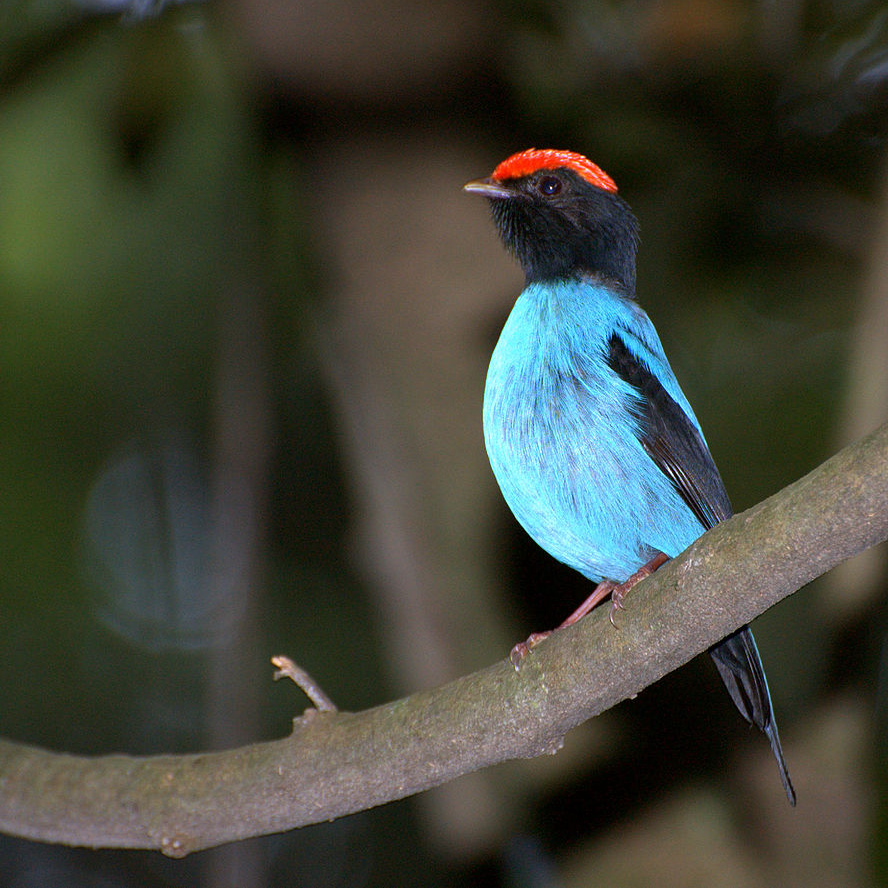
The White-crowned Manakin is immediately recognizable by its stark white crown, a feature that distinguishes it from many other manakin species. The adult male boasts a glossy black plumage that contrasts sharply with the clean, white cap on its head. In contrast, females and juveniles exhibit a more subdued appearance, with olive-green plumage that provides effective camouflage within their forest habitat. This sexual dimorphism is typical among manakins, where males often display brighter colors to attract mates. Both male and female White-crowned Manakins have short tails and a stout, slightly hooked bill adapted for a frugivorous diet. Their flight silhouette is compact, and they are known for quick, direct flights through dense foliage. While perched, the White-crowned Manakin often holds a horizontal posture, which enhances its streamlined appearance. When identifying this species, one may also compare it to the similar Red-capped Manakin, which, as its name suggests, has a red crown instead of white. The White-crowned Manakin's distinctive head coloration and vocalizations further aid in its identification in the field.
Having trouble telling birds apart? Upload a photo to our bird identification tool for an instant species match.
White-crowned Manakin Habitat and Range
Preferred Habitat
The White-crowned Manakin primarily inhabits lowland tropical forests, favoring areas with dense understory vegetation. These birds are most commonly found at elevations ranging from sea level to about 1,200 meters. They thrive in the humid, lush environments provided by primary and secondary growth forests. Within these habitats, they often select the middle strata of the forest, where they can forage for fruit and engage in courtship displays. While they prefer undisturbed forest regions, White-crowned Manakins can also adapt to certain degraded habitats, although their presence is less frequent in urban areas. Seasonal shifts in habitat are minimal, as these birds are largely sedentary, maintaining their territories throughout the year.
Geographic Range
The White-crowned Manakin's range is extensive throughout northern South America. It is resident from the eastern slopes of the Andes in Colombia and Venezuela eastward through the Guianas and across the vast Amazon Basin in Brazil. This species also occupies parts of Ecuador, Peru, and northern Bolivia. The bird's presence is notably dense in the Amazonian regions, where the habitat conditions are ideal. Unlike many other passerines, the White-crowned Manakin does not engage in long migrations, instead showing only minor movements in response to local environmental conditions. Populations remain relatively stable across most of their range, though habitat destruction has led to localized declines.
Want to know which birds visit your area? Browse our backyard birds by location guides for region-specific species lists.
What Does the White-crowned Manakin Eat?
The diet of the White-crowned Manakin primarily consists of small fruits and berries, making it an important frugivore in its ecosystem. It forages in the forest understory, often leaping between branches in short, agile flights to reach fruiting trees and shrubs. The bird consumes a variety of fruits, including those of the Melastomataceae and Rubiaceae families. During the wet season, when fruit is more abundant, its diet remains heavily fruit-based. However, during drier periods, the White-crowned Manakin may supplement its diet with small insects, which provide necessary protein. The bird typically feeds during daylight hours, with peak activity observed in the early morning and late afternoon.
White-crowned Manakin Behavior and Social Structure
The White-crowned Manakin is known for its dynamic social and courtship behaviors. Males are highly territorial and engage in elaborate courtship displays to attract females. These displays include rapid, acrobatic flights and distinctive mechanical sounds produced by their modified wing feathers. Males often gather in leks, where they perform these displays in close proximity to one another. Despite their competitive courtship, White-crowned Manakins are generally solitary outside of the breeding season, with both males and females maintaining separate territories. Their response to predators involves rapid, evasive flights and reliance on their cryptic plumage for concealment. Daily activity patterns involve periods of active foraging interspersed with rest during the hottest parts of the day.
White-crowned Manakin Nesting and Reproduction
The nesting behavior of the White-crowned Manakin involves building a simple, cup-shaped nest constructed from fine plant fibers and spider webs. These nests are typically placed in the fork of a small tree or shrub, often 1-3 meters above the ground. Females are solely responsible for nest construction and incubation. A typical clutch consists of two eggs, which the female incubates for about 18-19 days. After hatching, the chicks remain in the nest for approximately 13-15 days before fledging. During this period, the female provides all parental care, including feeding the chicks. The species is known to produce one to two broods per breeding season, depending on environmental conditions and resource availability.
White-crowned Manakin Sounds and Vocalizations
The White-crowned Manakin's vocalizations are characterized by a series of sharp, metallic 'tick' notes, often delivered in rapid succession. These calls serve various purposes, including territory defense and communication between individuals. During courtship, males produce an array of mechanical sounds, including distinctive wing snaps and whirring noises, which play a crucial role in attracting females. The male's display repertoire is one of the most complex among manakins, and these sounds are often accompanied by visual displays. The dawn chorus of the White-crowned Manakin is less prominent than that of many other forest birds, but their calls can still be heard resonating through the dense understory in the early morning.
Interesting Facts About the White-crowned Manakin
- 1The White-crowned Manakin's courtship display is so vigorous that it can cause the vegetation around its lek to become visibly worn.
- 2Despite its small size, the White-crowned Manakin can make remarkably loud mechanical sounds during its display, audible up to 50 meters away.
- 3The White-crowned Manakin is one of over 50 species of manakins, each known for unique and complex courtship behaviors.
- 4Males may spend several hours each day displaying at leks during the breeding season, which can last for several months.
- 5In some parts of its range, the White-crowned Manakin is one of the most common manakin species, frequently spotted by birdwatchers.
- 6The species' ability to thrive in both primary and secondary forests demonstrates its adaptability to changing environments.
- 7White-crowned Manakins contribute to forest regeneration by dispersing seeds over large areas as they feed on a variety of fruits.
White-crowned Manakin Conservation Status
The White-crowned Manakin is currently classified as Least Concern by the IUCN, reflecting the species' relatively stable population numbers across its extensive range. However, ongoing deforestation and habitat fragmentation in the Amazon Basin pose significant threats to its habitat. Conservation efforts focus on preserving large tracts of tropical forest and promoting sustainable land use practices. While the species has shown some adaptability to secondary growth forests, its reliance on dense understory vegetation makes it vulnerable to habitat degradation. Monitoring population trends and protecting key habitats remain critical to ensuring the long-term survival of the White-crowned Manakin.
Other Pipridae Species


Birds Similar to the White-crowned Manakin
These species are often confused with the White-crowned Manakin due to similar appearance or overlapping range.

