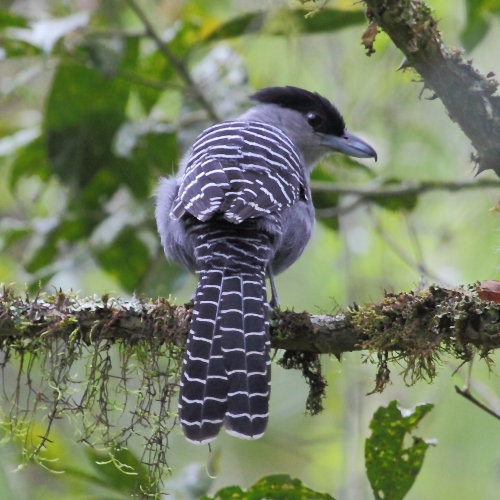
White-fringed Antwren
Formicivora grisea
Order: Passeriformes / Family: Thamnophilidae

Wikimedia Commons
About the White-fringed Antwren
The White-fringed Antwren (Formicivora grisea) is a small passerine bird belonging to the Thamnophilidae family. Found predominantly in the tropical regions of northern South America, this species thrives in countries such as Venezuela, Brazil, and Colombia. Its ecological significance lies in its role as an insectivore, contributing to the control of arthropod populations within its habitat. The antwren prefers humid forest undergrowth and edge habitats where dense foliage provides ample cover and feeding opportunities. Typically, these birds remain within lower forest strata, actively foraging and nesting close to the ground or slightly above it. Seasonal behaviors of the White-fringed Antwren are closely tied to breeding cycles and food availability. During the wet season, which varies depending on the specific region within its range, the antwren increases its foraging activity to meet the demands of raising young. This period also coincides with an abundance of insects, which form the primary diet of this bird. The antwren's presence is a reliable indicator of ecosystem health, as it requires intact forest environments to thrive. Observing the White-fringed Antwren in its natural habitat provides valuable insights into the complex interdependencies of tropical forest ecosystems.
The White-fringed Antwren belongs to the family Thamnophilidae, within the order Passeriformes. These birds typically live average 3-4 years, with a maximum recorded of 5 years..
How to Identify a White-fringed Antwren
The White-fringed Antwren is a small bird, typically measuring around 12 cm in length. Its most distinctive field mark is the white edging on its wings, which contrasts sharply with the predominantly gray or brown plumage. Adult males often exhibit darker grayish tones, while females may appear more brownish with slightly paler underparts. Juveniles resemble females but can be distinguished by their less defined wing fringes and slightly duller coloring. In terms of sexual dimorphism, males and females display subtle differences primarily in plumage intensity rather than pattern. The antwren's flight silhouette is compact and swift, characterized by rapid wingbeats as it navigates through dense vegetation. When perched, the White-fringed Antwren maintains an alert posture, often flicking its wings and tail. This behavior aids in quick identification among similarly sized species such as other antwrens and small flycatchers. Its preference for undergrowth habitats can sometimes make visual identification challenging, but persistence and attention to its unique wing pattern can aid birders in confirming their observations.
Having trouble telling birds apart? Upload a photo to our bird identification tool for an instant species match.
White-fringed Antwren Habitat and Range
Preferred Habitat
The White-fringed Antwren inhabits tropical and subtropical forests, with a preference for dense undergrowth along forest edges and secondary growth areas. These birds are typically found at elevations ranging from sea level to about 1,000 meters, with occasional sightings at higher altitudes in some regions. They thrive in areas where vegetation provides ample cover and feeding opportunities, such as lowland rainforests, gallery forests, and even some swampy areas with sufficient dry perches. While the antwren is primarily associated with rural environments, it can occasionally be found in more urban settings where forest fragments persist. This adaptability allows the species to occupy a range of habitats, although its presence often indicates relatively intact forest areas. Seasonal habitat shifts are minimal, as the White-fringed Antwren tends to remain resident within its established range throughout the year.
Geographic Range
The White-fringed Antwren is a resident bird across a broad swath of northern South America. Its breeding range extends from the coastal regions of Venezuela and Guyana through central and northern Brazil, encompassing areas such as the Amazon Basin. The species does not engage in long-distance migrations, but local movements may occur in response to food availability and breeding needs. Population density is particularly high in regions of continuous forest cover, with notable hotspots in the Amazonian lowlands and the foothills of the Andes. The antwren's range does not typically extend into southern Brazil or the southernmost parts of the continent. Despite its widespread distribution, the White-fringed Antwren is not uniformly abundant throughout its range, with localized declines in areas experiencing significant deforestation and habitat fragmentation.
Want to know which birds visit your area? Browse our backyard birds by location guides for region-specific species lists.
What Does the White-fringed Antwren Eat?
The White-fringed Antwren primarily feeds on insects and other small arthropods, making it an integral part of the forest's pest control network. Its diet includes ants, beetles, spiders, and caterpillars, which it gleans from leaves and branches within its forest habitat. Seasonal changes in diet are not pronounced, although availability of certain prey items may vary with rainfall patterns. The antwren employs a methodical foraging technique, hopping and flitting through the underbrush while inspecting foliage for hidden prey. It may also engage in sallying flights to catch flying insects, though this behavior is less common. Prey size generally ranges from small to medium, with the antwren adept at handling a variety of invertebrate prey. Feeding typically occurs throughout the day, with peaks in activity during the cooler morning and late afternoon hours.
White-fringed Antwren Behavior and Social Structure
The White-fringed Antwren exhibits a socially monogamous structure, with pairs often observed foraging and nesting together. Territorial behavior is pronounced during the breeding season, when pairs aggressively defend their nesting area from intruders. Courtship displays involve both visual and vocal components, with males performing short flights and song to attract and maintain pair bonds. The antwren does not form large flocks, typically remaining in pairs or small family groups. It responds to predators with a combination of alarm calls and evasive actions, retreating into dense cover when threatened. Daily activity patterns are largely diurnal, with foraging and social interactions peaking in the morning and tapering off as temperatures rise. During late afternoon, antwrens may resume activity, particularly in cooler regions or during overcast weather.
White-fringed Antwren Nesting and Reproduction
The White-fringed Antwren builds cup-shaped nests, typically positioned low in shrubs or small trees within dense undergrowth. Nests are constructed using fine plant fibers, leaves, and spider silk, creating a well-camouflaged structure that blends seamlessly with its surroundings. Clutch size generally ranges from two to three eggs, with both parents sharing incubation duties over a period of approximately 14 days. Post-hatching, both parents continue to provide food and protection to the fledglings. The young typically fledge after about 10-12 days, but parental care may extend beyond this period as juveniles learn to forage independently. The White-fringed Antwren may produce two broods per year, depending on environmental conditions and food availability.
White-fringed Antwren Sounds and Vocalizations
The primary song of the White-fringed Antwren is a series of rapid, high-pitched notes that carry through the dense forest. The rhythm is consistent, with a rising and falling pattern that can be likened to a 'tsee-tsee-tsee-tsee' sequence. Call notes are typically short and sharp, serving as contact calls between mates or signaling alarm. In response to predators, the antwren may emit a more urgent series of calls, alerting nearby birds to potential danger. During the dawn chorus, the White-fringed Antwren actively participates, with males often singing from exposed perches within their territory. This vocal behavior reinforces pair bonds and establishes territorial boundaries.
Interesting Facts About the White-fringed Antwren
- 1The White-fringed Antwren's diet includes a variety of insects, playing a crucial role in controlling potential pest populations.
- 2Despite its small size, the White-fringed Antwren can be quite territorial, especially during the breeding season.
- 3This antwren often uses spider silk in its nest construction, providing strength and elasticity to the nest structure.
- 4The White-fringed Antwren is a year-round resident in its range, showing minimal migratory behavior.
- 5Its distinctive white wing fringes make it easier to identify despite its preference for dense undergrowth habitats.
White-fringed Antwren Conservation Status
The White-fringed Antwren is currently listed as Least Concern by the IUCN. However, its population trend is suspected to be decreasing due to ongoing habitat destruction and fragmentation. Deforestation for agriculture and urban development poses the primary threats to its habitat. Conservation efforts focus on preserving large tracts of continuous forest and promoting sustainable land-use practices. Historically, the population of the White-fringed Antwren has remained stable in regions with minimal human impact, but localized declines highlight the importance of targeted conservation initiatives.