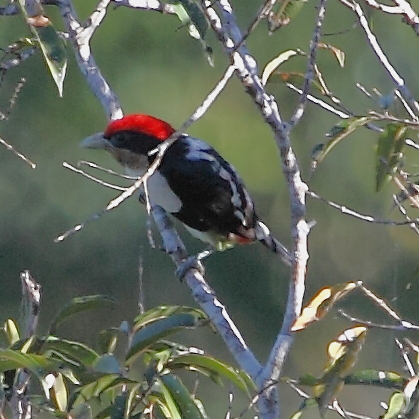
White-mantled Barbet
Capito hypoleucus
Order: Piciformes / Family: Capitonidae

Wikimedia Commons
About the White-mantled Barbet
The White-mantled Barbet (Capito hypoleucus) is a vibrant and distinctive bird species found primarily in the Andean foothills of Colombia. This bird, belonging to the family Capitonidae, is characterized by its striking plumage and distinct coloration. Recognizable by its white mantle, this barbet is a key component of the montane forest ecosystems where it resides. Its presence indicates a healthy forest environment due to its reliance on fruiting trees and insects as food sources. The White-mantled Barbet plays a significant role in seed dispersal and insect population control, directly affecting the forest's ecological balance.
Endemic to Colombia, the White-mantled Barbet inhabits the subtropical or tropical moist montane forests. These habitats provide the essential resources and conditions for feeding, nesting, and breeding. The White-mantled Barbet is often found at elevations ranging from 900 to 2,100 meters, where the dense canopy offers protection and abundant food supplies. Despite its vibrant appearance, this bird can be challenging to spot due to its preference for the upper canopy where it forages among the foliage.
This species exhibits fascinating seasonal behaviors. During breeding seasons, typically from March to July, the White-mantled Barbet can be observed participating in courtship displays and territorial defense. The change in season also influences its diet, as it shifts focus from primarily consuming insects to incorporating a more fruit-heavy diet when such resources become available. These shifts illustrate the bird's adaptability and its ability to thrive in the fluctuating conditions of its montane forest home.
The White-mantled Barbet's ecological role extends beyond its immediate environment. As a seed disperser, it contributes to forest regeneration, helping maintain the biodiversity that characterizes these rich ecosystems. Its interactions with the environment underscore the importance of conserving its habitat, vital for the survival of not only the barbet but also numerous other species that depend on the same ecological niches.
The White-mantled Barbet belongs to the family Capitonidae, within the order Piciformes. These birds typically live average 8-10 years, with a maximum of 12 years recorded..
How to Identify a White-mantled Barbet
Identifying the White-mantled Barbet involves noting several key features. Adult barbets display a distinctive white mantle that contrasts sharply with their black wings and tail. The head is adorned with a striking red cap, which is more pronounced in males. The underparts are predominantly white, with a subtle wash of yellow on the belly, a feature that becomes more apparent under certain lighting conditions. The bill is robust and black, well-suited for its diet of fruits and insects.
Juvenile White-mantled Barbets differ slightly in coloration, with less vivid red caps and a more muted yellow wash on the belly. These differences fade as the birds mature and reach full adult plumage. Males and females are similar in appearance, though males often have slightly brighter and more extensive red caps. This species can be confused with other barbet species within its range, but the unique combination of its white mantle and red cap helps in distinguishing it from others.
In flight, the White-mantled Barbet shows a silhouette typical of the barbet family, with a short neck, large head, and a compact body. When perched, it often adopts an upright posture on branches, making use of its zygodactyl feet to grasp the bark firmly. These physical characteristics, combined with its distinctive vocalizations, make the White-mantled Barbet a unique presence in its native habitat.
Having trouble telling birds apart? Upload a photo to our bird identification tool for an instant species match.
White-mantled Barbet Habitat and Range
Preferred Habitat
The White-mantled Barbet primarily inhabits subtropical and tropical moist montane forests. It thrives in areas with dense canopy cover, which provides both protection from predators and ample feeding opportunities. These forests, located at elevations between 900 and 2,100 meters, are characterized by high humidity and rich biodiversity. Such conditions are ideal for the barbet, as they support a wide range of fruiting trees and insect populations that constitute its diet.
The barbet has adapted to various forested environments within its range, from primary forests to secondary growth areas where human activity has altered the landscape. However, it shows a preference for undisturbed habitats, where the ecological balance remains intact. Seasonal changes influence its habitat use, as it may move to areas with more abundant food resources during certain times of the year.
While primarily a forest-dwelling species, the White-mantled Barbet can occasionally be observed in semi-urban areas where suitable forest patches exist. However, its presence in such environments is limited, emphasizing the importance of conserving natural montane forest habitats to ensure the species' long-term survival.
Geographic Range
The White-mantled Barbet is endemic to Colombia, where it is primarily found in the Andean foothills. Its range is restricted to the western and central Andes, specifically in the regions of Antioquia, Caldas, and Risaralda. These areas provide the montane forest environments that the species requires.
Within this range, the barbet's distribution is closely tied to the availability of suitable habitat. Population density tends to be higher in areas where primary and mature secondary forests are intact, supporting the barbet's needs for food and nesting sites. As a non-migratory species, the White-mantled Barbet remains within its range year-round, though it may exhibit local movements in response to seasonal changes in food availability.
Despite its limited range, the White-mantled Barbet's distribution overlaps with several protected areas and reserves, which play a crucial role in conserving its habitat and supporting stable population levels. Conservation efforts within these regions are essential to counteract the effects of habitat loss and fragmentation, ensuring that this vibrant species continues to thrive in its native landscape.
Want to know which birds visit your area? Browse our backyard birds by location guides for region-specific species lists.
What Does the White-mantled Barbet Eat?
The diet of the White-mantled Barbet consists primarily of fruits and insects, reflecting its role as both a seed disperser and an insectivore. This species exhibits a preference for fruits from a variety of tree species found within its montane forest habitat. Commonly consumed fruits include those from the Lauraceae and Moraceae families, which are abundant in its range.
Insects form a secondary but significant part of the barbet's diet, particularly during the breeding season when the demand for protein increases. The bird employs a foraging technique that involves gleaning insects from leaves and bark, as well as occasionally catching flying insects in mid-air. Its robust bill is well-suited for breaking into tougher fruit skins and accessing hidden insect larvae.
Seasonal variations affect the White-mantled Barbet's diet, with a shift towards more fruit consumption during periods of fruit abundance. This adaptability in diet helps the barbet to thrive throughout the year, as it can take advantage of the cyclical availability of different food resources. The barbet typically feeds during the early morning and late afternoon, periods when food is most accessible and competition with other species is reduced.
White-mantled Barbet Behavior and Social Structure
The White-mantled Barbet exhibits a variety of behaviors that reflect its adaptation to the montane forest environment. It is a generally solitary bird but can occasionally be seen in pairs or small family groups, particularly during the breeding season. Territorial behavior is prominent, with males often engaging in vocal displays and physical posturing to defend their feeding and nesting areas from intruders.
Courtship displays among White-mantled Barbets are characterized by mutual preening and synchronized movements, which strengthen pair bonds. These displays are essential during the breeding season, as they facilitate mate selection and ensure reproductive success. The species is known for its resilience to predators, employing alarm calls to alert others of potential threats. Its primary predators include raptors and arboreal mammals.
Daily activity patterns of the White-mantled Barbet are dictated by the availability of food and the need for territorial defense. The barbet is most active during the cooler parts of the day, engaging in feeding and territorial displays. During the hottest hours, it often retreats to the shaded canopy, conserving energy and avoiding predators. These behavioral adaptations contribute to its success in the challenging montane forest environment.
White-mantled Barbet Nesting and Reproduction
The nesting habits of the White-mantled Barbet are indicative of its adaptation to the montane forest environment. This species typically excavates its nests in dead trees or large branches, creating a cavity that provides protection for the eggs and chicks. The selection of nesting sites is critical, as it must ensure safety from predators and environmental conditions.
A typical clutch consists of 2 to 3 eggs, which the female incubates for about 14 to 16 days. Both parents participate in feeding and caring for the chicks once they hatch, demonstrating a strong cooperative breeding strategy. The young fledge after approximately 30 days, but they remain dependent on the parents for food and protection for several weeks thereafter.
The White-mantled Barbet usually produces one brood per year, although in optimal conditions with abundant food resources, a second brood is possible. Nesting success is closely linked to habitat quality, as well-preserved forests offer the necessary resources for successful breeding. The choice of nesting sites, coupled with parental care strategies, highlights the species' adaptation to its specific ecological niche.
White-mantled Barbet Sounds and Vocalizations
The vocalizations of the White-mantled Barbet are distinctive and serve various communicative functions. Its primary song consists of a series of rhythmic, repetitive notes that carry well through the dense forest canopy. The song is often described as a series of "tuk-tuk-tuk" sounds, delivered in rapid succession, which can be heard at dawn and during territorial disputes.
Call notes are varied, including sharp, high-pitched chirps used for communication between mates and family members. Alarm calls are more abrupt and louder, designed to alert others to the presence of predators or intruders. These vocalizations play a crucial role in maintaining social bonds and ensuring the safety of the species within its habitat.
The dawn chorus of the White-mantled Barbet, a vibrant mix of songs and calls, is a key feature of its daily routine. This behavior not only establishes territory but also reinforces pair bonds and signals the start of a new day in the bustling montane forest environment.
Interesting Facts About the White-mantled Barbet
- 1The White-mantled Barbet is one of only two barbet species endemic to Colombia, making it a unique treasure of the region.
- 2This barbet is known to play a role in seed dispersal, particularly for fruiting plants in the Lauraceae family.
- 3Despite its vibrant colors, the White-mantled Barbet can be surprisingly difficult to spot due to its preference for the upper canopy.
- 4The species' robust bill allows it to feed on a wide variety of fruits, as well as insects hidden under bark and leaves.
- 5White-mantled Barbets are cavity nesters, often choosing to excavate their nests in dead trees or large branches.
- 6Both male and female White-mantled Barbets participate in raising their young, showcasing a strong pair bond.
- 7The bird's primary song, a series of rhythmic "tuk-tuk-tuk" notes, is a common sound in the montane forests of Colombia.
White-mantled Barbet Conservation Status
The White-mantled Barbet is currently listed as Vulnerable on the IUCN Red List. Its population trend is decreasing, primarily due to habitat loss and fragmentation resulting from agricultural expansion and logging activities. The barbet's reliance on montane forests makes it particularly susceptible to deforestation, as these habitats are often cleared for coffee plantations and other crops. Conservation efforts focus on protecting and restoring the barbet's natural habitat through the establishment of protected areas and reserves. Environmental organizations in Colombia are working to create corridors that connect fragmented forest patches, allowing for greater genetic exchange and movement between populations. Historical population changes highlight the impact of human activity on this species, with significant declines noted in regions where deforestation has been most pronounced. Raising awareness about the ecological importance of the White-mantled Barbet and its role in maintaining forest health is crucial for its conservation. Continued efforts to monitor populations and implement habitat restoration projects are essential to prevent further declines and ensure the survival of this vibrant bird species.