
Xingu Scale-backed Antbird
Willisornis vidua
Order: Passeriformes / Family: Thamnophilidae

Wikimedia Commons
About the Xingu Scale-backed Antbird
The Xingu Scale-backed Antbird (Willisornis vidua) is a remarkable species found predominantly in the humid tropical forests of the Amazon basin, specifically thriving in regions like the Xingu River area in Brazil. This bird plays a significant role in its ecosystem by controlling insect populations, serving as an indicator for forest health. The antbird's presence is often a sign of a well-preserved, biodiverse forest environment. Its ecological role extends beyond mere insect control; it acts as a mutualistic participant in army ant swarms, benefiting from the insects flushed out by these ants. The diet predominantly consists of ants, beetles, and other small arthropods, which the bird captures with its sharp, pointed bill.
The Xingu Scale-backed Antbird exhibits seasonal behaviors that align with the region's climatic patterns. During the wet season, when insect populations surge, the bird engages in more active foraging and breeding activities. The dry season sees a slight decline in food availability, prompting the antbird to adjust its foraging range slightly, often moving closer to water sources or more densely vegetated areas in search of sustenance. As a non-migratory bird, it remains within its home range year-round, though it may exhibit minor local movements depending on resource availability.
The importance of the Xingu Scale-backed Antbird extends to conservation efforts as well. As its habitat faces threats from deforestation and forest fragmentation, this species becomes a sentinel for environmental changes. Conservationists closely monitor populations of Willisornis vidua to gauge the health of forest ecosystems in the Amazon basin. Protecting its habitat not only ensures the survival of this striking bird but also benefits a multitude of other species relying on the same forest resources.
The Xingu Scale-backed Antbird belongs to the family Thamnophilidae, within the order Passeriformes. These birds typically live 4-6 years, with some individuals living up to 8 years..
How to Identify a Xingu Scale-backed Antbird
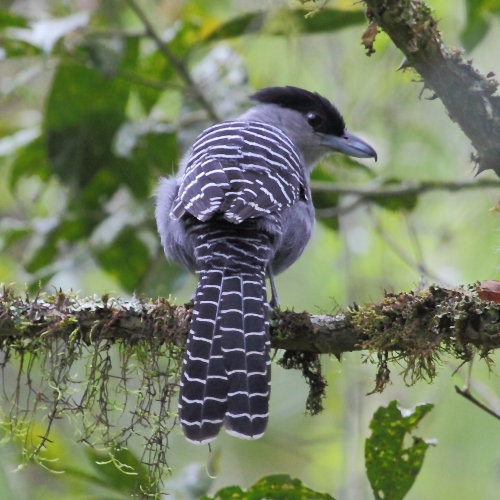
The Xingu Scale-backed Antbird can be identified by its distinctive scale-like plumage pattern, which gives it its name. Adult males exhibit a primarily black and dark gray plumage with a noticeable scaly appearance on their back and wings, a characteristic that is less pronounced in females and juveniles. The females tend to have a more muted brown coloration with lighter gray scaling, providing a stark contrast to the males. Juvenile birds often resemble females but with an overall softer and paler palette.
One of the key distinguishing features of Willisornis vidua is its size, falling into the small category of passerines, typically measuring around 12-13 cm in length. Its compact body and short tail are complemented by a strong, sharply pointed bill that is well-adapted for insect foraging. The flight silhouette of the Xingu Scale-backed Antbird is characterized by short, rapid wing beats and a low, undulating flight pattern as it moves through dense undergrowth.
This species can be easily confused with similar antbirds within the genus Willisornis, particularly those sharing overlapping ranges. However, the specific scale-backed pattern and vocalizations can help distinguish the Xingu Scale-backed Antbird from its relatives. When perched, the bird often adopts a horizontal posture, staying close to the forest floor or within dense foliage, making it a challenge to observe without careful attention.
Having trouble telling birds apart? Upload a photo to our bird identification tool for an instant species match.
Xingu Scale-backed Antbird Habitat and Range
Preferred Habitat
The Xingu Scale-backed Antbird is primarily found in the lowland tropical forests of the Amazon basin, with a notable presence in the Xingu River area in Brazil. This species favors dense undergrowth and forest interior habitats, often avoiding open or fragmented forest areas. It thrives at elevations ranging from sea level up to about 600 meters, seldom venturing into higher altitudes.
The bird's preference for dense, humid forests makes it a forest specialist, rarely found outside these lush environments. Seasonal habitat shifts occur as the bird may move locally within its territory in response to changes in food availability, particularly during dry spells when water becomes scarcer.
While the Xingu Scale-backed Antbird's presence in urban areas is rare, it occasionally frequents forest edges near human settlements, provided there is enough dense vegetation available. However, this species is predominantly associated with pristine forest habitats, making it a key indicator of forest health and integrity.
Geographic Range
The Xingu Scale-backed Antbird's range is largely confined to the Amazon basin, with its core distribution centered in the Xingu River region of Brazil. This area includes a stretch of tropical rainforest that supports a dense population of these antbirds. Unlike many other passerines, Willisornis vidua does not migrate, maintaining a year-round presence within its established range.
Population density hotspots occur in regions where dense, healthy forest environments are intact, allowing for ample foraging opportunities. They are notably absent from heavily deforested or otherwise degraded forest areas, underscoring their sensitivity to habitat disruption.
The bird's range does not extend far beyond Brazil, as it is endemic to the specific ecological niches found in the Amazonian forests of this region. Its restricted range makes habitat conservation efforts crucial for its continued survival, particularly in light of ongoing deforestation pressures in the Amazon basin.
Want to know which birds visit your area? Browse our backyard birds by location guides for region-specific species lists.
What Does the Xingu Scale-backed Antbird Eat?
The diet of the Xingu Scale-backed Antbird primarily consists of ants, beetles, and various other small arthropods. This insectivorous feeding strategy is complemented by their close association with army ant swarms, from which they capture insects and other prey items flushed out by the ants' movement. The bird's sharp, pointed bill is adept at picking insects from leaves, branches, and the forest floor.
Seasonal changes in diet are minimal, although the abundance of certain prey items may fluctuate with the seasons. During the wet season, when insect populations peak, the Xingu Scale-backed Antbird may consume a greater variety of prey. In the drier months, it relies more heavily on ants and other resilient prey to sustain its dietary needs.
Foraging typically occurs during daylight hours, with peak activity in the early morning and late afternoon when insects are most active. The bird often forages alone or in pairs, moving rapidly through the forest undergrowth in search of food. Its feeding schedule and techniques remain consistent throughout the year, reflecting its specialization in an insect-dominated diet.
Xingu Scale-backed Antbird Behavior and Social Structure
The Xingu Scale-backed Antbird exhibits a range of intriguing behaviors, particularly in its social structure and territoriality. This species is largely monogamous, with pairs establishing and maintaining territories within the dense forest undergrowth. Territorial behavior is pronounced, with both males and females actively defending their range against intruders through vocalizations and displays.
Courtship displays involve a combination of vocal calls and physical postures, with males often engaging in a series of rapid wing flicks and tail fanning to attract a mate. Once paired, the birds remain within their established territory, exhibiting strong site fidelity throughout the year.
Flocking behavior is generally limited, as the Xingu Scale-backed Antbird prefers to forage in pairs or small family groups. This species is known for its close association with army ant swarms, where it exhibits a unique form of cooperative foraging. The antbird positions itself near the front of the swarm, capturing insects and other prey flushed out by the ants' activity.
In response to predators, the Xingu Scale-backed Antbird relies on its cryptic plumage and quick movements to evade detection. It often seeks cover in dense vegetation when threatened, using its small size and agility to its advantage. Daily activity patterns are consistent, with peak activity occurring during cooler parts of the day, such as early morning and late afternoon.
Xingu Scale-backed Antbird Nesting and Reproduction
The Xingu Scale-backed Antbird constructs a cup-shaped nest, typically nestled within dense foliage or low shrubs in the forest undergrowth. Nest materials consist of fine twigs, leaves, and occasionally moss, woven together to provide a secure and camouflaged environment for the eggs.
Preferred nesting sites are well-concealed areas that offer protection from predators and the elements. The female lays a clutch of 2-3 eggs, which she incubates with occasional assistance from the male. The incubation period lasts approximately 14-16 days, during which the parents remain vigilant in defending the nest from potential threats.
Upon hatching, both parents participate in feeding the chicks, primarily providing them with a diet of small insects and arthropods. The fledging period extends over 10-12 days, after which the young birds gradually become more independent. The parental roles are well-defined, with both birds contributing to feeding and protecting the chicks.
The Xingu Scale-backed Antbird typically raises one brood per year, although favorable conditions may occasionally allow for a second brood. The species' nesting behavior reflects its adaptation to the dense and competitive environment of the Amazon rainforest.
Xingu Scale-backed Antbird Sounds and Vocalizations
The primary song of the Xingu Scale-backed Antbird consists of a series of sharp, high-pitched notes delivered in rapid succession. The rhythm is steady and deliberate, often lasting several seconds before pausing. These vocalizations serve both territorial and mating purposes, as well as maintaining communication between pair members.
Call notes are less complex, typically consisting of single or paired chirps used for contact or alarm. These calls are softer and lower in pitch compared to the primary song, allowing the bird to communicate subtle information without attracting undue attention.
Alarm calls are more urgent and higher in pitch, intended to warn of potential threats. In the context of the dawn chorus, the Xingu Scale-backed Antbird's song can be heard as a distinct, repetitive motif among the symphony of forest sounds. Its vocal patterns are consistent with those of many passerines, yet its specific tonal quality and rhythm set it apart.
Interesting Facts About the Xingu Scale-backed Antbird
- 1The Xingu Scale-backed Antbird has a unique association with army ant swarms, using them as foraging partners to flush out insects.
- 2Despite its small size, the Xingu Scale-backed Antbird is an aggressive defender of its territory, often confronting larger birds.
- 3Willisornis vidua is largely sedentary, making it a reliable species for studying the effects of habitat changes over time.
- 4The scale-like pattern on its plumage provides excellent camouflage in the dappled light of the forest undergrowth.
- 5While primarily insectivorous, the Xingu Scale-backed Antbird occasionally consumes small amphibians and lizards.
- 6The bird's vocalizations are an important aspect of its behavior, used extensively in territory defense and mate attraction.
- 7The Xingu Scale-backed Antbird's presence is often an indicator of high biodiversity within a given forest area.
Xingu Scale-backed Antbird Conservation Status
The IUCN currently lists the Xingu Scale-backed Antbird as Near Threatened, with a decreasing population trend primarily due to habitat loss. Deforestation and forest fragmentation in the Amazon basin pose significant threats to its survival, as the species relies on dense, undisturbed forest environments. Conservation efforts focus on preserving critical habitat areas within the bird's range, particularly in regions where deforestation rates are highest. Initiatives include the establishment of protected areas and sustainable land management practices that consider the ecological needs of forest-dependent species like Willisornis vidua. Historical population changes have mirrored the patterns of habitat destruction across the Amazon, with declines most notable in areas experiencing intense logging or agricultural expansion. Ongoing conservation work seeks to stabilize and eventually increase population numbers by addressing the root causes of habitat degradation.
Other Thamnophilidae Species



Birds Similar to the Xingu Scale-backed Antbird
These species are often confused with the Xingu Scale-backed Antbird due to similar appearance or overlapping range.

