Yapacana Antbird
Myrmeciza disjuncta
Order: Passeriformes / Family: Thamnophilidae

Wikimedia Commons
About the Yapacana Antbird
The Yapacana Antbird, Myrmeciza disjuncta, is a member of the Thamnophilidae family, which is renowned for its rich diversity and ecological importance in Neotropical forests. This species inhabits the dense understory of lowland tropical forests, particularly in the Amazon Basin, where its presence is often detected by its characteristic vocalizations rather than visual sightings. The Yapacana Antbird is predominantly found in the regions of southern Venezuela, northern Brazil, and eastern Colombia, with scattered populations extending into adjacent areas. This bird is an integral part of the Amazonian ecosystem, contributing to the control of insect populations and serving as an indicator of forest health. As a specialist insectivore, the Yapacana Antbird plays a crucial role in the trophic dynamics of its habitat, feeding on a variety of arthropods that inhabit the forest floor. The seasonal behaviors of the Yapacana Antbird are closely tied to the breeding season, during which males establish territories and engage in vocal displays to attract mates and deter rivals. Outside of the breeding season, these birds become less conspicuous, often remaining silent and elusive. The annual flooding of the Amazon Basin leads to slight shifts in habitat use, with the Yapacana Antbird moving to higher ground during peak water levels. This seasonal movement underscores the species' adaptability to the dynamic conditions of its environment. Despite its elusive nature, the Yapacana Antbird has captured the interest of ornithologists and bird enthusiasts alike, serving as a flagship species for the conservation of Amazonian avifauna. The bird's reliance on intact forest habitats makes it particularly vulnerable to deforestation and habitat fragmentation, which have become pressing conservation concerns in the region. Efforts to study and preserve the Yapacana Antbird and its habitat are vital for maintaining the ecological balance of the Amazon rainforest.
The Yapacana Antbird belongs to the family Thamnophilidae, within the order Passeriformes. These birds typically live average 4-6 years, with a maximum recorded of 8 years..
How to Identify a Yapacana Antbird
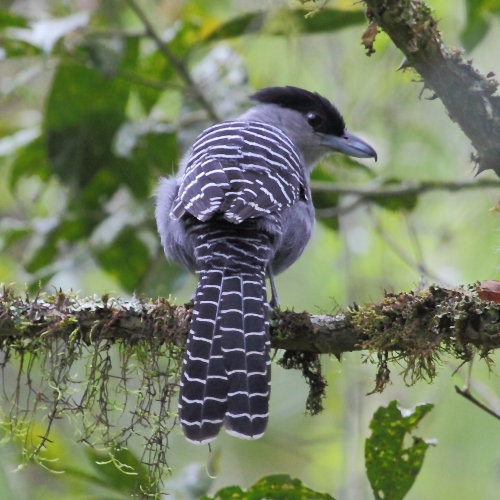
The Yapacana Antbird is easily identified by its striking black and white plumage, which provides a stark contrast to the lush green of its forest habitat. Adult males exhibit a predominantly black body with a white belly and undertail coverts, while females possess a slightly duller coloration with brownish tones interspersed with black. Juvenile Yapacana Antbirds are more uniformly brown, lacking the distinct black and white contrast seen in adults, which gradually develops as they mature. One of the most distinctive features of the Yapacana Antbird is its bold white wing bars, which are visible both in flight and while perched. The bird's flight silhouette is characterized by short, rounded wings and a relatively long tail, which aid in maneuverability through dense vegetation. When perched, the Yapacana Antbird often adopts an upright posture, making it easier to spot among the undergrowth. Despite these distinctive features, the Yapacana Antbird can occasionally be confused with similar species in its range, such as the White-plumed Antbird or the Ferruginous-backed Antbird. However, careful attention to plumage details and vocalizations can help differentiate these species in the field.
Having trouble telling birds apart? Upload a photo to our bird identification tool for an instant species match.
Yapacana Antbird Habitat and Range
Preferred Habitat
The Yapacana Antbird primarily inhabits lowland tropical rainforests, with a preference for dense understory and vine-laden areas. It is commonly found in the Amazon Basin, favoring areas with rich leaf litter and abundant arthropod prey. This species typically resides at elevations below 500 meters, although it may occasionally be found at slightly higher elevations in localized areas. During the wet season, when water levels rise, the Yapacana Antbird may shift to slightly higher ground to avoid flooded areas, but it generally remains within its preferred forested habitat. Unlike some other antbird species, the Yapacana Antbird does not typically venture into urban or heavily disturbed environments, relying instead on the cover and resources of intact primary forests. This habitat preference underscores the importance of conserving large tracts of continuous forested areas to ensure the survival of this unique species.
Geographic Range
The Yapacana Antbird's range is confined to the northern part of the South American continent, specifically within the Amazon Basin. Its breeding range encompasses southern Venezuela, particularly in the vicinity of the Yapacana National Park, from which the bird derives its name. The species is also found in northern Brazil, especially in the states of Amazonas and Roraima, as well as in eastern Colombia. In these regions, the Yapacana Antbird occupies a range of forested environments, showing a preference for dense, humid forests with minimal human disturbance. There is no evidence to suggest that the Yapacana Antbird undertakes long-distance migrations, although local movements in response to seasonal flooding have been noted. Population densities of the Yapacana Antbird are highest in areas where forest cover remains intact, and they are notably lower in regions subjected to deforestation and habitat degradation. Conservation efforts aimed at protecting the Amazon Basin's biodiversity are crucial for maintaining the habitat and range of this and other forest-dependent species.
Want to know which birds visit your area? Browse our backyard birds by location guides for region-specific species lists.
What Does the Yapacana Antbird Eat?
The Yapacana Antbird primarily subsists on a diet of insects and other small arthropods, which it forages from the forest floor and lower vegetation strata. Ants, beetles, spiders, and caterpillars constitute the main components of its diet, with the bird employing a variety of foraging techniques to capture these prey. The Yapacana Antbird typically forages alone or in pairs, meticulously searching through leaf litter and probing crevices with its bill. During the breeding season, its dietary preferences may shift slightly to include a higher proportion of protein-rich prey, which is essential for nourishing nestlings. Observations suggest that the Yapacana Antbird is most active in its foraging efforts during the early morning and late afternoon, coinciding with the periods when insect activity is at its peak. This species shows a remarkable ability to adapt its foraging behavior to the availability of prey, demonstrating a level of ecological flexibility that is vital for its survival in the dynamic Amazonian environment.
Yapacana Antbird Behavior and Social Structure
The Yapacana Antbird exhibits a range of intriguing behavioral adaptations that allow it to thrive in its dense forest habitat. It is primarily a solitary or pair-dwelling species, with strong territorial instincts, particularly during the breeding season. Males establish and defend territories through vocal displays, using their song to communicate their presence and deter rival males. Courtship displays are subtle, often involving mutual preening and feeding between pairs. The Yapacana Antbird is rarely observed in large flocks, preferring the solitude of the dense understory. During encounters with predators, the Yapacana Antbird employs a combination of stealth and vocal alarm calls to avoid detection. Its daily activity patterns show a marked diurnal rhythm, with peak activity occurring during the cooler parts of the day. Despite its generally reclusive nature, the Yapacana Antbird exhibits a remarkable resilience and adaptability to environmental changes, which are essential traits for survival in the fluctuating Amazonian ecosystems.
Yapacana Antbird Nesting and Reproduction
The nesting behavior of the Yapacana Antbird is a testament to its adaptability and resourcefulness. This species typically constructs its nest in dense thickets or low branches, using a variety of materials such as twigs, leaves, and fibrous plant matter to form a cup-shaped structure. The choice of nesting site is usually influenced by the availability of cover and proximity to food resources. The typical clutch size for the Yapacana Antbird ranges from two to three eggs, which are incubated by both parents over a period of approximately 14 to 16 days. Following hatching, the nestlings are altricial, meaning they require extensive parental care. Both parents are actively involved in feeding and protecting the young, with fledging occurring around 12 to 14 days post-hatching. The Yapacana Antbird may raise one or two broods per year, depending on environmental conditions and food availability. The collaborative efforts of both parents in nurturing their offspring highlight the cooperative breeding strategy that is characteristic of this species.
Yapacana Antbird Sounds and Vocalizations
The Yapacana Antbird is known for its distinctive vocalizations, which play a crucial role in communication and territory establishment. The primary song of the Yapacana Antbird consists of a series of clear, melodious whistles that rise and fall in pitch, often described as resembling the sound of a flute. These whistles serve as an auditory marker of territory boundaries and are most frequently heard during the early morning hours. In addition to its primary song, the Yapacana Antbird produces a variety of call notes, including sharp 'pik' sounds and softer, more conversational tones used for communication between mates. Alarm calls are harsher and more urgent, designed to alert conspecifics to potential threats. The Yapacana Antbird's vocal repertoire is an essential tool for survival, facilitating social interactions and enhancing its ability to navigate the complex soundscape of the Amazon rainforest.
Interesting Facts About the Yapacana Antbird
- 1The Yapacana Antbird is named after the Yapacana National Park in southern Venezuela, one of its primary habitats.
- 2Despite its secretive nature, the Yapacana Antbird can be reliably detected by its distinct vocalizations, which are often used in surveys.
- 3The Yapacana Antbird's diet primarily consists of insects, but it occasionally consumes small fruits, showcasing its dietary adaptability.
- 4This species is part of a diverse family known as Thamnophilidae, which contains over 200 species of antbirds.
- 5The Yapacana Antbird often follows army ant swarms to capture escaping prey, a behavior known as 'ant-following'.
- 6The Yapacana Antbird typically nests at a height of 1-3 meters above the ground, providing some protection from ground predators.
- 7The Yapacana Antbird's song is so distinctive that it is often used by birdwatchers to identify the species in dense forests.
Yapacana Antbird Conservation Status
The Yapacana Antbird is currently listed as Near Threatened on the IUCN Red List, reflecting concerns about its habitat and population trends. The primary threat to the Yapacana Antbird is habitat loss due to deforestation, particularly in the Amazon Basin where agricultural expansion and logging are prevalent. Although the species has demonstrated some resilience to habitat changes, ongoing destruction of primary forests poses a significant risk to its long-term survival. Conservation efforts aimed at protecting large tracts of undisturbed forest are essential for maintaining stable populations of the Yapacana Antbird. Historically, the bird's population has experienced fluctuations in response to environmental pressures, but targeted conservation actions and increased awareness could help reverse current declines. Collaborative efforts between governmental and non-governmental organizations are crucial for securing the habitat and future of the Yapacana Antbird.