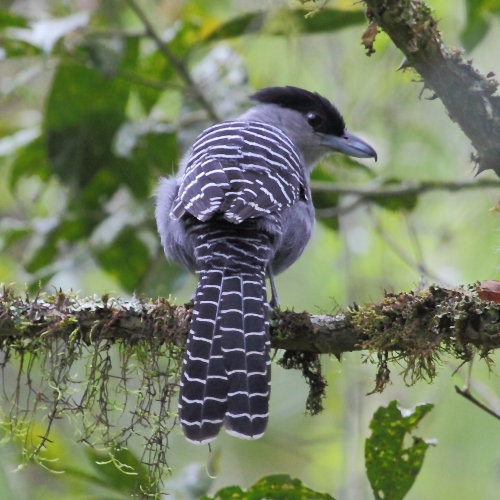
Yellow-breasted Antwren
Herpsilochmus axillaris
Order: Passeriformes / Family: Thamnophilidae

Wikimedia Commons
About the Yellow-breasted Antwren
The Yellow-breasted Antwren (Herpsilochmus axillaris) is a small passerine bird belonging to the Thamnophilidae family. This species is notable for its vibrant yellow breast and underparts, which contrast sharply with its more subdued grayish upperparts. This antwren inhabits the rich biodiversity of the Amazon Basin, extending through countries like Brazil, Peru, and Colombia. It thrives in lowland tropical forests, often favoring the dense, tangled understory where it is well-camouflaged from predators. During the breeding season, which typically coincides with the rainy season, the Yellow-breasted Antwren becomes more vocal and active, engaging in mate selection and territorial displays.
The ecological role of the Yellow-breasted Antwren is significant, primarily as an insectivore, helping to control insect populations and contributing to the health of its forest habitat. Its presence indicates a healthy ecosystem, as it requires a diverse array of insect prey and adequate cover. The antwren's song, a series of high-pitched whistles, is an integral part of the dawn chorus in its habitat, adding to the symphony of the tropical forest.
This species exhibits a certain degree of flexibility in its habitat preferences, occasionally venturing into secondary forests and forest edges, especially during the non-breeding season. Such adaptability makes the Yellow-breasted Antwren an important species for studying the effects of habitat fragmentation and climate change on tropical bird populations. Despite its adaptability, the Yellow-breasted Antwren faces threats from deforestation and habitat loss due to agricultural expansion and logging. Conservation efforts focus on habitat preservation and sustainable land use practices to ensure the survival of this and many other dependent species.
The Yellow-breasted Antwren belongs to the family Thamnophilidae, within the order Passeriformes. These birds typically live typically 3-5 years, with some individuals reaching up to 6 years..
How to Identify a Yellow-breasted Antwren
The adult Yellow-breasted Antwren is unmistakable, with its bright yellow underparts and a contrasting grayish-black upper body. Males and females are similar in plumage, though males may exhibit slightly brighter yellow in the breeding season. Juveniles resemble adults but often appear duller, with less pronounced yellow tones. Both sexes have a distinctive facial pattern, characterized by a bold white stripe above the eye, which can aid in identification.
In terms of size, the Yellow-breasted Antwren is small, typically measuring around 10-11 cm in length. Its wings are rounded, and its tail, although not particularly long, is often held upright when the bird perches. In flight, the antwren exhibits a rapid, somewhat fluttery wingbeat, typical of many small passerines.
The Yellow-breasted Antwren can be confused with similar species such as the White-flanked Antwren. However, the latter lacks the yellow underparts and has more pronounced white flanks, making the Yellow-breasted Antwren's coloration a key distinguishing feature. Observers should note the bird's behavior of foraging in pairs or small family groups, often giving a series of sharp, high-pitched calls.
Having trouble telling birds apart? Upload a photo to our bird identification tool for an instant species match.
Yellow-breasted Antwren Habitat and Range
Preferred Habitat
The Yellow-breasted Antwren primarily inhabits the lowland tropical forests of the Amazon Basin. It favors dense, humid understory environments where it can forage in relative safety. These forests range from 200 to 800 meters in elevation, though the bird is most commonly found at lower elevations where the forest canopy is thickest.
While the Yellow-breasted Antwren is predominantly a forest-dweller, it can also be found in secondary growth and along forest edges, particularly during the non-breeding season when it may wander outside its usual territories. It is less commonly found in urban areas, preferring the complex structure of tropical forests that provide ample cover and feeding opportunities. Seasonal habitat shifts are minimal, as the bird generally remains within its preferred forested regions year-round.
Geographic Range
The Yellow-breasted Antwren is native to the expansive Amazon Basin, with its range primarily covering Brazil, Peru, Colombia, and parts of Venezuela. It occupies a stable, non-migratory range within these countries, thriving in the lowland tropical forests that dominate the region.
The bird's distribution is relatively continuous throughout its range, although local population densities can vary significantly, often influenced by habitat quality and availability. Areas such as the western Amazon, particularly in regions like the Madre de Dios in Peru and the state of Amazonas in Brazil, are known hotspots for this species, where dense, pristine forests provide optimal conditions.
While the Yellow-breasted Antwren's range does not extend into the migratory corridors that characterize many other bird species, its consistency and preference for undisturbed forested areas underscore the importance of ongoing conservation efforts in these regions.
Want to know which birds visit your area? Browse our backyard birds by location guides for region-specific species lists.
What Does the Yellow-breasted Antwren Eat?
The Yellow-breasted Antwren is primarily insectivorous, feeding on a diverse array of arthropods found in its forested habitat. Its diet consists mainly of ants, beetles, spiders, and caterpillars, which it gleans from foliage and branches. The bird uses a technique known as 'hover-gleaning' to capture prey, where it hovers momentarily near leaves or bark to snatch insects.
During the wet season, prey abundance increases, allowing the Yellow-breasted Antwren to diversify its diet slightly, including more varied insect species in its meals. Conversely, in the dry season, when insects become scarcer, this antwren may rely more heavily on ants and other readily available prey.
The bird's foraging activity peaks during the early morning and late afternoon, coinciding with higher insect activity levels. The Yellow-breasted Antwren often forages in mixed-species flocks, benefiting from the increased efficiency and safety that such associations provide.
Yellow-breasted Antwren Behavior and Social Structure
The Yellow-breasted Antwren exhibits a social structure that includes forming small family groups or pairs, especially during the breeding season. These groups often join mixed-species flocks, which enhances their foraging efficiency and provides added protection against predators.
Territorial behavior becomes most pronounced during the breeding season, with males actively defending their territories through vocalizations and displays. Courtship involves a series of visual displays and call exchanges, with both sexes participating in the selection process.
In response to predators, the Yellow-breasted Antwren employs a combination of alarm calls and evasive maneuvers, typically retreating into denser foliage to avoid detection. Its daily activity patterns are diurnal, with peak activity occurring in the early morning and late afternoon, aligning with insect availability.
Yellow-breasted Antwren Nesting and Reproduction
The Yellow-breasted Antwren constructs a delicate, cup-shaped nest using fine plant materials and spider webs. These nests are typically located in the understory, well-hidden among dense foliage, at heights of 1 to 3 meters above the ground.
Clutch sizes range from two to three eggs, with both parents sharing incubation duties over a period of approximately 14 to 16 days. Post-hatching, both parents continue to feed and care for the fledglings, which leave the nest roughly 12 to 15 days after hatching.
The species generally raises one brood per year, with breeding closely tied to the rainy season when food resources are abundant. Parental roles are shared equitably, with both members of the pair contributing to feeding and protecting the young, ensuring their survival in a competitive and predator-rich environment.
Yellow-breasted Antwren Sounds and Vocalizations
The Yellow-breasted Antwren's primary song is a series of high-pitched whistles that rise and fall in a rhythmic pattern, often described as a 'tsee-tsee-tsee' sequence. These calls are most frequently heard at dawn and dusk, contributing to the vibrant soundscape of the tropical forest.
Apart from its song, the bird also produces sharp call notes used for communication within family groups or mixed-species flocks. Alarm calls are more abrupt and louder, designed to alert others to potential threats.
The antwren's vocalizations play a crucial role in mate attraction and territory defense, with males often engaging in song duels to assert dominance and establish their presence within a given area.
Interesting Facts About the Yellow-breasted Antwren
- 1The Yellow-breasted Antwren's song can reach frequencies that are difficult for human ears to detect, showcasing its unique adaptation to dense forest environments.
- 2Despite its vibrant coloration, the Yellow-breasted Antwren is adept at avoiding predators, often relying on dense understory cover for camouflage.
- 3This species is a key member of mixed-species foraging flocks, which can include up to 15 different bird species in the Amazon.
- 4The Yellow-breasted Antwren's nests are meticulously crafted with spider silk, providing both flexibility and strength to withstand tropical weather.
- 5Studies show that the Yellow-breasted Antwren can consume up to 50% of its body weight in insects daily, highlighting its role in pest control.
- 6The antwren's territorial calls are not only used for defense but also play a role in reinforcing pair bonds with its mate.
- 7This bird exhibits a unique 'teetering' behavior while foraging, where it moves side to side, possibly to flush out hidden insects.
Yellow-breasted Antwren Conservation Status
The Yellow-breasted Antwren is currently listed as Least Concern by the IUCN, with stable population trends across its range. However, the species faces ongoing threats from habitat destruction due to logging, agriculture, and infrastructure development in the Amazonian regions. Conservation efforts focus on preserving large tracts of contiguous forest and promoting sustainable land-use practices. Organizations working in the Amazon Basin emphasize the importance of protecting critical habitats and biodiversity hotspots where the Yellow-breasted Antwren thrives. While current populations remain stable, continued monitoring and habitat preservation are essential to ensuring the long-term survival of this and other forest-dependent species.