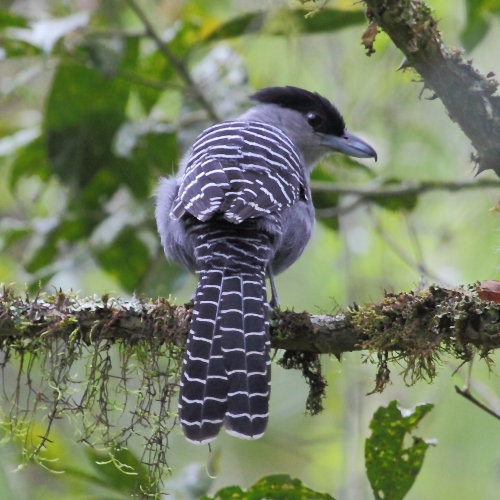
Zeledon's Antbird
Hafferia zeledoni
Order: Passeriformes / Family: Thamnophilidae

Wikimedia Commons
About the Zeledon's Antbird
The Zeledon's Antbird, Hafferia zeledoni, is an intriguing member of the Thamnophilidae family, found primarily in the humid forests of Central and South America. This small, yet captivating bird inhabits regions from Costa Rica down to western Colombia and Ecuador. The species has garnered interest not only for its striking appearance but also for its role in the rich tapestry of the tropical forest ecosystem. As an understory dweller, the Zeledon's Antbird contributes significantly to the ecological balance by controlling insect populations, particularly ants, which form a substantial part of its diet. The bird's presence in these regions highlights the importance of conserving these biodiverse habitats. While it is not a long-distance migrant, the Zeledon's Antbird does exhibit some local seasonal movements, likely influenced by food availability and breeding cycles. During the wet season, they tend to spread out more, taking advantage of the plethora of insects, while in the dry season, they may be found more frequently in denser forest patches where moisture and food sources are more reliable. The Zeledon's Antbird plays a crucial role in seed dispersion and forest dynamics. Its feeding habits help in controlling insect populations, which benefits the broader ecological community. The bird’s preference for dense, moist forests makes it a reliable indicator of forest health. Despite its role in these ecosystems, the Zeledon's Antbird's habitat faces threats from deforestation and habitat fragmentation. Conservation efforts are ongoing to protect these essential areas, ensuring that the Zeledon's Antbird and other forest species continue to thrive in their natural environments.
The Zeledon's Antbird belongs to the family Thamnophilidae, within the order Passeriformes. These birds typically live typically 4-6 years, with some instances of individuals reaching 7 years..
How to Identify a Zeledon's Antbird
Identifying the Zeledon's Antbird involves noting its predominantly black plumage with contrasting white wing spots, which are particularly noticeable when the bird is at rest. Male Zeledon's Antbirds exhibit a more intense black coloration compared to the slightly grayer females. Juveniles can be distinguished by their browner tones and less pronounced white markings. This species is often confused with similar antbirds, such as the Spotted Antbird, but can be differentiated by the lack of barring on its underparts and the distinctive white spots on its wings. In flight, the Zeledon's Antbird displays a characteristic low, undulating pattern, typical of many forest-dwelling birds. When perched, it maintains an upright posture, often flicking its wings and tail, a behavior that aids in identification. The bird's small size and agility make it well-suited to maneuvering through dense underbrush, and its movements are often quick and deliberate, reflecting its insectivorous diet.
Having trouble telling birds apart? Upload a photo to our bird identification tool for an instant species match.
Zeledon's Antbird Habitat and Range
Preferred Habitat
The Zeledon's Antbird thrives in the lower strata of humid tropical forests, favoring areas with dense undergrowth and a high canopy. These birds are typically found at elevations ranging from sea level up to 1,500 meters, although they occasionally venture higher in search of food. They prefer primary forests, but can also inhabit well-preserved secondary forests. Seasonal shifts in habitat usage are minor, with the birds remaining closely tied to forest interiors year-round. While they are generally not associated with urban environments, they may be found in rural areas that maintain patches of native forest. The bird's reliance on forest habitats underscores the importance of conserving these areas amidst ongoing deforestation pressures.
Geographic Range
The Zeledon's Antbird's range extends from the humid lowland forests of Costa Rica through Panama, reaching into the Chocó region of western Colombia and northern Ecuador. Within these countries, the bird is more prevalent in regions with dense forest cover, often in areas with limited human disturbance. It does not undertake long migrations, instead displaying localized movements in response to seasonal changes in food availability. Population densities are generally higher in areas with extensive primary forest, making these habitats crucial for the bird's continued survival. Its range is limited to the western slopes of the Andes, and it is rarely found outside this specific geographical corridor.
Want to know which birds visit your area? Browse our backyard birds by location guides for region-specific species lists.
What Does the Zeledon's Antbird Eat?
The diet of the Zeledon's Antbird is primarily insectivorous, with ants comprising a significant portion. The bird utilizes a foraging technique known as 'ant-following,' where it accompanies swarms of army ants to catch insects and other arthropods disturbed by the ants' movements. This method allows the antbird to exploit a reliable food source with minimal effort. While ants dominate their diet, Zeledon's Antbirds also consume beetles, spiders, and small invertebrates, adjusting their diet seasonally based on availability. Foraging occurs predominantly during the early morning and late afternoon, aligning with peak insect activity. The bird's sharp, slightly curved bill is well-suited for plucking insects from foliage and the forest floor.
Zeledon's Antbird Behavior and Social Structure
Zeledon's Antbird exhibits notable territorial behavior, often defending its range vigorously against intruders. This territoriality is particularly evident during the breeding season, when pairs engage in duet singing to establish and maintain territory boundaries. The bird's social structure is primarily monogamous, with pairs maintaining close bonds throughout the year. Courtship involves complex vocal exchanges and mutual preening. The bird is typically solitary or found in pairs, though it may occasionally join mixed-species flocks to exploit food resources more efficiently. When faced with predators, Zeledon's Antbird often employs a strategy of concealment, using dense foliage to avoid detection. Its daily activity revolves around foraging and territory maintenance, with peaks in activity during the cooler morning and late afternoon hours.
Zeledon's Antbird Nesting and Reproduction
Zeledon's Antbird constructs its nest close to the ground, often in dense vegetation where it is well camouflaged. The nest is cup-shaped, made from a combination of leaves, fibers, and twigs. The female typically lays two eggs per clutch, with both parents sharing incubation duties over a period of about 14-16 days. Once the chicks hatch, both parents continue to contribute to feeding and caring for the young. Fledging occurs approximately 12-14 days post-hatching, after which the young birds remain dependent on the parents for guidance and feeding for several weeks. The species generally raises one brood per year, although in optimal conditions a second brood is possible.
Zeledon's Antbird Sounds and Vocalizations
The primary song of the Zeledon's Antbird is a rapid series of high-pitched notes, often described as a 'tseep tseep tseep' that accelerates and then abruptly stops. The song is a key tool in territory defense and mate attraction. In addition to their song, these birds produce a variety of call notes used in communication between mates and to signal alarm in response to threats. During the dawn chorus, the Zeledon's Antbird's song can be a prominent component of the acoustic landscape in its forest habitat, although it may be overshadowed by louder species. The antbird's calls are generally sharp and clear, with a quality that some compare to the sound of a squeaky hinge.
Interesting Facts About the Zeledon's Antbird
- 1Zeledon's Antbird is named in honor of the Costa Rican ornithologist José C. Zeledón.
- 2This species was formerly considered a subspecies of the Immaculate Antbird but was elevated to full species status based on vocal and genetic differences.
- 3Zeledon's Antbird is an 'ant-follower,' relying on army ants to flush out prey from the forest floor.
- 4Despite their name, antbirds do not typically eat ants but rather the insects stirred up by ant swarms.
- 5The white wing spots of Zeledon's Antbird are used in visual signaling during territorial disputes.
Zeledon's Antbird Conservation Status
The IUCN currently lists the Zeledon's Antbird as a species of Least Concern, but its populations are experiencing pressure from habitat loss due to deforestation and land conversion. Although the species is relatively stable, ongoing habitat destruction could pose significant risks in the future. Conservation efforts focus on preserving large tracts of tropical forest within its range, with several protected areas established to safeguard critical habitats. Historical population changes are difficult to quantify, but anecdotal evidence suggests that the species has maintained a stable presence in undisturbed forest regions. Continued monitoring and habitat protection are essential to ensure its long-term survival.