
Ash-winged Antwren
Terenura spodioptila
Order: Passeriformes / Family: Thamnophilidae

Wikimedia Commons
About the Ash-winged Antwren
The Ash-winged Antwren (Terenura spodioptila) is a small but captivating member of the Thamnophilidae family, renowned for its unique adaptations to the dense, humid undergrowth of the Amazon rainforest. This bird is a vital component of the ecosystem, serving as both predator and prey within its complex food web. The Ash-winged Antwren primarily inhabits lowland forests, stretching from the eastern slopes of the Andes in Peru to the expansive reaches of Brazil and Bolivia. This species exhibits a range of behaviors and adaptations that allow it to thrive in the challenging understory environment. The Ash-winged Antwren's role in controlling insect populations highlights its ecological significance, as it helps maintain the delicate balance of the forest floor. During the breeding season, which coincides with the wet season from November to May, the Ash-winged Antwren becomes especially active, engaging in elaborate courtship displays. These displays are crucial for pair bonding and successful reproduction, ensuring the continuation of the species. Outside of the breeding season, the Ash-winged Antwren demonstrates less territorial behavior, often joining mixed-species foraging flocks. This social structure enables the bird to maximize its foraging efficiency while also offering some protection from predators. The Ash-winged Antwren's reliance on the rainforest makes it an excellent indicator of forest health, and its presence is often used as a measure of habitat integrity. The bird's adaptability to seasonal changes, such as those brought on by the periodic flooding of the Amazon basin, further underscores its resilience and importance in its native habitat.
The Ash-winged Antwren belongs to the family Thamnophilidae, within the order Passeriformes. These birds typically live average 3-5 years, with a maximum of 6 years recorded..
How to Identify a Ash-winged Antwren
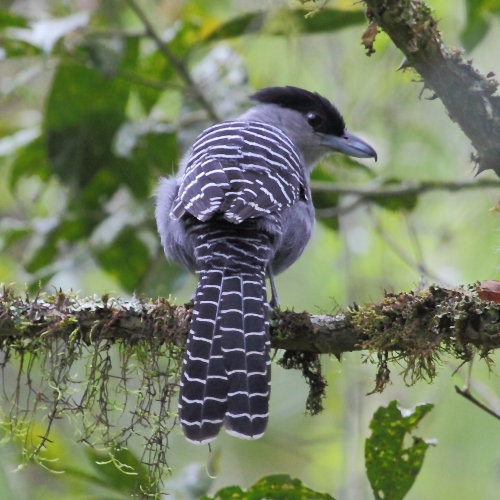
The Ash-winged Antwren exhibits a striking plumage characterized by its namesake ash-gray wings, which contrast with its otherwise darker body. Adults typically present a slate-gray back and a lighter gray underbelly, with subtle but distinctive patterns on the wings that aid in identification. Juvenile Ash-winged Antwrens, on the other hand, possess a more brownish tint, gradually acquiring the mature plumage as they age. Sexual dimorphism is subtle in this species, with males and females appearing quite similar, though males may exhibit slightly more pronounced gray tones. In terms of similar species, birders may confuse the Ash-winged Antwren with other members of the Terenura genus, but careful observation of its wing patterns and vocalizations can help distinguish it. The bird's flight silhouette is compact and fast, with rapid wingbeats typical of antwrens. When perched, the Ash-winged Antwren often adopts a horizontal posture, characteristic of its foraging style among the lower branches and foliage.
Having trouble telling birds apart? Upload a photo to our bird identification tool for an instant species match.
Ash-winged Antwren Habitat and Range
Preferred Habitat
The Ash-winged Antwren predominantly inhabits the dense, humid understory of lowland tropical rainforests. It is particularly associated with the vast Amazon Basin, where it finds ample cover and food resources. This species prefers areas with thick foliage, which provide both protection from predators and abundant foraging opportunities. While primarily a forest-dwelling bird, it is occasionally observed in seasonally flooded forests, where it adapts to the changing environment. The Ash-winged Antwren does not typically occur in urban or heavily disturbed areas, as it relies on the complex structure of mature forests. During the wet season, the bird may shift slightly in elevation, following insect prey and adapting to temporary changes in the forest floor. The elevation range for this species is generally restricted to lowland areas, rarely exceeding 500 meters above sea level.
Geographic Range
The Ash-winged Antwren's range is concentrated within the tropical rainforest regions of South America. It is primarily found in the Amazon Basin, encompassing parts of Peru, Brazil, and Bolivia. The bird's distribution is closely tied to the presence of continuous forest cover, which provides its essential habitat. Within this range, the Ash-winged Antwren is a resident species, showing little evidence of long-distance migration. However, it may exhibit local movements in response to seasonal variations in food availability or habitat conditions. Population density hotspots for the Ash-winged Antwren often align with areas of high insect abundance and minimal habitat disturbance. The species' presence in remote, undisturbed regions underscores the importance of preserving large tracts of intact rainforest to ensure its continued survival.
Want to know which birds visit your area? Browse our backyard birds by location guides for region-specific species lists.
What Does the Ash-winged Antwren Eat?
The diet of the Ash-winged Antwren consists primarily of small insects and other arthropods, which it skillfully gleans from foliage and branches. The bird employs an active foraging style, often seen darting through the understory in search of prey. Its foraging technique involves quick, deliberate movements, allowing it to capture a wide range of insects, including beetles, ants, and spiders. Seasonal diet changes are minimal, as the Amazon's evergreen environment provides a relatively consistent supply of food throughout the year. However, during the wet season, the Ash-winged Antwren may exploit temporary increases in insect populations, aligning its breeding cycle with peak food availability. The bird's small size allows it to target prey items often overlooked by larger bird species, thus reducing competition and ensuring a niche role in its ecosystem.
Ash-winged Antwren Behavior and Social Structure
The Ash-winged Antwren exhibits a range of fascinating behaviors, reflecting its adaptation to life in the dense rainforest understory. Socially, this bird is typically found in pairs or small family groups, although it often associates with mixed-species flocks outside the breeding season. Such flocking behavior provides mutual benefits, including increased foraging efficiency and enhanced predator vigilance. Territorial behavior is particularly pronounced during the breeding season, with pairs defending their chosen nesting sites against intruders. Courtship displays play a critical role in pair formation, involving complex vocalizations and displays of plumage. The Ash-winged Antwren is primarily diurnal, with peak activity occurring during the cooler morning and late afternoon hours. In response to predators, the bird utilizes the dense foliage for cover, relying on its cryptic coloration to avoid detection. Its flight is typically brief and low to the ground, reflecting its preference for remaining within the protective understory. The bird's daily routine is characterized by periods of intense foraging interspersed with rest and preening.
Ash-winged Antwren Nesting and Reproduction
The nesting habits of the Ash-winged Antwren are intricately tied to the dense foliage of the rainforest understory. The bird constructs a small, cup-shaped nest from fine plant materials, such as leaves, fibers, and moss, expertly woven to provide stability and camouflage. Nests are typically located a few feet above the ground, often in dense thickets or among the lower branches of trees. The average clutch size ranges from two to three eggs, with both parents sharing responsibilities for incubation. The incubation period lasts approximately 14 to 16 days, after which the altricial chicks hatch. Both parents actively participate in feeding the young, delivering small insects and other prey directly to the nest. Fledging occurs about 10 to 12 days post-hatching, with the fledglings remaining under parental care for several weeks as they develop their foraging skills. The Ash-winged Antwren typically raises one to two broods per year, depending on environmental conditions and food availability.
Ash-winged Antwren Sounds and Vocalizations
The Ash-winged Antwren's vocal repertoire includes a series of sharp, high-pitched notes that serve various communicative functions. Its primary song consists of a rapid, repetitive sequence of notes, often described as a 'tsee-tsee-tsee' pattern, delivered at a steady pace. These vocalizations are crucial for territory defense and mate attraction, particularly during the breeding season. In addition to its song, the Ash-winged Antwren emits distinctive call notes that serve as contact calls among conspecifics. Alarm calls are typically harsher and more abrupt, designed to alert nearby birds of potential threats. The bird often participates in the dawn chorus, adding its voice to the symphony of sounds that characterize the rainforest at daybreak. Its calls, while not as melodious as those of some other songbirds, are a vital component of its communication repertoire.
Interesting Facts About the Ash-winged Antwren
- 1The Ash-winged Antwren was first described scientifically in 1905, highlighting its relatively recent recognition.
- 2Despite its small size, the Ash-winged Antwren plays a significant role in controlling insect populations in its habitat.
- 3The bird's name 'spodioptila' derives from Greek, meaning 'ash-winged,' a direct reference to its distinctive wing coloring.
- 4Ash-winged Antwrens are often heard before they are seen due to their vocal nature and the dense forest they inhabit.
- 5This species rarely ventures more than a few meters above the forest floor, showcasing its adaptation to the understory.
- 6The Ash-winged Antwren's diet primarily consists of insects, but it may occasionally consume small fruits.
- 7The bird's range is largely confined to the Amazon Basin, making it a true rainforest specialist.
Ash-winged Antwren Conservation Status
The Ash-winged Antwren is currently not listed as threatened on the IUCN Red List, with its population considered stable. However, the primary threat to this species remains habitat destruction, particularly due to deforestation for agriculture and development. Conservation efforts focus on preserving large tracts of intact rainforest, which are essential for the survival of the Ash-winged Antwren and many other species. Historical population changes have been difficult to assess due to the bird's secretive nature and remote habitat. Continued monitoring and habitat protection are critical to ensure this species does not face more severe threats in the future. The Ash-winged Antwren serves as an important indicator of ecosystem health, and its presence reflects the quality of its forest environment.
Other Thamnophilidae Species



Birds Similar to the Ash-winged Antwren
These species are often confused with the Ash-winged Antwren due to similar appearance or overlapping range.

