
Orange-bellied Antwren
Terenura sicki
Order: Passeriformes / Family: Thamnophilidae

Wikimedia Commons
About the Orange-bellied Antwren
The Orange-bellied Antwren, known scientifically as Terenura sicki, is a rare and captivating species that inhabits the dwindling Atlantic Forest of Brazil. This bird is particularly noted for its strikingly vibrant orange belly juxtaposed against a subtler black and white plumage. The species is named in honor of Helmut Sick, a notable ornithologist who contributed significantly to Brazilian avifauna studies. The Orange-bellied Antwren plays a crucial role in its ecosystem by controlling insect populations and serving as an indicator of forest health due to its sensitivity to habitat changes.
This species resides primarily in the humid lowland forests of northeastern Brazil, particularly within the states of Alagoas and Pernambuco. These regions are characterized by dense, tropical vegetation that provides the necessary cover and food resources for the antwren. Seasonal behaviors often include minor altitudinal movements, although the species predominantly remains within the same range throughout the year, relying on the stability of the forest environment.
The Orange-bellied Antwren is significant not only for its ecological role but also as a symbol of the conservation challenges faced by the Atlantic Forest. With its restricted range and declining habitat, the species serves as a focal point for conservation efforts aimed at preserving what remains of this biodiversity hotspot. As a resident of the canopy and midstory layers of the forest, it influences the vertical distribution of insects and maintains the ecological balance within its territory.
The Orange-bellied Antwren belongs to the family Thamnophilidae, within the order Passeriformes. These birds typically live average 4-5 years, with a maximum of 6 years recorded..
How to Identify a Orange-bellied Antwren
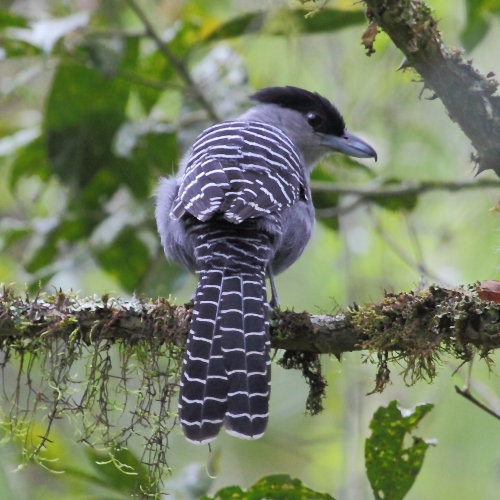
The Orange-bellied Antwren exhibits a distinctive appearance that aids birdwatchers in its identification. Adult males display a bright orange belly, a feature that contrasts with their otherwise black and white plumage. The upperparts are predominantly black with subtle white streaks and spots, while the wings show white bars. Females have a duller hue compared to males, with a more subdued orange on the belly and their overall plumage being more grayish, providing some camouflage within their forest habitat.
Juvenile Orange-bellied Antwrens can be identified by their slightly more muted coloration compared to adults. Both sexes in juvenile form lack the fully developed vibrancy of the adults, and their markings can appear somewhat blurred. Unlike many other small forest birds, the Orange-bellied Antwren is unlikely to be confused with similar species due to its unique coloration and habitat preferences.
The bird's flight silhouette is characteristic of small insectivorous birds, with rapid, undulating movements as it flits between branches. When perched, the antwren often adopts a horizontal posture, using its tail for balance as it searches for insects among leaves and branches.
Having trouble telling birds apart? Upload a photo to our bird identification tool for an instant species match.
Orange-bellied Antwren Habitat and Range
Preferred Habitat
The Orange-bellied Antwren is a specialized denizen of the Atlantic Forest, favoring humid lowland forests with dense undergrowth. These forests are rich in biodiversity, providing ample food resources and shelter. The species is typically found at elevations ranging from sea level to about 500 meters, although its presence is heavily dependent on the quality of the forest.
This antwren is not adapted to urban environments and is rarely found outside its pristine forest habitat. Seasonal habitat shifts are minimal, as the bird relies on consistent forest conditions year-round. The Atlantic Forest's complex structure, with its multi-layered canopy and rich understory, is essential for the Orange-bellied Antwren's survival.
Conservation of these habitats is critical, as the Orange-bellied Antwren does not adapt well to deforested areas or secondary growth, making habitat preservation a priority for maintaining its populations.
Geographic Range
The Orange-bellied Antwren's range is confined to the northeastern regions of Brazil, predominantly within the states of Alagoas and Pernambuco. This geographic limitation makes the bird particularly vulnerable to habitat loss and environmental changes. There is no significant migration behavior observed in this species, as it maintains a relatively stable presence within its forested range year-round.
Within its range, population density is highest in areas where the forest remains intact and undisturbed by human activities. These pockets of habitat are crucial for the species' survival, as they provide both the necessary food resources and nesting sites. The antwren's inability to disperse across fragmented landscapes further exacerbates its vulnerability to habitat loss.
Conservation efforts focus on preserving and restoring the Atlantic Forest, aiming to ensure the long-term viability of small, isolated populations of the Orange-bellied Antwren. The establishment of protected areas and corridors is vital for connecting fragmented habitats and enabling genetic exchange between populations.
Want to know which birds visit your area? Browse our backyard birds by location guides for region-specific species lists.
What Does the Orange-bellied Antwren Eat?
The Orange-bellied Antwren primarily feeds on a variety of insects, which constitute the bulk of its diet. This bird is adept at gleaning insects from leaves and branches, employing a methodical and persistent foraging technique. Its diet includes ants, beetles, caterpillars, and other small arthropods, which it captures with agility and precision.
During the rainy season, when insect abundance peaks, the antwren increases its foraging activity to take advantage of the plentiful resources. This seasonal abundance influences its foraging behavior and territorial range, as the bird moves through the forest in search of the densest insect populations.
The Orange-bellied Antwren's feeding schedule is dictated by daylight, with peak activity occurring during the early morning and late afternoon. This pattern allows the bird to avoid the midday heat while maximizing its foraging efficiency in the cooler hours.
Orange-bellied Antwren Behavior and Social Structure
The Orange-bellied Antwren exhibits intriguing behavioral patterns that reflect its adaptation to a forested environment. It is primarily a solitary bird, although it may sometimes join mixed-species flocks, particularly during non-breeding seasons. In these flocks, the antwren benefits from increased vigilance against predators and enhanced foraging opportunities.
Territorial behavior is pronounced in males, who defend their territory vigorously through vocal displays and physical posturing. These territories are essential for breeding success, as they provide both food resources and nesting sites. Courtship displays in the Orange-bellied Antwren involve the male showcasing its vibrant plumage and engaging in aerial chases.
Daily activity patterns are largely diurnal, with the bird being most active during the cooler parts of the day. The Orange-bellied Antwren responds to predators with alarm calls and evasive maneuvers, taking advantage of the dense forest to escape threats. Its behavior underscores its reliance on the forest for protection and sustenance.
Orange-bellied Antwren Nesting and Reproduction
The nesting habits of the Orange-bellied Antwren are intimately tied to the structure of the Atlantic Forest. This bird constructs small, cup-shaped nests using materials like fibers, leaves, and moss, often positioned in the fork of a branch within dense foliage. The nest's location provides concealment from predators and shelter from the elements.
A typical clutch consists of two to three eggs, which both parents incubate for approximately 14 to 16 days. The shared parental roles extend to feeding the hatchlings, with both male and female diligently providing food to the young. Fledging occurs around two weeks after hatching, although the young remain dependent on their parents for several additional weeks.
The Orange-bellied Antwren usually raises one brood per year, in accordance with the availability of resources in its habitat. This limited reproductive capacity highlights the importance of stable environmental conditions for the species' survival.
Orange-bellied Antwren Sounds and Vocalizations
The Orange-bellied Antwren's vocalizations are a key aspect of its behavior, serving both territorial and communicative functions. Its primary song consists of a series of short, sharp notes delivered in rapid succession, creating a rhythmic and somewhat mechanical sound. These calls are often used to establish and defend territory, especially by males during the breeding season.
Aside from its song, the antwren emits various call notes, which can vary in pitch and intensity. Alarm calls are sharper and more urgent, alerting other birds to potential threats. During the dawn chorus, the Orange-bellied Antwren's song contributes to the acoustic tapestry of the forest, although it is not as dominant as some larger, more vocal species.
Interesting Facts About the Orange-bellied Antwren
- 1The Orange-bellied Antwren was only discovered in 1983, highlighting how little we know about the world's rainforests.
- 2Despite its bright plumage, the Orange-bellied Antwren can be surprisingly difficult to spot in its dense forest habitat.
- 3The species' name honors Helmut Sick, a German ornithologist who made significant contributions to the study of Brazilian birds.
- 4Habitat loss has reduced the Orange-bellied Antwren's range by over 90% since its discovery, underscoring its precarious status.
- 5The Atlantic Forest, home to the Orange-bellied Antwren, is one of the world's most endangered ecosystems, with only 7% of its original area remaining.
- 6The bird's diet of ants and other insects helps control forest insect populations, playing a crucial ecological role.
- 7The Orange-bellied Antwren relies heavily on the dense vertical structure of the forest for foraging and nesting, making it an indicator of forest health.
Orange-bellied Antwren Conservation Status
The Orange-bellied Antwren is currently listed as Critically Endangered on the IUCN Red List, a status that reflects its narrow range and the severe threats to its habitat. The primary threat to this species is the ongoing deforestation of the Atlantic Forest, driven by agricultural expansion, logging, and urban development. Conservation efforts focus on habitat protection and restoration, aiming to preserve existing forest fragments and connect them through ecological corridors. Organizations work to raise awareness about the importance of the Atlantic Forest and the species it supports, including the Orange-bellied Antwren. Despite these efforts, the population trend for the Orange-bellied Antwren remains concerningly negative, emphasizing the need for continued and enhanced conservation initiatives to secure the future of this remarkable bird.
Other Thamnophilidae Species



Birds Similar to the Orange-bellied Antwren
These species are often confused with the Orange-bellied Antwren due to similar appearance or overlapping range.

