
Banded Quail
Philortyx fasciatus
Order: Galliformes / Family: Odontophoridae

Wikimedia Commons
About the Banded Quail
The Banded Quail (Philortyx fasciatus) is a distinctive member of the family Odontophoridae, known for its intricate and attractive banded plumage. This species is endemic to Mexico, where it occupies a range of habitats, demonstrating both adaptability and resilience. The ecological role of the Banded Quail is significant as it contributes to seed dispersion and serves as prey for a variety of predators, thus maintaining ecological balance. Its presence is a good indicator of habitat health, particularly in semi-arid regions. The Banded Quail is frequently found in dry scrublands, open woodlands, and areas with dense underbrush, often at elevations ranging from sea level to about 2,500 meters. This quail is a non-migratory bird, which means it remains in its habitat throughout the year, facing the challenges of seasonal changes in food availability and weather conditions. Seasonally, these quails may shift slightly within their range to take advantage of food resources and favorable conditions. During the breeding season, which occurs primarily in the wetter months from May to August, the Banded Quail engages in elaborate courtship displays that include vocalizations and physical posturing. The Banded Quail's ecological role is multifaceted. By foraging on seeds, insects, and small invertebrates, they help control pest populations and aid in the dispersal of plant species. Their diet varies with the seasons, becoming more insectivorous during the breeding season when protein demands are higher. Predators of the Banded Quail include birds of prey and terrestrial mammals, indicating their position as a crucial link in the food web. Conservation efforts are essential for maintaining healthy populations of the Banded Quail, especially in areas where habitat fragmentation and agricultural expansion pose significant threats. Despite these challenges, the Banded Quail remains a common species within its range, thanks to its adaptability and the relative abundance of suitable habitats across Mexico.
The Banded Quail belongs to the family Odontophoridae, within the order Galliformes. These birds typically live typically 3-5 years, with some individuals reaching up to 7 years..
How to Identify a Banded Quail
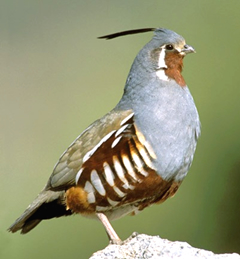
Identifying the Banded Quail involves noting its distinctive banded pattern across its chest and back. Adult Banded Quails exhibit a striking combination of gray and brown hues with black and white banding, which provides effective camouflage in their native habitats. Males and females appear similar, though males tend to have slightly more vivid coloration. Juveniles, on the other hand, are less distinctly banded and possess more muted tones, aiding in their concealment from predators. The Banded Quail can be confused with other ground-dwelling birds, but its unique banding helps differentiate it from similar species like the California Quail. When observed in flight, the Banded Quail shows a characteristic rapid fluttering with bursts of gliding, typical of quails, which is often a last resort when startled. On the ground, it is often seen in small groups or coveys, maintaining a low profile and using its cryptic plumage to blend seamlessly into its surroundings.
Having trouble telling birds apart? Upload a photo to our bird identification tool for an instant species match.
Banded Quail Habitat and Range
Preferred Habitat
The Banded Quail thrives in a variety of habitats, primarily favoring arid and semi-arid regions such as dry scrublands and open woodlands. These areas often feature dense underbrush that provides cover from predators. The quail is also commonly found in agricultural areas and along the edges of forested regions. Elevationally, it ranges from sea level up to 2,500 meters, though it is most prevalent at mid-elevations where dry and open conditions prevail. Seasonal habitat shifts are minimal due to its non-migratory nature, though it may move locally in response to changing food availability or environmental conditions. Unlike some other quail species, the Banded Quail is less frequently found in urban settings, preferring more rural and undisturbed areas that offer ample cover and food sources.
Geographic Range
The Banded Quail's range is confined primarily to Mexico, where it is widely distributed across the central and western parts of the country. Notably, it is found in states such as Jalisco, Michoacán, and Guerrero, extending as far north as southern parts of the Mexican Plateau. This bird does not engage in long-distance migration, remaining within its established range throughout the year. Within this range, the Banded Quail's population density is highest in regions where suitable habitats are abundant and well-preserved. While its distribution is extensive within Mexico, the species does not generally extend into the United States or further south into Central America. Its presence in specific locales can fluctuate with local environmental conditions and habitat changes, underscoring the importance of habitat conservation efforts to ensure its continued survival.
Want to know which birds visit your area? Browse our backyard birds by location guides for region-specific species lists.
What Does the Banded Quail Eat?
The Banded Quail's diet is primarily composed of seeds and small invertebrates, with a marked dietary shift that occurs seasonally. During the dry season, seeds from grasses and shrubs form the bulk of their diet, providing essential nutrients and energy. As the wet season arrives, the availability of insects increases, and the Banded Quail's diet becomes more protein-rich, which is particularly important during the breeding season when nutritional demands are heightened. Foraging occurs mainly on the ground, where the quail uses its strong legs to scratch the soil and uncover food. The bird's feeding schedule is diurnal, with activities peaking during the cooler hours of the morning and late afternoon. The size of prey items typically ranges from small seeds to insects like ants and beetles, which are captured using a combination of quick pecks and scratching movements.
Banded Quail Behavior and Social Structure
Banded Quails are social birds, often found in small coveys that provide enhanced protection against predators. These groups typically consist of family members, with covey sizes ranging from six to twelve individuals. Territorial behavior is less pronounced outside of the breeding season, but pairs will defend nesting sites vigorously when it is time to breed. Courtship involves vocalizations and display behaviors, with males exhibiting a series of calls and postures to attract females. Flocking behavior is common outside the breeding season, offering safety in numbers. In response to predators, Banded Quails are adept at using their cryptic plumage to remain undetected or will flush suddenly in a burst of rapid flight if threatened. Their daily activities are primarily conducted during daylight hours, with foraging and social interactions peaking in the early morning and late afternoon. As ground-dwelling birds, they spend much of their time walking and scratching the ground for food.
Banded Quail Nesting and Reproduction
Nesting for the Banded Quail involves ground-based nests that are well-concealed in dense vegetation. These nests are typically shallow depressions lined with grasses and leaves to provide insulation and camouflage. Nesting sites are chosen for their proximity to food sources and cover, reducing exposure to predators. Clutch sizes usually range from 8 to 12 eggs, which are incubated primarily by the female for about 22 to 23 days. Both parents participate in rearing the chicks, leading them to food sources and protecting them from threats. Fledging occurs relatively quickly, given the need for young quails to become independent. The Banded Quail generally raises one brood per year, though favorable conditions can sometimes lead to a second brood. The involvement of both parents in chick-rearing is crucial for the high survival rate of the offspring.
Banded Quail Sounds and Vocalizations
The Banded Quail's vocalizations are characterized by a series of short, repetitive calls that vary in pitch and rhythm. The primary song, often heard during the breeding season, consists of a repeated "cheee-wit, cheee-wit," which serves to establish territory and attract mates. Alarm calls are sharper and more abrupt, designed to alert other members of the covey to potential danger. These calls are usually emitted when the birds are startled or sense a predator nearby. During the dawn chorus, Banded Quails contribute with their distinctive calls, creating a complex soundscape typical of their habitats. Compared to other quail species, their calls are less melodic but are nonetheless effective for communication and maintaining social bonds within the covey.
Interesting Facts About the Banded Quail
- 1The Banded Quail can lay up to 12 eggs in a single clutch, one of the larger clutch sizes among quails.
- 2Despite being non-migratory, the Banded Quail can cover considerable ground in search of food within its range.
- 3The cryptic plumage of the Banded Quail makes it exceptionally well-camouflaged against predators in its arid habitats.
- 4Banded Quails use complex vocalizations to communicate, each serving different purposes like mating or warning of danger.
- 5They prefer to run from predators rather than fly, using flight as a last resort due to their strong legs and camouflage.
Banded Quail Conservation Status
The Banded Quail is currently listed as Least Concern by the IUCN, although certain local populations may face pressures from habitat loss and degradation. Agricultural expansion, urbanization, and changes in land use are primary threats that could impact their habitats. Conservation efforts focus on habitat preservation and management, ensuring that their natural environments remain intact and capable of supporting healthy quail populations. Historically, the Banded Quail has maintained stable population numbers, but ongoing monitoring is necessary to detect any potential declines. Efforts to educate local communities about the importance of conserving natural habitats also play a vital role in sustaining the species.
Other Odontophoridae Species


Birds Similar to the Banded Quail
These species are often confused with the Banded Quail due to similar appearance or overlapping range.
