
Black-backed Antshrike
Thamnophilus melanonotus
Order: Passeriformes / Family: Thamnophilidae

Wikimedia Commons
About the Black-backed Antshrike
The Black-backed Antshrike, scientifically known as Thamnophilus melanonotus, is a fascinating and lesser-known member of the Thamnophilidae family. This bird inhabits the tropical forests of South America, particularly thriving in the dense undergrowth of regions like the Amazon Basin and the Atlantic Forest of Brazil. It is an important species for the ecosystem, playing a vital role in controlling insect populations. With its robust build and strong territorial instincts, the Black-backed Antshrike exhibits a commanding presence in the forest understory.
One of the most remarkable aspects of the Black-backed Antshrike is its adaptability to various forest types, including primary and secondary growth forests. It is often found in humid lowland forests, but it can also adapt to drier forest areas, showcasing its versatility. This adaptability is crucial for its survival in an era of habitat fragmentation and deforestation. The bird's ecological role extends beyond mere insect control, as it also participates in seed dispersal, contributing to forest regeneration.
The Black-backed Antshrike is particularly active during the early morning and late afternoon, when it engages in foraging and territorial singing. Its presence is signaled by its loud, distinctive calls, which resonate through the forest. During the breeding season, which aligns with the rainy season in its habitat, the bird becomes even more vocal and visible. Its courtship displays and pair-bonding rituals are vital for maintaining its population levels. The Black-backed Antshrike's resilience and adaptability make it a key species for understanding the dynamics of tropical forest ecosystems.
The Black-backed Antshrike belongs to the family Thamnophilidae, within the order Passeriformes. These birds typically live average 5-8 years with a maximum recorded of 11 years..
How to Identify a Black-backed Antshrike
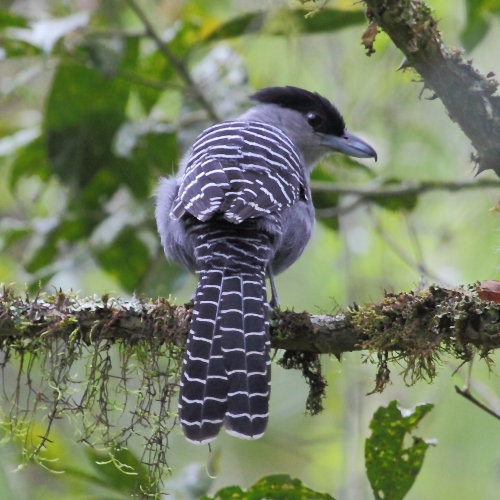
The Black-backed Antshrike is a medium-sized bird, measuring approximately 15 to 17 centimeters in length. Adult males are predominantly black, featuring striking white wing bars that are unmistakable in the field. The contrasting colors make them relatively easy to identify compared to other antbirds. Females, however, sport a more subdued plumage, with brownish tones replacing the males' stark black, yet they retain the characteristic white wing bars. Juveniles resemble the females but often exhibit even duller coloration until they mature.
The bird's robust body and slightly downcurved bill are distinctive characteristics of the Thamnophilidae family. It has a strong, upright perching posture, often displaying a cocked tail-a behavior that can aid identification. In flight, the Black-backed Antshrike shows a rapid, direct flight pattern, which is more agile than one might expect from its appearance.
Distinguishing the Black-backed Antshrike from similar species such as the Barred Antshrike (Thamnophilus doliatus) is crucial. The latter has barred plumage and lacks the solid black back, making the Black-backed Antshrike's name an apt descriptor of its most distinguishing feature. Observers can rely on these field marks and behaviors to correctly identify this bird in its natural habitat.
Having trouble telling birds apart? Upload a photo to our bird identification tool for an instant species match.
Black-backed Antshrike Habitat and Range
Preferred Habitat
The Black-backed Antshrike thrives in a variety of tropical forest habitats, ranging from humid lowland rainforests to drier secondary forests. It is predominantly found in the undergrowth, where the dense foliage provides cover and abundant foraging opportunities. This bird favors elevations from sea level up to approximately 1,200 meters, depending on the region.
In its preferred habitats, the Black-backed Antshrike can be found in countries like Brazil, Guyana, and Suriname, where it occupies both pristine and disturbed forest environments. During the wet season, it exploits the lush growth of vegetation, while in the dry season, it adapts to the changing availability of cover and food resources.
Unlike some avian species that are more tolerant of urban encroachment, the Black-backed Antshrike rarely ventures into urban areas, preferring the seclusion and resources of rural and forested landscapes. Its presence is a good indicator of healthy forest ecosystems, as it relies on the structural complexity and biodiversity typical of tropical forests.
Geographic Range
The Black-backed Antshrike's range is primarily confined to the northern part of South America. Its distribution includes the dense rainforests of Brazil, particularly in the Amazon Basin, as well as regions in Guyana and Suriname. This bird's range is relatively narrow, as it tends to avoid areas that have been significantly altered by human activity.
During the breeding season, the Black-backed Antshrike is more commonly found in the core of its range, where it takes advantage of the wet season's abundance of food and nesting sites. The bird is not known for extensive migratory behavior, often remaining within its established territories year-round.
Population density hotspots are most notable in the Amazon Basin, where the convergence of rich biodiversity and suitable habitat supports a stable population. However, their presence can also be noted in parts of the Atlantic Forest, where isolated populations exist. Despite its relatively restricted range, the Black-backed Antshrike is able to maintain a stable presence in areas where its habitat remains intact.
Want to know which birds visit your area? Browse our backyard birds by location guides for region-specific species lists.
What Does the Black-backed Antshrike Eat?
The Black-backed Antshrike is primarily insectivorous, feeding on a diverse array of arthropods. Its diet includes ants, beetles, spiders, and caterpillars, which it gleans from the forest undergrowth. During the wet season, the abundance of prey allows the bird to feed more intensively, supporting its breeding and chick-rearing activities.
While insects make up the core of its diet, the Black-backed Antshrike occasionally consumes small vertebrates like lizards, reflecting its opportunistic feeding habits. The bird employs a sit-and-wait foraging technique, often perching quietly before making quick, darting movements to capture prey.
In terms of feeding schedule, the bird is most active in the morning and late afternoon, aligning with peak insect activity. This feeding pattern ensures that the Black-backed Antshrike efficiently meets its dietary needs while minimizing competition with other insectivores in the forest.
Black-backed Antshrike Behavior and Social Structure
The Black-backed Antshrike exhibits a complex social structure, typically maintaining monogamous pair bonds. These pairs defend their territory vigorously, using vocalizations and physical displays to deter rivals. The bird's territorial behavior is particularly prominent during the breeding season, when it becomes more vocal and visible.
Courtship displays involve a series of calls and postures designed to strengthen pair bonds and ensure reproductive success. These displays often include both members of the pair engaging in mutual preening and synchronized movements. The Black-backed Antshrike is generally solitary or found in pairs, though it may join mixed-species flocks when foraging, particularly outside the breeding season.
In response to predators, the Black-backed Antshrike employs a variety of behaviors, including mobbing and alarm calls, to protect itself and its territory. Its daily activity pattern is diurnal, with peak activity occurring in the early morning and late afternoon, allowing it to exploit the cooler hours of the day for feeding and territorial defense.
Black-backed Antshrike Nesting and Reproduction
The Black-backed Antshrike constructs a cup-shaped nest, typically situated in dense foliage or low shrubs, which provides both concealment and protection. The nest is crafted from fine twigs, leaves, and other plant materials, woven together with spider silk for added strength and flexibility.
Clutch size generally consists of two to three eggs, which are incubated by both parents. The incubation period lasts approximately 14 to 16 days, during which the parents take turns attending the nest. Once hatched, the chicks are altricial, requiring substantial parental care, including feeding and protection.
Fledging occurs about 12 to 15 days post-hatching, with both parents involved in feeding the young and teaching them essential survival skills. The Black-backed Antshrike typically raises one brood per year, although favorable conditions may allow for a second brood. The cooperative breeding efforts of both parents ensure the successful rearing of their offspring.
Black-backed Antshrike Sounds and Vocalizations
The Black-backed Antshrike's primary song is a loud, rhythmic series of whistles that can be described as a rising and falling 'wee-wee-wee-wee.' This song serves both territorial and mating purposes, resonating through the dense forest undergrowth.
Its call notes include sharp, metallic 'chak' sounds, often used in communication between mates or to signal alarm. When faced with potential threats, the bird emits a rapid, chattering alarm call, alerting both its mate and neighboring birds.
During the dawn chorus, the Black-backed Antshrike is particularly vocal, taking advantage of the quiet morning hours to assert its presence. Its vocalizations, while not melodious, are distinctive and serve as an acoustic marker of its territory.
Interesting Facts About the Black-backed Antshrike
- 1The Black-backed Antshrike's loud song is often one of the first sounds heard in the early morning within its habitat.
- 2Despite its small size, the Black-backed Antshrike can be quite aggressive when defending its territory from intruders.
- 3This species has adapted to both primary and secondary forests, showcasing its resilience to environmental changes.
- 4The white wing bars of the Black-backed Antshrike are a striking contrast to its otherwise dark plumage, aiding in identification.
- 5Monogamous pairs of Black-backed Antshrikes often engage in mutual preening, a behavior that strengthens their bond.
- 6Their nests are often camouflaged with spider silk, making them challenging to spot in dense foliage.
- 7The Black-backed Antshrike's diet is diverse, allowing it to thrive in various forest environments.
Black-backed Antshrike Conservation Status
The Black-backed Antshrike is currently listed as Least Concern by the IUCN, with a stable population trend. However, habitat loss due to deforestation poses a significant threat to its long-term survival, particularly in the Amazon Basin and the Atlantic Forest. Conservation efforts focus on preserving its natural habitat, with initiatives to protect large tracts of forest and promote sustainable land-use practices. Historical population changes have been relatively stable, although localized declines have occurred in areas facing severe deforestation. Ongoing research and monitoring are essential to ensure the continued stability of the Black-backed Antshrike's population. Conservationists emphasize the importance of maintaining biodiversity in tropical forests, where this bird plays a crucial ecological role.
Other Thamnophilidae Species



Birds Similar to the Black-backed Antshrike
These species are often confused with the Black-backed Antshrike due to similar appearance or overlapping range.

