
Cassin's Honeyguide
Prodotiscus insignis
Order: Piciformes / Family: Indicatoridae

Wikimedia Commons
About the Cassin's Honeyguide
The Cassin's Honeyguide (Prodotiscus insignis) is a fascinating member of the Indicatoridae family, known for its unique ecological role within the lush forests of sub-Saharan Africa. This bird primarily inhabits dense, tropical woodlands and moist forests, ranging from the lowland regions to montane environments. The honeyguide's presence is vital as it engages in a mutualistic relationship with humans and other animals by leading them to beehives. Its ability to locate and guide others to bees' nests has intrigued naturalists since its initial documentation. Ecologically, Cassin's Honeyguide plays a significant role in controlling bee populations and facilitating the dispersal of seeds and pollen. During the breeding season, which varies with location but generally occurs during the rainy months, this species can be observed engaging in intricate courtship displays. Outside the breeding season, the Cassin's Honeyguide remains relatively solitary, although it may occasionally join mixed-species foraging flocks. This bird's adaptability to various forest types highlights its resilience in the face of habitat changes. The Cassin's Honeyguide's ability to thrive across different elevations, from sea level up to 2,500 meters, further underscores its ecological versatility. As a resident of a continent bustling with avian diversity, the honeyguide contributes to the ecological tapestry by maintaining the balance of its environment and supporting other species' survival.
The Cassin's Honeyguide belongs to the family Indicatoridae, within the order Piciformes. These birds typically live typically lives 4-6 years, with some reaching up to 8 years..
How to Identify a Cassin's Honeyguide
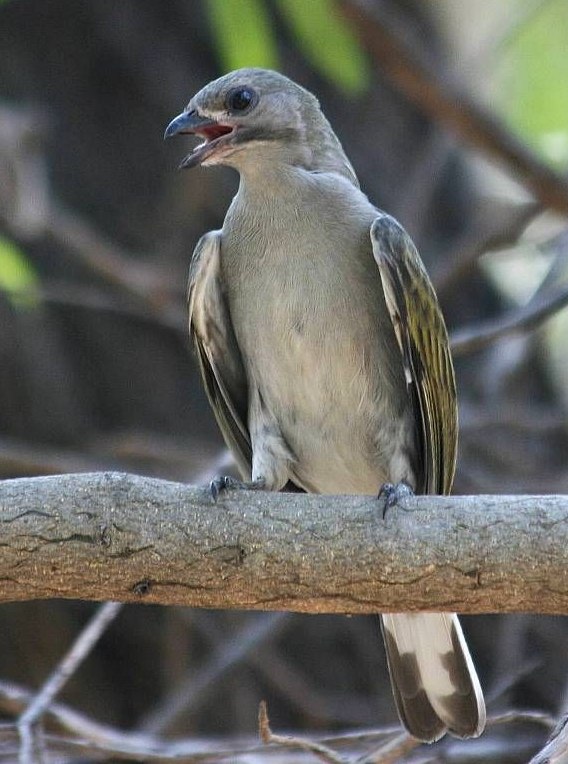
The adult Cassin's Honeyguide is characterized by its olive-green upperparts and pale underparts, which blend harmoniously with its forest surroundings. This small bird, measuring approximately 12 to 14 centimeters in length, displays a subtle but distinct white patch on the throat and a narrow, dark eye stripe. Juveniles resemble adults but often exhibit duller plumage and lack the defined throat patch. Male and female Cassin's Honeyguides look similar, although females may have slightly browner tones. In flight, the honeyguide's short, rounded wings and relatively long tail are noticeable, giving it a distinctive silhouette against the forest canopy. When perched, its upright posture and slightly tilted head convey an air of alertness. Although some might confuse it with other small forest birds like the African Greenbul or the Little Greenbul, the honeyguide's unique bill-adapted for feeding on beeswax and insects-and its specific habitat preferences help distinguish it from these species.
Having trouble telling birds apart? Upload a photo to our bird identification tool for an instant species match.
Cassin's Honeyguide Habitat and Range
Preferred Habitat
Cassin's Honeyguide thrives in the humid, dense forests of central and western Africa. It prefers tropical and subtropical moist broadleaf forests, where it can find ample food and nesting opportunities. The bird is commonly found at elevations ranging from sea level to about 2,500 meters, although it primarily occupies lowland forests. Despite its preference for forested regions, the honeyguide can adapt to secondary forests and even forest edges, showcasing its ability to survive in modified landscapes. It is less frequently observed in urban areas, maintaining a strong association with natural habitats.
Geographic Range
The geographical range of Cassin's Honeyguide spans several African countries, including Cameroon, Gabon, the Democratic Republic of the Congo, Uganda, and Kenya. It resides year-round in these areas, with no significant migratory movements noted. While the bird primarily inhabits equatorial regions, its presence in higher elevations demonstrates its adaptability to diverse environmental conditions. Population densities are generally higher in protected areas and national parks, where forest cover remains intact, providing ideal conditions for its survival.
Want to know which birds visit your area? Browse our backyard birds by location guides for region-specific species lists.
What Does the Cassin's Honeyguide Eat?
Cassin's Honeyguide primarily feeds on beeswax and bee larvae, showcasing an incredible evolutionary adaptation among birds. It visits active beehives, often following honey badgers or humans who open the hives. The honeyguide also consumes a variety of insects, including termites and ants, supplementing its diet with small fruits and berries. This dietary flexibility allows it to meet its nutritional needs throughout the year. Foraging occurs mostly during daylight hours, with the bird adopting a methodical approach as it moves through the canopy in search of food.
Cassin's Honeyguide Behavior and Social Structure
Socially, the Cassin's Honeyguide tends to be solitary, especially outside the breeding season. However, it may occasionally join mixed-species flocks, taking advantage of the protective benefits these groups offer. The bird is territorial, defending its preferred feeding and nesting areas with vigor. During courtship, males engage in aerial displays, showcasing their agility and stamina to attract females. In the presence of predators, the honeyguide employs a combination of evasion and camouflage, relying on its cryptic coloration to blend into the forest environment.
Cassin's Honeyguide Nesting and Reproduction
Cassin's Honeyguide exhibits a fascinating nesting behavior, as it is a brood parasite. It lays its eggs in the nests of other bird species, such as barbets and bulbuls, entrusting its offspring to be raised by these unsuspecting hosts. A female may lay one egg per host nest, ensuring that her chick has minimal competition for resources. After an incubation period of approximately 14 to 16 days, the chick hatches and typically fledges within three weeks. Parental care is absent, as the young honeyguide is raised entirely by its host parents.
Cassin's Honeyguide Sounds and Vocalizations
The primary song of the Cassin's Honeyguide consists of a series of clear, whistled notes, delivered in a rhythmic pattern. Each note is sharp and distinct, resembling the calls of other small forest birds but with a unique sequence that sets it apart. In addition to its song, the honeyguide produces short, high-pitched call notes, often used in communication between individuals. Alarm calls, while less frequent, are harsher and more insistent, alerting nearby birds to potential threats. During the dawn chorus, the honeyguide's song blends into the symphony of forest sounds, contributing to the vibrant acoustic landscape.
Interesting Facts About the Cassin's Honeyguide
- 1Cassin's Honeyguide has an unusual diet, primarily consuming beeswax and bee larvae, a rare trait among birds.
- 2This species engages in mutualistic behavior by guiding humans and other animals to beehives, benefiting both parties.
- 3The honeyguide practices brood parasitism, laying its eggs in the nests of other bird species, a strategy that reduces parental investment.
- 4Its name honors the American ornithologist John Cassin, who contributed significantly to the study of African birds.
- 5Cassin's Honeyguide's vocalizations are distinctive, comprising clear, whistled notes that stand out in the dense forest acoustics.
Cassin's Honeyguide Conservation Status
According to the IUCN Red List, the Cassin's Honeyguide is currently classified as Least Concern, with stable population trends. Despite facing threats from habitat loss due to deforestation and agricultural expansion, its adaptability to secondary forests has aided its survival. Conservation efforts focus on preserving primary forest habitats and establishing protected areas. Historically, population numbers have remained relatively stable, though localized declines have occurred where habitat destruction is most intense.
Other Indicatoridae Species



Birds Similar to the Cassin's Honeyguide
These species are often confused with the Cassin's Honeyguide due to similar appearance or overlapping range.