
East Andean Antbird
Drymophila caudata
Order: Passeriformes / Family: Thamnophilidae

Wikimedia Commons
About the East Andean Antbird
The East Andean Antbird (Drymophila caudata) is a fascinating species of passerine bird within the family Thamnophilidae, renowned for its captivating presence in the richly biodiverse Andean regions. This bird primarily inhabits the mist-laden cloud forests that stretch along the eastern slopes of the Andes, from Venezuela through Colombia and into Ecuador. These regions are characterized by high humidity and diverse flora, offering an ideal environment for this species, which thrives in the dense understory. The East Andean Antbird plays a crucial ecological role as both a predator and prey. It participates in the complex food web of these forest ecosystems, controlling insect populations while serving as a food source for larger predators. Seasonal behaviors of the East Andean Antbird include territorial displays and vocalizations, particularly during the breeding season, which typically coincides with the rainy season when food is abundant. The antbird's presence is significant as an indicator of healthy forest ecosystems. This bird is often found in mixed-species flocks, contributing to the dynamic avian communities characteristic of the Andean slopes. By foraging alongside other insectivorous birds, the East Andean Antbird helps maintain a balance within the ecosystem, ensuring that insect populations do not overwhelm the vegetation. Furthermore, this species displays a fascinating adaptability to different elevations within its range, providing insights into avian adaptation and resilience in the face of environmental changes. The East Andean Antbird's relationship with its environment highlights the interconnectedness of species within cloud forest ecosystems. As an insectivore, it consumes a variety of arthropods, contributing to pest control and promoting plant health. The bird's presence in specific regions serves as an ecological indicator, reflecting the overall health of the forest. Conservation efforts focusing on preserving the East Andean Antbird's habitat can have cascading benefits for numerous other species, underscoring the importance of maintaining the delicate balance within these unique ecosystems.
The East Andean Antbird belongs to the family Thamnophilidae, within the order Passeriformes. These birds typically live average 4 years with a maximum recorded of 6 years..
How to Identify a East Andean Antbird
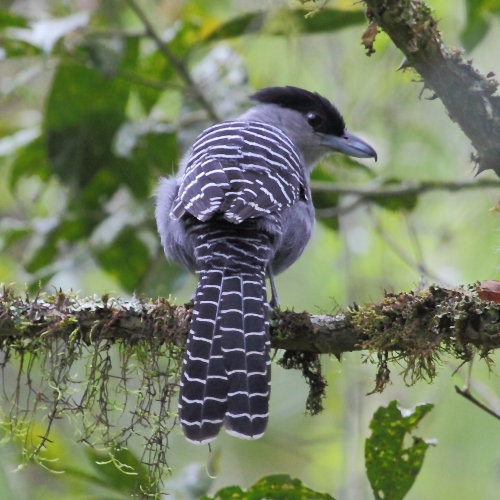
The East Andean Antbird is readily identifiable by its distinctive black-and-white plumage. Adult males typically display a striking contrast between their glossy black upperparts and white underparts, with a black bib that extends from the throat to the chest. In contrast, females exhibit more subdued coloration, with grayish-brown tones replacing the stark black seen in males. Juveniles resemble females but possess even duller plumage, gradually acquiring the adult coloration as they mature. One of the key identification features of the East Andean Antbird is its elongated tail, which it often cocks upward, a behavior that adds to its distinctive silhouette. Unlike some similar species, such as the Long-tailed Antbird, the East Andean Antbird's tail is not as prominently marked, aiding in differentiation. When perched, this antbird exhibits a horizontal posture, often seen flitting through dense foliage in search of insects. In flight, the East Andean Antbird shows rapid wingbeats and short, direct movements, typical of many understory insectivores. Its flight silhouette is compact, with the tail providing a slight fan shape. This flight pattern, combined with its unique plumage, helps birders distinguish the East Andean Antbird from other sympatric species. Observers should pay attention to the bird's behavior and vocalizations, as these can also aid in confirming identification.
Having trouble telling birds apart? Upload a photo to our bird identification tool for an instant species match.
East Andean Antbird Habitat and Range
Preferred Habitat
The East Andean Antbird inhabits the lush cloud forests found on the eastern slopes of the Andes, thriving at elevations ranging from 1,000 to 2,500 meters. These montane forests provide the dense understory and high humidity that the species requires. Within this habitat, the bird prefers areas with a complex structure, where it can forage effectively among the tangled vegetation. It often avoids open areas, sticking to the protective cover of the forest. Seasonal shifts in habitat use are minimal, as the East Andean Antbird is largely sedentary, maintaining its territory year-round. Although primarily found in rural and remote forested areas, the bird can occasionally be seen on the edges of more disturbed habitats, such as secondary forests or forest fragments near agricultural lands. However, its presence in urban areas is rare, as it relies on the intact forest ecosystems that provide its primary food sources.
Geographic Range
The East Andean Antbird's range is confined to the eastern Andes across several South American countries. It is predominantly found in Venezuela, Colombia, and Ecuador, occupying a narrow band of suitable habitat along the Andean slopes. This distribution aligns with the cloud forests that stretch across these countries, providing the specific microhabitats the species requires. The bird does not undertake long migrations but rather remains within its established territories throughout the year. However, there may be minor altitudinal movements in response to local conditions, such as food availability or weather changes. Within its range, population densities can vary, with higher concentrations found in regions where forest cover is dense and continuous. Specific hotspots of abundance include the Sierra Nevada de Santa Marta in Colombia and the subtropical forests of Ecuador's eastern Andes. The East Andean Antbird's distribution is an excellent example of a species adapted to a specific ecological niche, highlighting the importance of these unique montane forests.
Want to know which birds visit your area? Browse our backyard birds by location guides for region-specific species lists.
What Does the East Andean Antbird Eat?
The East Andean Antbird's diet primarily consists of insects and other small invertebrates, making it an important insectivore within its ecosystem. It forages methodically through the dense understory, capturing prey items such as beetles, ants, spiders, and caterpillars. The bird employs a variety of foraging techniques, including gleaning insects from leaves and branches, probing bark crevices, and occasionally catching flying insects mid-air. This varied diet allows the East Andean Antbird to exploit different food sources throughout the year, adapting to seasonal changes in prey availability. During the rainy season, when insect populations surge, the bird's diet becomes more diverse, including a wider range of arthropods. Prey size typically ranges from small to medium-sized insects, which the bird consumes whole. The East Andean Antbird's feeding schedule is largely diurnal, with peak activity occurring in the early morning and late afternoon when insects are most active. This feeding behavior underscores the bird's role as a vital component of the forest's ecological balance, contributing to pest control and the overall health of the vegetation.
East Andean Antbird Behavior and Social Structure
The East Andean Antbird exhibits intriguing behaviors that reflect its adaptation to the dense understory of Andean cloud forests. It is a primarily solitary bird, but during the breeding season, it forms monogamous pairs that engage in cooperative territory defense. These pairs are highly territorial, using vocalizations to assert their presence and deter intruders. The bird's call serves as both a territorial marker and a means of communication between mates. Courtship displays often involve vocal duets and mutual preening, strengthening the pair bond. Outside of the breeding season, the East Andean Antbird may join mixed-species flocks, benefiting from increased foraging efficiency and predator vigilance. These flocks typically consist of other insectivorous birds, allowing for cooperative hunting and reduced competition. In response to predators, the East Andean Antbird employs alarm calls and swift evasive maneuvers, taking advantage of its agility in dense vegetation. Its daily activity pattern involves active foraging during daylight hours, with periods of rest and preening interspersed throughout the day. As a ground-dwelling species, it moves with quick, jerky motions, often raising its tail as a signal of alertness. This behavior, combined with its distinctive vocalizations, makes the East Andean Antbird a dynamic presence in its forest habitat.
East Andean Antbird Nesting and Reproduction
The East Andean Antbird constructs its nest close to the ground, often within dense vegetation that provides concealment from predators. The nest is typically cup-shaped, woven from fine plant fibers, leaves, and moss, securing it to low branches or shrubs. This strategic placement offers protection while allowing easy access for the adult birds. The breeding season aligns with the rainy period, when food is abundant. A typical clutch consists of two to three eggs, which are oval and speckled, providing camouflage against the nest's surroundings. Both male and female share incubation duties, which last approximately two weeks. During this period, the parents are highly vigilant, taking turns to forage and guard the nest. After hatching, the chicks remain in the nest for about 12 to 15 days before fledging. Post-fledging, the young continue to receive care and feeding from the parents until they are fully independent. The East Andean Antbird generally raises one brood per year, although in favorable conditions, a second brood might be attempted. Parental roles are clearly defined, with both sexes contributing equally to nest building, incubation, and chick rearing, ensuring a high survival rate for their offspring.
East Andean Antbird Sounds and Vocalizations
The East Andean Antbird is known for its distinctive vocalizations, which play a crucial role in communication and territory defense. Its primary song consists of a series of clear, melodious notes delivered in rapid succession, often described as a 'whistled phrase' that rises and falls in pitch. This song is typically used during the breeding season to establish and maintain territory boundaries, as well as to attract a mate. In addition to its primary song, the antbird emits a variety of call notes, including sharp 'chip' sounds and softer 'tseet' calls, which facilitate communication between mates and indicate the presence of danger. Alarm calls are harsher and more urgent, serving to alert other birds to the presence of predators. During the dawn chorus, the East Andean Antbird's song is particularly prominent, contributing to the vibrant soundscape of the cloud forest. Its vocal repertoire is not only a key component of its behavior but also assists birders in locating and identifying the species in its dense habitat.
Interesting Facts About the East Andean Antbird
- 1The East Andean Antbird is part of a genus known for its long tails, with 'caudata' in its name meaning 'tailed'.
- 2Despite its name, the East Andean Antbird primarily feeds on insects, not ants, reflecting its diverse diet.
- 3The East Andean Antbird's habitat is among the most biodiverse regions, home to numerous endemic species.
- 4This bird often joins mixed-species flocks, enhancing its foraging efficiency and reducing predation risk.
- 5East Andean Antbirds contribute to pest control, consuming a variety of insects that could damage vegetation.
- 6The bird's ability to adapt to different elevations demonstrates its remarkable ecological versatility.
- 7The East Andean Antbird's song is a key tool for territory defense, often heard during the vibrant dawn chorus.
East Andean Antbird Conservation Status
The East Andean Antbird is currently classified as Least Concern by the IUCN, indicating a stable population trend. However, like many forest-dependent species, it faces threats from habitat loss due to deforestation and land conversion for agriculture. The fragmentation of cloud forests poses a significant risk, potentially isolating populations and reducing genetic diversity. Conservation efforts focus on preserving these critical habitats through the establishment of protected areas and the promotion of sustainable land-use practices. Historical records suggest that while the East Andean Antbird has maintained a relatively stable population over time, continued monitoring is essential to ensure its long-term survival. Conservation organizations are working to raise awareness about the importance of cloud forests and their role in supporting diverse avian communities. By highlighting the ecological significance of species like the East Andean Antbird, these efforts aim to foster conservation action and habitat protection across its range.
Other Thamnophilidae Species



Birds Similar to the East Andean Antbird
These species are often confused with the East Andean Antbird due to similar appearance or overlapping range.
