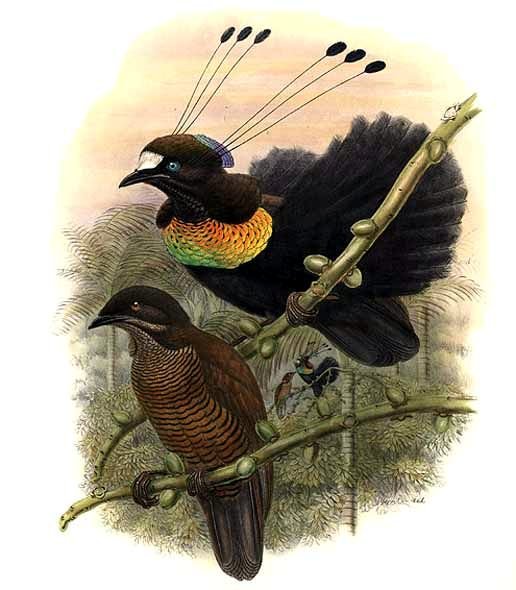
Eastern Parotia
Parotia helenae
Order: Passeriformes / Family: Paradisaeidae

Wikimedia Commons
About the Eastern Parotia
The Eastern Parotia (Parotia helenae), an exquisite member of the Paradisaeidae family, inhabits the montane forests of Papua New Guinea. Known for its mesmerizing display behaviors, the male Eastern Parotia captivates with its intricate dance and shimmering feathers, showcasing the evolutionary marvels of sexual selection. This bird plays a significant ecological role within its habitat, contributing to seed dispersal and maintaining the forest ecosystem's balance. Found primarily in the Bird's Head Peninsula's Arfak Mountains and the central ranges of Papua, the Eastern Parotia thrives in the dense, humid montane forests at elevations ranging from 1,000 to 2,300 meters. These forests provide a rich and diverse environment, supporting not only the Eastern Parotia but also a plethora of other avian species and wildlife. The Eastern Parotia has a complex social structure, with males establishing territories where they perform elaborate courtship displays to attract females. These performances, characterized by a series of hops, twirls, and wing flares, highlight the bird's iridescent plumage, which can reflect a dazzling array of colors depending on the light. The male's impressive display is a testament to the pressures of sexual selection, where female choice drives the evolution of such extraordinary traits. The Eastern Parotia contributes to the ecological integrity of its montane forest habitat, playing a vital role in seed dispersal. By consuming a diet rich in fruits, this bird aids in the propagation of various plant species. During the breeding season, its activities help ensure the continued growth and health of the forest. Beyond its ecological contributions, the Eastern Parotia holds cultural significance, symbolizing beauty and extravagance in local folklore. It serves as a reminder of the intricate relationships between species and their environments, emphasizing the importance of conservation efforts to protect such unique ecosystems.
The Eastern Parotia belongs to the family Paradisaeidae, within the order Passeriformes. These birds typically live average 5-8 years with a maximum recorded of 10 years..
How to Identify a Eastern Parotia
Identifying the Eastern Parotia involves observing several distinct features. Adult males exhibit a striking combination of velvety black plumage with iridescent golden-green breast shields and elongated flank feathers. These feathers, used prominently during courtship displays, create an impressive visual spectacle. In contrast, females and juveniles present a more subdued appearance, with brownish plumage and lighter underparts, allowing for better camouflage within the dense forest. The sexual dimorphism in Eastern Parotias is pronounced, with the males' vibrant plumage and ornate feathers contrasting sharply with the females' modest appearance. Males possess elongated head plumes and a unique six-wired head tufts, which are distinct field marks. These features are absent in females and juveniles, aiding in differentiation in the field. When comparing the Eastern Parotia to similar species, such as the Western Parotia, observers should note the differences in plumage coloration and the specific arrangement of the flank feathers during displays. In flight, the Eastern Parotia exhibits a compact silhouette with rapid wingbeats, often staying close to the forest canopy. When perching, it maintains a poised and alert posture, frequently scanning its surroundings.
Having trouble telling birds apart? Upload a photo to our bird identification tool for an instant species match.
Eastern Parotia Habitat and Range
Preferred Habitat
The Eastern Parotia primarily inhabits montane forest environments, thriving at altitudes between 1,000 and 2,300 meters. These forests, characterized by dense vegetation and high humidity, provide an ideal setting for the bird's survival and reproductive activities. The Arfak Mountains and the central Papua ranges serve as key strongholds for the species, offering abundant food resources and suitable nesting sites. Seasonal habitat shifts are minimal, as the Eastern Parotia remains relatively sedentary throughout the year, with individuals maintaining well-defined territories. Although predominantly a forest dweller, the Eastern Parotia occasionally ventures into adjacent forest edges and clearings, especially when foraging. Unlike some other birds of paradise, it shows limited adaptability to urban environments, largely avoiding areas heavily impacted by human activity.
Geographic Range
The Eastern Parotia's range is confined to specific regions within Papua New Guinea, primarily in the Arfak Mountains of the Bird's Head Peninsula and the central mountainous regions. Within these areas, it occupies a relatively narrow altitudinal band, favoring montane forests. This species does not exhibit long-distance migration, instead showing a preference for stable territories. Population densities are highest in the central highlands, where the combination of suitable habitat and food availability supports thriving communities. While the Eastern Parotia does not undertake extensive seasonal movements, it may shift slightly within its range in response to local food resource fluctuations. Conservation efforts focus on these key areas, ensuring the preservation of its critical habitat.
Want to know which birds visit your area? Browse our backyard birds by location guides for region-specific species lists.
What Does the Eastern Parotia Eat?
The Eastern Parotia primarily consumes a diet rich in fruits, playing a crucial role in seed dispersal within its montane forest habitat. Its foraging behavior involves agile movements through the canopy in search of ripe fruits, which constitute the bulk of its diet. Supplementary food items include insects and small invertebrates, which provide essential proteins. During certain seasons, when fruit availability declines, the Eastern Parotia may increase its intake of these alternative food sources. This dietary flexibility aids its survival during leaner periods. Typical foraging patterns involve solitary or paired individuals methodically exploring their territory, with a preference for foraging during the cooler morning and late afternoon hours.
Eastern Parotia Behavior and Social Structure
The Eastern Parotia exhibits complex social and territorial behaviors, with males establishing and defending display territories to attract mates. These territories become the stage for their renowned courtship displays, where males perform elaborate dances involving intricate movements and feather manipulations. Such displays are vital for attracting females and establishing breeding rights. In addition to courtship rituals, the Eastern Parotia shows a strong territorial instinct, with males often engaging in vocal displays to assert dominance over their chosen areas. Outside of the breeding season, the Eastern Parotia demonstrates a solitary nature, with individuals foraging independently or in loose pairs. It remains vigilant against potential predators, relying on its keen senses and rapid flight to evade threats. Daily activity patterns involve peak activity during the early morning and late afternoon, aligning with optimal foraging conditions.
Eastern Parotia Nesting and Reproduction
The Eastern Parotia's nesting habits reflect its adaptation to the montane forest environment. Females construct cup-shaped nests using twigs, leaves, and other plant materials, strategically placing them in dense foliage to conceal from potential predators. Nest sites are typically located several meters above the ground, providing safety and access to nearby food sources. Clutch sizes generally consist of one to two eggs, with an incubation period lasting approximately 18 to 20 days. During this time, the female assumes sole responsibility for incubation and care of the young. Once hatched, chicks remain in the nest for several weeks, receiving food and protection from the mother. The fledging period is marked by cautious exploration of the surrounding area before gaining full independence.
Eastern Parotia Sounds and Vocalizations
The Eastern Parotia's vocal repertoire includes a variety of calls and songs, integral to its social and territorial behavior. The primary song, a series of sharp, metallic notes delivered in rapid succession, serves to announce territory and attract mates. These vocalizations, often described as tinkling or bell-like, can travel considerable distances through the forest. In addition to its primary song, the Eastern Parotia produces a range of call notes, including soft, conversational chirps exchanged between mates. Alarm calls, characterized by sharp, urgent notes, alert others to potential threats. The species participates in the dawn chorus, with males contributing prominently to the morning symphony.
Interesting Facts About the Eastern Parotia
- 1The male Eastern Parotia performs a courtship dance so elaborate it is often compared to a ballet, involving precise foot movements and feather displays.
- 2Eastern Parotias can reflect a dazzling array of colors, including greens, blues, and golds, thanks to microscopic structures in their feathers.
- 3Males use specially prepared display areas, or 'stages,' which they meticulously clear of debris to ensure unobstructed performances.
- 4Females choose mates based on the quality of their displays, with some males attracting multiple females through superior performances.
- 5The species' name, Parotia, refers to the unique head plumes that resemble a dancer's tutu, a signature trait of the genus.
- 6Eastern Parotias exhibit remarkable memory, recalling the location of fruiting trees and returning to favored foraging spots over time.
- 7Despite their dazzling displays, Eastern Parotias remain elusive and shy, often retreating into dense foliage when approached.
Eastern Parotia Conservation Status
The Eastern Parotia currently holds a status of Least Concern on the IUCN Red List, although its population faces pressures from habitat loss due to logging and agricultural expansion. While population trends remain stable in protected areas, ongoing deforestation poses a significant threat to its habitat. Conservation efforts focus on preserving these critical montane forests and implementing sustainable land management practices. Historically, the Eastern Parotia's population has benefited from the establishment of protected areas, which has helped mitigate some of the habitat loss. Continued conservation measures are essential to ensure the long-term survival of this unique species.
Other Paradisaeidae Species


Birds Similar to the Eastern Parotia
These species are often confused with the Eastern Parotia due to similar appearance or overlapping range.