
Lawes's Parotia
Parotia lawesii
Order: Passeriformes / Family: Paradisaeidae
Wikimedia Commons
About the Lawes's Parotia
Lawes's Parotia, scientifically known as Parotia lawesii, captivates bird watchers with its extraordinary courtship displays and iridescent plumage. This bird belongs to the family Paradisaeidae, which includes some of the most visually striking and behaviorally fascinating birds on the planet. Found primarily in the montane forests of Papua New Guinea, Lawes's Parotia plays a crucial role in these ecosystems, particularly in pollination and seed dispersal processes. Typically residing at elevations ranging from 1,200 to 2,300 meters, this bird thrives in moist, tropical environments. The dense undergrowth and towering canopy of these forests provide an ideal habitat for foraging and nesting. During the breeding season, male Lawes's Parotia performs an elaborate and highly choreographed dance to attract females. This display, characterized by a combination of feather spreading and rhythmic movements, takes place in carefully cleared dance courts on the forest floor. These courts are maintained meticulously by the males, who spend a considerable amount of time removing debris and arranging the area to highlight their performance. The significance of Lawes's Parotia extends beyond its enchanting displays. It acts as an important indicator of forest health due to its sensitivity to environmental changes and habitat degradation. Furthermore, the bird's presence contributes to the biodiversity of its habitat, supporting ecological balance. As with many species in the Paradisaeidae family, Lawes's Parotia faces threats from habitat loss due to logging and agricultural expansion. Conservation efforts are crucial to safeguard these birds and their habitats. The study of Lawes's Parotia offers insights into the evolutionary processes that have shaped its behavior and appearance. Researchers continue to explore its role in the broader ecosystem, as well as the complex social structures that emerge during the breeding season. With its remarkable adaptations and ecological significance, Lawes's Parotia remains a subject of great interest for ornithologists and conservationists alike.
The Lawes's Parotia belongs to the family Paradisaeidae, within the order Passeriformes. These birds typically live average 5-8 years with a maximum recorded of 10 years..
How to Identify a Lawes's Parotia
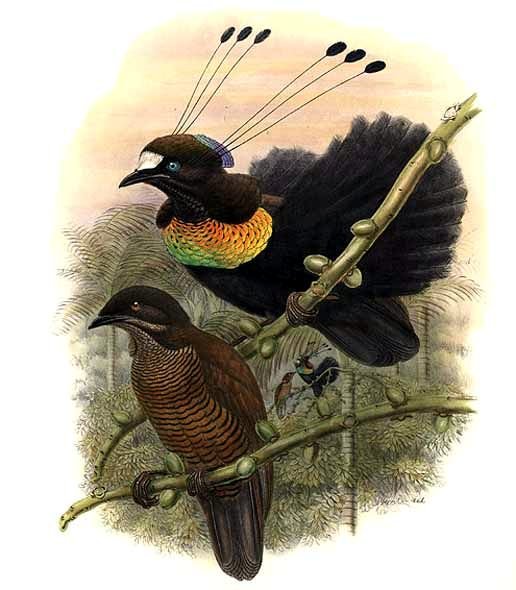
Lawes's Parotia is a medium-sized bird, measuring approximately 27 cm in length. The male is particularly striking, with a combination of velvety black plumage and iridescent highlights. Its crown features bright green and blue hues, while the breast shield displays a dazzling array of colors ranging from metallic greens to bronzes. The male's most distinctive feature is its ornate flank plumes, which fan out during courtship displays. Females, in contrast, have more subdued brown plumage with subtle streaking, providing effective camouflage in their forest environment. Juveniles resemble females but are distinguishable by their softer, more mottled appearance. In flight, Lawes's Parotia presents a compact silhouette, with rounded wings and a slightly elongated tail. The bird's perching posture is upright, often seen on branches or in the undergrowth as it surveys its surroundings. Confusion with similar species, such as other members of the Paradisaeidae family, can occur due to overlapping ranges. However, the combination of its unique courtship behavior and specific plumage characteristics aids in accurate identification.
Having trouble telling birds apart? Upload a photo to our bird identification tool for an instant species match.
Lawes's Parotia Habitat and Range
Preferred Habitat
Lawes's Parotia inhabits the montane forests of Papua New Guinea, preferring elevations between 1,200 and 2,300 meters. These forests provide a rich tapestry of flora, offering abundant food sources and nesting sites. The bird thrives in environments with dense vegetation, which includes a mix of mature trees and understory shrubs. Seasonal habitat shifts are minimal, as Lawes's Parotia tends to remain within its montane forest range year-round. While primarily a forest dweller, the bird occasionally ventures into more open areas within its habitat, especially during foraging. Unlike some other species, it shows little tendency to adapt to urban environments.
Geographic Range
Lawes's Parotia is endemic to the montane forests of Papua New Guinea, particularly found on the Huon Peninsula and in the eastern highlands. Its range includes several key areas such as the Owen Stanley Range. The bird is non-migratory, maintaining a relatively stable presence within its range throughout the year. Population density hotspots are often located in regions where forest conditions remain pristine and undisturbed. Though its range is limited to Papua New Guinea, the bird is considered a vital component of the local avifauna. Conservation efforts focus on protecting these habitats to ensure the survival of the species.
Want to know which birds visit your area? Browse our backyard birds by location guides for region-specific species lists.
What Does the Lawes's Parotia Eat?
The diet of Lawes's Parotia primarily consists of fruits and small invertebrates. The bird plays a critical role in seed dispersal within its habitat, consuming a wide variety of fruits from the forest canopy. Seasonal diet changes occur, with some shifts towards more protein-rich invertebrates during breeding periods. Foraging predominantly takes place in the mid to upper levels of the forest, where the bird utilizes its agility to maneuver through branches. The bird's feeding schedule aligns with daylight hours, with peak activity in the morning and late afternoon. Its prey includes small insects and arthropods, which it captures through quick, precise movements.
Lawes's Parotia Behavior and Social Structure
Lawes's Parotia exhibits a complex social structure during the breeding season, characterized by the males' elaborate courtship displays. These displays involve intricate dance routines performed at meticulously maintained courtship arenas on the forest floor. Males are fiercely territorial, defending these areas against rivals. Outside of the breeding season, the bird's social behavior shifts to a more solitary or loosely social mode. Lawes's Parotia is generally non-flocking, although loose associations may form around abundant food sources. In response to predators, the bird relies on its cryptic plumage and agility, often seeking cover in dense foliage. Daily activity patterns reveal peak periods in the early morning and late afternoon, when the bird engages in foraging and maintenance of its courtship display area.
Lawes's Parotia Nesting and Reproduction
Nesting in Lawes's Parotia involves constructing a simple cup-shaped nest using materials such as twigs, leaves, and moss. These nests are typically located in the fork of a tree, well concealed by surrounding foliage. The female assumes primary responsibility for nest construction, incubation, and rearing of the young. A typical clutch consists of one to two eggs, with an incubation period of approximately 18-20 days. After hatching, the chicks remain in the nest for around 20-25 days before fledging. The female provides all parental care, as males do not participate in nurturing the young. Lawes's Parotia generally produces one brood per year, with breeding typically aligned with the availability of food resources.
Lawes's Parotia Sounds and Vocalizations
The primary song of Lawes's Parotia is a series of melodious whistles and clicks, varying in pitch and rhythm. These vocalizations serve as part of the courtship ritual, with males incorporating song into their display to attract females. Call notes are generally soft and subdued, used primarily for communication between individuals. Alarm calls are sharper and more abrupt, alerting others to potential dangers. During the dawn chorus, the bird's song contributes to the rich acoustic tapestry of the forest, with males often competing vocally as well as visually to establish dominance.
Interesting Facts About the Lawes's Parotia
- 1The courtship dance of Lawes's Parotia is so complex that researchers have likened it to a ballet, involving precise movements and feather manipulation.
- 2Lawes's Parotia is named in honor of Sir William George Lawes, a missionary who worked in Papua New Guinea during the late 19th century.
- 3The flank plumes of male Lawes's Parotia can spread outwards like a tutu, a feature unique among birds-of-paradise.
- 4Despite their striking appearance, Lawes's Parotia are surprisingly difficult to spot in the dense forest understory.
- 5The iridescence in the plumage of Lawes's Parotia results from microscopic structures that refract light, rather than pigments.
Lawes's Parotia Conservation Status
Lawes's Parotia currently holds a status of Least Concern on the IUCN Red List, though its population trend is decreasing. Primary threats include habitat loss due to logging and agricultural expansion. Conservation efforts focus on habitat preservation and mitigating the impacts of human encroachment. Protected areas within its range are crucial for the bird's continued survival. Historical population changes reflect a decline in regions where forest degradation is most pronounced. Continued monitoring and conservation action remain essential to prevent further declines.
Other Paradisaeidae Species


Birds Similar to the Lawes's Parotia
These species are often confused with the Lawes's Parotia due to similar appearance or overlapping range.

