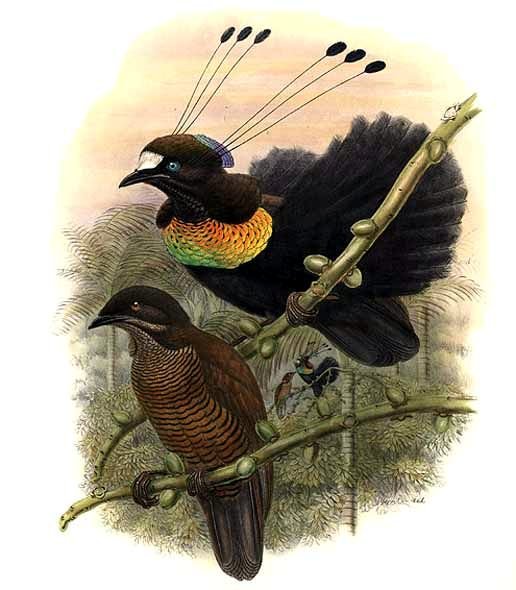
Western Parotia
Parotia sefilata
Order: Passeriformes / Family: Paradisaeidae

Wikimedia Commons
About the Western Parotia
The Western Parotia, scientifically named Parotia sefilata, is a striking bird of paradise endemic to the island of New Guinea. This species is a member of the Paradisaeidae family and holds a special place in the rich tapestry of New Guinea's avian diversity. Renowned for its intricate courtship rituals, the Western Parotia is a marvel of avian evolution, showcasing the extraordinary lengths to which natural selection can drive the development of extravagant physical and behavioral traits. Males are particularly notable for their elaborate plumage and unique dance displays, which play a crucial role in their mating success. During these displays, the male performs a captivating ballet-like dance, spreading its flank feathers and shaking its head to create a mesmerizing performance that can be likened to a ballerina's pirouette. These displays are not only a testament to the bird's agility and coordination but also serve to attract females by highlighting the male's vibrant plumage. The Western Parotia is predominantly found in the montane and submontane rainforests of New Guinea, occupying elevations ranging from 1,200 to 2,400 meters. This bird prefers dense, humid forests where it can find ample food resources and suitable sites for its courtship displays. It plays a vital ecological role as a seed disperser, contributing to the maintenance of forest biodiversity. Additionally, the Western Parotia's presence is a key indicator of the health of its forest habitat, as this species is sensitive to environmental changes such as habitat loss and degradation. Seasonal behaviors of the Western Parotia include a noticeable increase in courtship activities during the breeding season, which coincides with the peak of the fruiting season in its habitat. This alignment ensures that the males' displays are backed by an abundant food supply, supporting the energetic demands of their performances. Furthermore, the Western Parotia's diet primarily consists of fruits and arthropods, making it an important participant in the forest food web. By consuming and dispersing a variety of fruit seeds, it promotes plant regeneration and forest sustainability. The Western Parotia's significance extends beyond its ecological contributions, as it also holds cultural value for indigenous communities in New Guinea. These communities often feature the bird in their traditional folklore and ceremonies, underscoring the species' role in shaping both the natural and cultural landscapes of the region. The conservation of the Western Parotia and its habitat is crucial, not only for preserving biodiversity but also for maintaining the cultural heritage of the people who share their environment with this extraordinary bird.
The Western Parotia belongs to the family Paradisaeidae, within the order Passeriformes. These birds typically live average 5-9 years with a maximum recorded of 12 years..
How to Identify a Western Parotia
The Western Parotia is a medium-sized bird of paradise, with males measuring around 33 cm in length, including their long tail feathers. Males are particularly eye-catching, adorned with iridescent black plumage that shimmers with hues of green and purple under sunlight. A defining characteristic is the set of six wire-like head plumes that curve outward, a feature unique to males and used prominently during courtship displays. Females, on the other hand, exhibit a more subdued appearance with brown plumage and speckled underparts, which provides camouflage against the forest floor. Juveniles resemble females but can be distinguished by their slightly duller coloration and less defined markings. When comparing males to similar species, such as the Huon Astrapia, the Western Parotia's wire-like plumes and distinctive dance are key differentiators. In flight, the Western Parotia can be identified by its rapid wingbeats and short, rounded wings, which facilitate quick maneuvering through dense foliage. Perching posture is often upright, with males frequently positioning themselves on low branches or clearings to maximize visibility during their displays.
Having trouble telling birds apart? Upload a photo to our bird identification tool for an instant species match.
Western Parotia Habitat and Range
Preferred Habitat
The Western Parotia inhabits the lush montane and submontane rainforests of New Guinea, favoring areas with dense vegetation and a rich canopy. It is typically found at elevations between 1,200 and 2,400 meters, where moisture and temperature conditions are optimal for its survival. These forests provide ample food resources and serve as ideal locations for the bird's elaborate courtship displays. While primarily associated with pristine forest environments, the Western Parotia can occasionally be found in secondary forests, provided that these areas offer sufficient cover and food supply. However, the bird tends to avoid heavily disturbed or deforested regions. Unlike some other bird species, the Western Parotia does not typically venture into urban areas, preferring the seclusion and relative safety of its forest habitat. Seasonal habitat shifts are minimal, as the bird remains resident within its montane range throughout the year, taking advantage of the stable climate and consistent availability of food resources associated with its elevated environment.
Geographic Range
The Western Parotia is endemic to the central highlands of New Guinea, with its range extending across several key regions. It primarily inhabits the Bird's Head Peninsula and the central mountain range of the island, including the Arfak Mountains in West Papua. Within these areas, the species occupies the montane forests that provide both food and suitable sites for its courtship rituals. Unlike migratory birds, the Western Parotia is a year-round resident of these highland forests, relying on the consistent availability of resources within its limited range. Population density tends to be higher in areas where the forest remains intact and undisturbed, allowing for the preservation of the complex ecological interactions upon which the bird depends. While the Western Parotia does not undertake long-distance migrations, it may exhibit minor altitudinal movements in response to seasonal variations in food availability, though these shifts are generally limited in scope. Conservation efforts focus on protecting the core areas of its range from deforestation and habitat fragmentation, ensuring that the ecological integrity of these forests is maintained for the survival of the species.
Want to know which birds visit your area? Browse our backyard birds by location guides for region-specific species lists.
What Does the Western Parotia Eat?
The diet of the Western Parotia consists primarily of fruits and a variety of arthropods, reflecting its role as both a frugivore and an insectivore. Its feeding habits are influenced by seasonal changes, with a preference for ripe, fleshy fruits during the peak fruiting season. Commonly consumed fruit species include those from the genera Ficus and Schefflera, which are abundant in its montane forest habitat. In addition to fruits, the Western Parotia supplements its diet with insects such as beetles and caterpillars, which provide essential proteins and nutrients. These are typically foraged from the forest understory and canopy, where the bird uses its agile movements to extract prey from foliage. The Western Parotia exhibits a diurnal feeding schedule, with most foraging activity occurring in the early morning and late afternoon when temperatures are cooler and prey is more active. Its foraging technique involves a combination of gleaning and sallying, allowing it to efficiently exploit a diverse array of food resources.
Western Parotia Behavior and Social Structure
Socially, the Western Parotia is known for its solitary nature, with individuals typically leading a rather independent existence outside the breeding season. During the breeding period, however, males become highly territorial, establishing and vigorously defending small display areas known as leks. These leks serve as the stage for the Western Parotia's courtship displays, where males perform intricate dances to attract potential mates. The complex display consists of a series of choreographed movements, including hops, pirouettes, and head shakes, all designed to showcase the male's iridescent plumage to maximum effect. While performing, the male spreads his flank feathers to create the appearance of a skirt, a unique characteristic of this species. The Western Parotia's daily activity pattern includes periods of foraging interspersed with display and rest. Although primarily solitary, the bird may occasionally join mixed-species foraging flocks, particularly when food resources become scarce. In response to predators, the Western Parotia relies on its cryptic plumage to blend into its surroundings, often remaining motionless to avoid detection. Vocalizations are used as alarm calls to alert others to potential threats, contributing to the collective vigilance of forest-dwelling avifauna.
Western Parotia Nesting and Reproduction
The nesting behavior of the Western Parotia reflects the bird's preference for seclusion and safety from predators. Nests are typically constructed by females, who select a secluded location within dense foliage to provide concealment. The nest itself is cup-shaped, crafted from a combination of twigs, leaves, and moss, which blend seamlessly with the surrounding vegetation. Clutch size usually consists of one to two eggs, which are incubated solely by the female for a period of approximately 18 to 20 days. During this time, the female remains vigilant, leaving the nest only to forage briefly. After hatching, chicks are altricial, requiring extensive parental care. The female provides all necessary nourishment and protection to the fledglings, which remain in the nest for about 25 to 30 days before fledging. The Western Parotia generally raises one brood per year, though in particularly favorable conditions, a second brood may be attempted. The male's role in nesting is limited to courtship and mating, as he does not participate in incubation or chick-rearing activities.
Western Parotia Sounds and Vocalizations
The primary song of the Western Parotia is a complex series of notes characterized by a rhythmic pattern and a high-pitched, melodic quality. This song is often used by males to establish and defend their territory, as well as to attract females during the breeding season. In addition to their primary song, Western Parotias produce a variety of call notes, including sharp, staccato clicks and whistles that serve as communication signals between individuals. Alarm calls are harsher and more urgent, alerting nearby birds to the presence of predators. At dawn, the Western Parotia may join the chorus of other forest birds, contributing its unique calls to the vibrant symphony of the morning.
Interesting Facts About the Western Parotia
- 1The Western Parotia's courtship dance, often referred to as the "ballerina dance," is one of the most elaborate among birds of paradise.
- 2Males can take up to seven years to acquire their full adult plumage, necessary for successful courtship displays.
- 3The Western Parotia uses its six wire-like head plumes during displays, which are unique among birds of paradise.
- 4In some indigenous cultures, the Western Parotia is considered a symbol of beauty and is often featured in traditional ceremonies.
- 5The bird's courtship display areas, or leks, are meticulously maintained by males who clear the ground of debris to enhance visibility.
Western Parotia Conservation Status
The Western Parotia is currently listed as Least Concern by the IUCN, reflecting a stable population trend. However, the species faces ongoing threats from habitat destruction due to logging and agricultural expansion. Conservation efforts focus on protecting critical habitat within New Guinea's montane forests, as well as raising awareness about the ecological and cultural importance of the species. Historically, the Western Parotia's population has remained relatively stable, thanks in part to the inaccessibility of its highland habitats, which offer some protection from human disturbance. Continued monitoring and habitat preservation are essential to ensure the long-term survival of this iconic bird.
Other Paradisaeidae Species


Birds Similar to the Western Parotia
These species are often confused with the Western Parotia due to similar appearance or overlapping range.