
Large-tailed Antshrike
Mackenziaena leachii
Order: Passeriformes / Family: Thamnophilidae

Wikimedia Commons
About the Large-tailed Antshrike
The Large-tailed Antshrike (Mackenziaena leachii) is a compelling member of the Thamnophilidae family, known for its melodious song and captivating appearance. This bird primarily inhabits the dense forests of southeastern Brazil, extending to parts of Paraguay and northeastern Argentina. It thrives in subtropical and tropical moist lowland forests, where its presence is a testament to the region's biodiversity. The Large-tailed Antshrike plays a vital ecological role as it controls insect populations, contributing to the health of its native ecosystems. During the breeding season, typically from September to February, this species becomes particularly vocal, showcasing its territorial calls that echo through the forest understory. Its calls are not only a declaration of territory but also serve as a means of communication between mates. The Large-tailed Antshrike's preference for dense, tangled vegetation offers it protection from predators and a rich resource base for foraging. As an insectivore, this bird methodically searches leaf litter and branches, employing a combination of gleaning and sallying techniques. Outside the breeding season, it may exhibit nomadic behavior, searching for optimal feeding grounds and sometimes joining mixed-species flocks. Its adaptability to different forest types, including secondary growth, emphasizes its resilience and ecological versatility. Despite this adaptability, deforestation poses a significant threat, as habitat loss continues to impact its populations. Conservation efforts are crucial to preserve the Large-tailed Antshrike's natural habitat, ensuring the survival of this iconic avian species.
The Large-tailed Antshrike belongs to the family Thamnophilidae, within the order Passeriformes. These birds typically live average 6 years with max recorded 10 years.
How to Identify a Large-tailed Antshrike
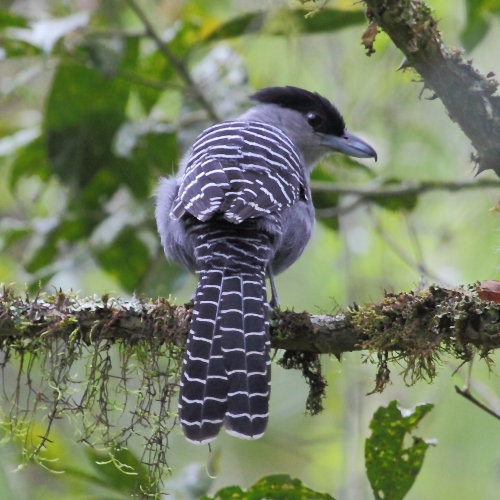
The Large-tailed Antshrike is a medium-sized bird, measuring about 23-26 cm in length, with its most distinctive feature being its elongated tail. The adult male is predominantly black, with a subtle bluish sheen, particularly noticeable in good lighting. Its tail is not just long but also broad, assisting in its balance and maneuverability through dense underbrush. In contrast, females exhibit a more subdued coloration, with brownish tones interspersed with black, providing effective camouflage. Juveniles resemble females but often have lighter brown plumage with a more pronounced streaking pattern. The Large-tailed Antshrike can be confused with other antshrikes, but its size and tail length are reliable distinguishing features. Its flight silhouette is characterized by a relatively short, rounded wing structure and a long, trailing tail. When perched, it often holds its tail slightly cocked, a posture that is both distinctive and functional for communication and balance.
Having trouble telling birds apart? Upload a photo to our bird identification tool for an instant species match.
Large-tailed Antshrike Habitat and Range
Preferred Habitat
The Large-tailed Antshrike primarily inhabits subtropical and tropical moist lowland forests. It is frequently found in regions with dense understory vegetation and a rich presence of vines and tangled growth. These habitats are typically characterized by high humidity and a complex vertical structure, providing the antshrike with ample cover and foraging opportunities. Its elevational range extends up to 1000 meters, though it is more commonly encountered at lower elevations. Seasonal habitat shifts are minimal, as the bird is mainly sedentary, but it may venture into secondary growth forests when primary habitats are disturbed. Urban presence is rare, reflecting its preference for undisturbed natural environments.
Geographic Range
The Large-tailed Antshrike's range encompasses parts of southeastern Brazil, extending into Paraguay and the northeastern regions of Argentina. Within these countries, it is most prevalent in forested areas such as the Atlantic Forest biome in Brazil, a biodiversity hotspot. The antshrike's distribution is relatively patchy, depending on the availability of suitable forest habitats. It does not exhibit long-distance migratory behavior, remaining largely within its established range year-round. Population density is highest in regions with minimal deforestation and where conservation efforts have been implemented to protect native flora and fauna.
Want to know which birds visit your area? Browse our backyard birds by location guides for region-specific species lists.
What Does the Large-tailed Antshrike Eat?
Primarily insectivorous, the Large-tailed Antshrike's diet consists of insects and other arthropods. It favors ants, beetles, and caterpillars, which it locates by meticulously foraging through leaf litter and probing bark crevices. Seasonal diet variations occur, with some plant matter, such as berries, consumed during periods of low insect availability. Its foraging technique is deliberate, often involving short flights to snatch prey or gleaning insects from foliage. Prey size is typically small to medium, aligning with the bird's agile handling capabilities. Feeding activity peaks during early morning and late afternoon when insect activity is highest.
Large-tailed Antshrike Behavior and Social Structure
The Large-tailed Antshrike is predominantly solitary or found in pairs, reflecting its territorial nature. It defends its territory vigorously through vocalizations and physical displays, often involving raised wings and tail fanning. Courtship involves mutual preening and duet singing, strengthening pair bonds. Unlike some antbirds, it rarely joins mixed-species flocks, preferring the company of its mate. In response to predators, it remains motionless, relying on its camouflaged plumage. Its daily activities revolve around foraging, with rest periods during the hottest parts of the day. The bird is most active at dawn and dusk, capitalizing on cooler temperatures and increased prey availability.
Large-tailed Antshrike Nesting and Reproduction
The nesting habits of the Large-tailed Antshrike involve constructing a cup-shaped nest, often hidden within dense shrubbery or low trees. Nests are crafted from twigs, leaves, and plant fibers, providing camouflage and stability. Preferred nesting locations are within 2-3 meters of the ground, ensuring protection from ground predators. The typical clutch size is two to three eggs, which are incubated by both parents over approximately 14-16 days. Once hatched, the young fledge in about 10-12 days, with both parents involved in feeding and protection. Generally, the Large-tailed Antshrike raises one to two broods per year, depending on environmental conditions.
Large-tailed Antshrike Sounds and Vocalizations
The primary song of the Large-tailed Antshrike is a series of melodious, whistle-like notes, often described as 'whee-weee-wheee,' with a rising and falling pattern. These calls are clear and resonant, carrying efficiently through dense forests. Call notes are shorter, consisting of sharp 'chip' sounds used for communication between mates. Alarm calls are harsher and more urgent, alerting others to potential threats. During the dawn chorus, the antshrike's song is particularly prominent, contributing to the symphony of sounds that characterize its habitat.
Interesting Facts About the Large-tailed Antshrike
- 1The Large-tailed Antshrike's tail accounts for nearly half of its total body length, aiding in maneuverability.
- 2Despite their name, Large-tailed Antshrikes do not exclusively eat ants, preferring a broader diet of insects.
- 3Their song is a key tool for territory defense and mate attraction, often involving complex vocal duets.
- 4They play a crucial ecological role by controlling insect populations, benefiting plant health in their habitats.
- 5Researchers have observed that Large-tailed Antshrikes sometimes use vocal mimicry to deter potential predators.
- 6These antshrikes can adapt to secondary forests, demonstrating their resilience in changing environments.
- 7The species is named after British naturalist William Elford Leach, who made significant contributions to zoology.
Large-tailed Antshrike Conservation Status
The IUCN lists the Large-tailed Antshrike as a species of Least Concern, but its population is decreasing due to habitat loss. Deforestation and land conversion for agriculture are the primary threats, reducing the availability of suitable habitat. Conservation efforts, including protected area designation and reforestation projects, aim to mitigate these impacts. While historical data on population trends is limited, ongoing habitat destruction necessitates continued conservation focus.
Other Thamnophilidae Species



Birds Similar to the Large-tailed Antshrike
These species are often confused with the Large-tailed Antshrike due to similar appearance or overlapping range.
