
Leaden Antwren
Myrmotherula assimilis
Order: Passeriformes / Family: Thamnophilidae

Wikimedia Commons
About the Leaden Antwren
The Leaden Antwren (Myrmotherula assimilis) is a small passerine bird belonging to the family Thamnophilidae, which includes a variety of antbirds. This species plays a significant role in the ecological systems of the Amazon and adjacent regions by participating in insect population control. Its presence often indicates healthy, undisturbed forest ecosystems. The Leaden Antwren primarily inhabits the undergrowth of humid lowland forests in South America, ranging from the eastern slopes of the Andes in Peru and Bolivia to the expansive Amazon Basin. This bird thrives in thick vegetation, often found near river edges where the forest meets water. During the breeding season, its activities focus on finding suitable nesting sites and attracting mates, while the non-breeding season sees them foraging more widely. As a member of the diverse antbird assemblage, the Leaden Antwren is a crucial part of mixed-species flocks, especially during the wet season, which influences its foraging and social behaviors. Despite its inconspicuous nature, careful observation reveals its importance in the complex web of rainforest life. The Leaden Antwren's ecological role transcends mere insectivory; it also participates in the symbiotic relationships characteristic of the Amazonian understorey. For instance, it often associates with army ant swarms, capitalizing on the insects flushed out by the ants' relentless march. This behavior not only aids in controlling ant populations but also facilitates energy transfer within the ecosystem. The Leaden Antwren, therefore, exemplifies the interdependent relationships that sustain the rich biodiversity of its habitat. Changes in seasonal patterns, such as the onset of the rainy season, impact its behavior and movement. As rain transforms the forest, the Leaden Antwren adjusts its foraging strategies to adapt to the influx of new insect prey. Such adaptability underscores its resilience in a dynamic environment and highlights the intricate connections between species and their habitats.
The Leaden Antwren belongs to the family Thamnophilidae, within the order Passeriformes. These birds typically live approximately 4-6 years, with longer lifespans rare in the wild..
How to Identify a Leaden Antwren
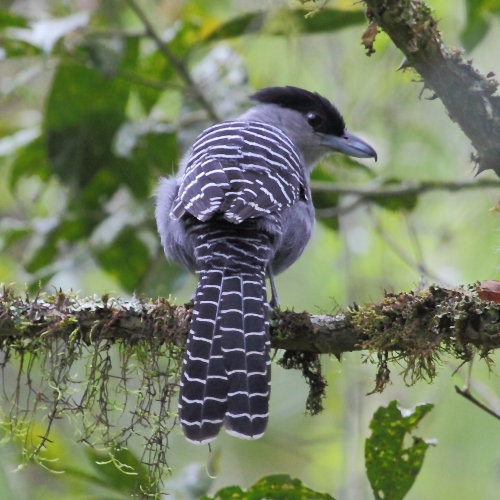
The Leaden Antwren is a small bird, approximately 10 cm in length, characterized by its subtle gray plumage which provides excellent camouflage in the shadowed understorey of its forest habitat. Males and females exhibit sexual dimorphism, with males displaying a more uniform leaden-gray coloration, while females have a slightly browner tinge with paler underparts. The wings of both sexes are marked with two distinct white wing bars. Juveniles resemble females but tend to have even paler and less defined markings. Identifying the Leaden Antwren requires careful observation of these plumage characteristics, as their small size and quick movements can easily lead to confusion with similar species, such as the White-flanked Antwren. In flight, their silhouette is compact with rapid wingbeats, often shifting abruptly as they dart between foliage. When perched, they exhibit a characteristic horizontal stance, often flicking their wings and tail nervously, a behavior that aids in the distinction from other sympatric antbirds. Their preference for remaining close to the forest floor, combined with their muted coloration, makes them a challenging but rewarding subject for birdwatchers.
Having trouble telling birds apart? Upload a photo to our bird identification tool for an instant species match.
Leaden Antwren Habitat and Range
Preferred Habitat
The Leaden Antwren predominantly inhabits the dense, humid lowland forests of the Amazon Basin. It thrives in areas with thick undergrowth, often near streams or riverbanks where forest density offers ample cover and foraging opportunities. In terms of elevation, they are most commonly found from sea level up to 500 meters, although they can occasionally be seen at slightly higher elevations. Seasonal habitat shifts occur minimally, as the bird remains largely sedentary, but local movements may happen in response to changes in food availability during the wet season. The Leaden Antwren is rarely found in urban areas, as its habitat preferences are closely tied to pristine forest environments. It avoids open spaces, preferring the tangled vines and dense foliage of untouched forest tracts, which offer protection from predators and abundant insect prey.
Geographic Range
The Leaden Antwren's range extends across the northern and western reaches of the Amazon Basin, including parts of Brazil, Peru, Bolivia, and Ecuador. Its distribution is closely associated with the vast tropical lowland forests in these regions. Within these countries, the bird's population density is highest in areas with well-preserved habitat, such as national parks and protected forest reserves. While it does not migrate over long distances, localized movements within its range occur in response to seasonal changes in food availability. The Leaden Antwren does not frequent areas north of the Amazon River, remaining largely confined to the southern and eastern forested regions. Its presence is notably absent from the more arid or deforested areas, highlighting its reliance on continuous forest cover for survival.
Want to know which birds visit your area? Browse our backyard birds by location guides for region-specific species lists.
What Does the Leaden Antwren Eat?
The diet of the Leaden Antwren consists primarily of small arthropods, particularly insects such as ants, beetles, and spiders. During the wet season, when insect populations surge, the antwren intensifies its foraging activity, often following army ant swarms to capitalize on the abundance of prey flushed out by the ants. This bird employs a strategy of 'gleaning' from foliage and twigs, using its sharp bill to extract insects hidden in the dense vegetation. The Leaden Antwren's foraging is typically done solo or in pairs, although it occasionally joins mixed-species flocks that enhance its ability to locate food. Its feeding schedule is largely diurnal, with peak activity occurring in the early morning and late afternoon when insect activity is highest. The bird's small size limits its prey to tiny insects, ensuring minimal competition with larger insectivorous birds.
Leaden Antwren Behavior and Social Structure
The Leaden Antwren exhibits a complex social structure, often participating in mixed-species flocks, which provides mutual benefits such as increased foraging efficiency and predator avoidance. Territorial behavior is pronounced during the breeding season, with males actively defending their chosen area through vocalizations and displays. Courtship involves a series of visual and auditory displays, with males showcasing their plumage while emitting soft trills to attract females. Following successful mating, pairs remain together, jointly defending their territory against intruders. The Leaden Antwren's response to predators includes a combination of cryptic behavior and alarm calls, alerting nearby birds to potential threats. Its daily activity patterns revolve around foraging and territory maintenance, with periods of rest during the hottest parts of the day. Flocking behavior outside the breeding season enhances survival by increasing vigilance and foraging success.
Leaden Antwren Nesting and Reproduction
The Leaden Antwren constructs its nest in the dense understorey, typically in a low shrub or small tree, where it is well-hidden from predators. The nest is a small cup made of fine plant fibers, leaves, and spider silk, providing a secure environment for the eggs. A typical clutch consists of two eggs, which the female incubates for about 14 days while the male guards the territory and assists in feeding. Both parents participate in feeding the hatchlings, which fledge approximately two weeks after hatching. The fledging period is critical for the young birds, as they must quickly learn to forage and avoid predators. The Leaden Antwren typically raises one brood per year, although favorable conditions may occasionally allow for a second.
Leaden Antwren Sounds and Vocalizations
The primary song of the Leaden Antwren is a series of rapid, high-pitched notes delivered in a trilling sequence, often described as a 'tseet-tseet-tseet' that rises and falls in intensity. This song serves both territorial and mating purposes. In addition to its song, the Leaden Antwren produces a variety of call notes, including sharp 'chip' sounds used to communicate with mates or signal alarm. During the dawn chorus, its trills blend with those of other antbirds, creating a symphony of sound typical of the Amazonian dawn. The alarm calls are more abrupt and can be likened to a nervous chatter, alerting others to the presence of predators.
Interesting Facts About the Leaden Antwren
- 1The Leaden Antwren weighs approximately 8 grams, making it lighter than a typical pencil.
- 2Despite its small size, the Leaden Antwren's territory can span up to 1.5 hectares in dense forest.
- 3The Leaden Antwren often joins mixed-species flocks, enhancing its foraging efficiency and predator awareness.
- 4This bird's diet primarily consists of insects, with ants and beetles forming the bulk of its prey.
- 5The Leaden Antwren's song consists of rapid trills, often blending into the forest's ambient noise.
- 6Females are slightly browner than males, allowing for sexual dimorphism to be observed even in the field.
- 7Juvenile Leaden Antwrens learn to forage by observing the adults, gradually becoming independent after fledging.
Leaden Antwren Conservation Status
The Leaden Antwren currently holds a status of Least Concern according to the IUCN Red List, but its population is facing threats due to habitat destruction and fragmentation in the Amazon Basin. Deforestation for agriculture and logging poses significant challenges to its survival. Conservation efforts focus on preserving large tracts of contiguous forest and establishing protected areas to ensure habitat continuity. Historical population changes are difficult to quantify due to the bird's elusive nature, but ongoing monitoring indicates a stable population within protected regions, contrasting with declines in unprotected areas.
Other Thamnophilidae Species



Birds Similar to the Leaden Antwren
These species are often confused with the Leaden Antwren due to similar appearance or overlapping range.

