
Myrmeciza zeledoni
Myrmeciza zeledoni
Order: Passeriformes / Family: Thamnophilidae

Wikimedia Commons
About the Myrmeciza zeledoni
Myrmeciza zeledoni, commonly known as Zeledon's Antbird, plays a significant role in the ecosystem of Central and South American rainforests. This bird thrives in the understory of humid forests, from southern Mexico through Costa Rica and into western Panama. Zeledon's Antbird is integral to its habitat, often following army ant swarms to catch insects that flee from the advancing ants. This behavior links it to a unique ecological niche, known as ant-following. The bird's presence often indicates a healthy ant population, which in turn reflects the well-being of the forest ecosystem.
In terms of seasonal behavior, Zeledon's Antbird remains largely sedentary, establishing territories that it maintains year-round. This species does not migrate, making it a reliable indicator of environmental changes in its habitat. Its preference for undisturbed forested areas highlights its vulnerability to deforestation and habitat fragmentation. As such, it serves as a key species for conservationists focusing on tropical forest preservation.
This antbird contributes to the biodiversity of its region, interacting with various species within its habitat. It often joins mixed-species foraging flocks, which enhances its survival through increased vigilance against predators. Zeledon's Antbird's role extends beyond its immediate ecosystem, as it also attracts birdwatchers and researchers, adding value to ecotourism in the regions it inhabits. Protecting this species involves safeguarding large tracts of continuous forest, ensuring the survival of not only Zeledon's Antbird but also countless other species sharing its habitat.
The Myrmeciza zeledoni belongs to the family Thamnophilidae, within the order Passeriformes. These birds typically live average 4 years, with a max recorded of 6 years..
How to Identify a Myrmeciza zeledoni
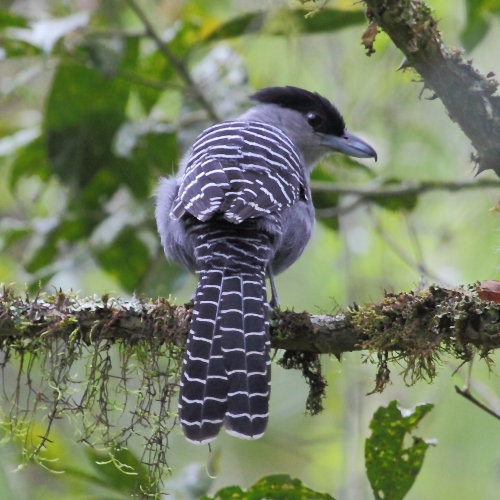
Zeledon's Antbird is a small, striking bird characterized by its predominantly black plumage and white wing spots. Adult males display a glossy black coloration, which can appear slightly blue-tinted in certain lighting. Females, while similar, possess a subtle brownish hue on their underparts, offering a vital distinction for birders.
Juvenile birds differ from adults, exhibiting a more muted brown plumage that gradually darkens as they mature. This transition helps young birds remain less conspicuous to predators while they gain experience. When observing Zeledon's Antbird, note its upright perching posture, often on low branches or vines within dense forest understory.
Confusion may arise with similar antbird species, such as the Spotted Antbird, which shares habitat regions. However, the latter has distinct spotting patterns that Zeledon's Antbird lacks. In flight, the bird's wings reveal its white spots, contrasting sharply against its dark body. This wing pattern, along with its distinctive behavior, aids in field identification.
Having trouble telling birds apart? Upload a photo to our bird identification tool for an instant species match.
Myrmeciza zeledoni Habitat and Range
Preferred Habitat
Zeledon's Antbird inhabits the humid lowland and foothill forests of Central America, particularly thriving in the dense understory. This species favors primary forests, where the complexity and diversity of the vegetation provide ample cover and foraging opportunities. In Costa Rica, for instance, it is commonly found in the evergreen forests of the Caribbean slope.
The bird's range spans elevations from sea level up to approximately 1,200 meters, though it is most frequently encountered at lower altitudes. Unlike some birds, Zeledon's Antbird does not adapt well to urban environments and avoids areas with significant human disturbance. Seasonal shifts in habitat are minimal, as the antbird remains within the same general area year-round, relying on the forest's consistent microclimate.
In areas where forests have been cleared or fragmented, Zeledon's Antbird is notably absent, underscoring its dependence on intact forest ecosystems. Conservation efforts often prioritize maintaining these habitats to support the species' long-term survival.
Geographic Range
The range of Myrmeciza zeledoni extends from southern Mexico through Central America, predominantly in Costa Rica and western Panama. It occupies a relatively narrow band along the Caribbean slope, where humid conditions prevail. This bird does not undertake long migrations, instead remaining within its established territories throughout the year.
In Costa Rica, Zeledon's Antbird is a permanent resident, frequently observed in protected areas such as the Braulio Carrillo National Park. Its presence in Panama is similarly stable, reflecting the bird's preference for contiguous forest tracts. While it does not migrate seasonally, localized movements may occur in response to changes in food availability, particularly following army ant swarms.
Population density tends to be higher in regions with well-preserved habitats, such as national parks and biological reserves. In contrast, areas experiencing deforestation and agricultural expansion witness a decline in antbird numbers. The conservation of these habitats is crucial for maintaining the species' range and population stability.
Want to know which birds visit your area? Browse our backyard birds by location guides for region-specific species lists.
What Does the Myrmeciza zeledoni Eat?
Zeledon's Antbird primarily feeds on insects and other arthropods, making it an insectivore with a specialized foraging technique. It frequently follows army ant swarms, capturing prey that attempts to escape the advancing ants. This behavior not only provides a reliable food source but also demonstrates the bird's unique ecological role.
The antbird's diet includes a wide variety of insects, such as beetles, spiders, and caterpillars, which it snatches from low vegetation or the forest floor. During the rainy season, when insect abundance peaks, Zeledon's Antbird may expand its diet to include small invertebrates not found at other times of the year.
Foraging typically occurs during daylight hours, with peak activity in the early morning and late afternoon. The bird employs a methodical approach, moving through the understory with short hops and pauses, scanning for movement. This precision allows it to exploit the resources provided by its habitat efficiently, ensuring a balanced diet throughout the year.
Myrmeciza zeledoni Behavior and Social Structure
Zeledon's Antbird exhibits a territorial and social behavior that is shaped by its unique ecological niche. It is typically found in pairs or small family groups, maintaining territories that they defend vigorously against intruding conspecifics. Territorial disputes often involve vocalizations and displays rather than physical confrontations.
Courtship displays include mutual preening and soft vocalizations, strengthening the bond between mates. These birds are monogamous, forming long-term pair bonds that persist across breeding seasons. Outside of the breeding season, Zeledon's Antbird may join mixed-species flocks, benefiting from the collective vigilance against predators.
The bird's response to predators involves a combination of alarm calls and discreet movements through dense foliage, minimizing exposure. Daily activity patterns include foraging in the cooler morning hours, followed by periods of rest during the heat of the day. Despite its small size, Zeledon's Antbird is an assertive and active participant in its ecosystem.
Myrmeciza zeledoni Nesting and Reproduction
Zeledon's Antbird constructs its nest close to the ground, typically using twigs, leaves, and other plant materials to form a cup-shaped structure. Nests are often located within dense understory vegetation, providing concealment from predators.
The typical clutch size for this species ranges from two to three eggs, which are incubated primarily by the female. The incubation period lasts approximately 14 days, during which the male may assist in feeding the incubating female. After hatching, both parents participate in feeding the chicks, which fledge around two weeks after hatching.
Zeledon's Antbird generally raises one brood per year, though in optimal conditions, a second brood may occur. This limited reproductive output underscores the importance of stable, undisturbed habitats for the species' successful breeding and survival.
Myrmeciza zeledoni Sounds and Vocalizations
The primary song of Zeledon's Antbird is a series of clear, melodious notes delivered at a steady tempo. This song serves both to establish territory and to maintain contact between mates. Call notes are shorter and more abrupt, often used in social interactions or to signal alarm.
Alarm calls consist of sharp, high-pitched notes that alert nearby birds to potential threats. During the dawn chorus, Zeledon's Antbird's song can be heard echoing through the forest, a signature sound of its habitat. Its vocalizations, though not as varied as some songbirds, are distinctive and play a crucial role in its communication and social structure.
Interesting Facts About the Myrmeciza zeledoni
- 1Zeledon's Antbird is named after the Costa Rican naturalist José Cástulo Zeledón, recognizing his contributions to ornithology.
- 2Despite its reliance on army ant swarms, Zeledon's Antbird does not hunt ants, instead capturing fleeing insects.
- 3The species was once considered part of the Immaculate Antbird before being reclassified based on vocal and genetic differences.
- 4Zeledon's Antbird's territory defense involves vocal duets between mates, reinforcing pair bonds and territorial boundaries.
- 5The white wing spots of Zeledon's Antbird are not just for identification; they play a role in intraspecific communication.
- 6Unlike many tropical birds, Zeledon's Antbird does not migrate, remaining in its territory year-round to maintain its ecological niche.
- 7The bird's preference for dense forest understory makes it a key indicator species for assessing forest health and integrity.
Myrmeciza zeledoni Conservation Status
As of the latest assessments, Zeledon's Antbird is classified as Least Concern by the IUCN, indicating a stable population trend. However, the species faces ongoing threats from deforestation and habitat fragmentation, particularly in regions experiencing rapid agricultural expansion. Conservation efforts focus on protecting and restoring forest habitats, with initiatives to establish protected areas and corridors that facilitate movement and genetic exchange between populations. Historical population changes have been relatively stable, but continued monitoring is essential to ensure that conservation measures remain effective. Community engagement and ecotourism also play roles in conservation, raising awareness and generating support for protecting the forests that Zeledon's Antbird and countless other species call home.
Other Thamnophilidae Species



Birds Similar to the Myrmeciza zeledoni
These species are often confused with the Myrmeciza zeledoni due to similar appearance or overlapping range.

