
Wing-banded Antbird
Myrmornis torquata
Order: Passeriformes / Family: Thamnophilidae

Wikimedia Commons
About the Wing-banded Antbird
The Wing-banded Antbird (Myrmornis torquata) is an enigmatic species belonging to the family Thamnophilidae, a group renowned for its adaptability and ecological significance in tropical ecosystems. Found predominantly within the Amazon Basin, the Wing-banded Antbird inhabits dense lowland forests across countries such as Brazil, Peru, and Colombia. This species plays an integral role in maintaining the ecological balance of its habitat by participating in intricate predator-prey dynamics and seed dispersal processes.
The Wing-banded Antbird is not just a visual marvel but also a critical component of the forest understory. It primarily resides in terra firme forests, avoiding flood-prone areas, which demonstrates its preference for stability and undisturbed habitats. This preference influences its distribution patterns significantly. Seasonal behaviors, such as breeding and foraging, are closely linked to the availability of resources like insects, which fluctuate with the wet and dry seasons typical of its habitat.
Ecologically, the Wing-banded Antbird contributes to the control of insect populations, including ants and beetles, lending its name and relevance to the ecosystem. It is also a part of the mixed-species flocks that roam the understory, a behavior that underscores its importance in enhancing foraging efficiency and predator vigilance. While its presence is predominantly year-round, observations indicate slight shifts in local population densities corresponding to seasonal variations in food availability. The Wing-banded Antbird's unique adaptations make it a subject of interest for ornithologists and conservationists alike.
The Wing-banded Antbird belongs to the family Thamnophilidae, within the order Passeriformes. These birds typically live average 5-8 years with a maximum recorded of 11 years..
How to Identify a Wing-banded Antbird
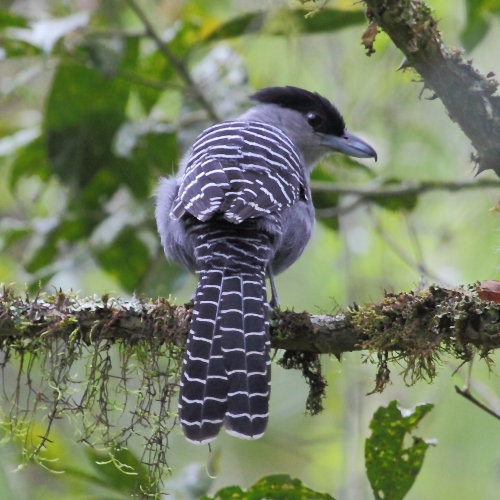
The adult Wing-banded Antbird is characterized by its striking black and white plumage, which serves as a distinguishing feature among the dense foliage. Males and females share similar color patterns, with males typically exhibiting slightly more vibrant contrasts. The bird's upperparts are primarily black, with a notable white band on the wings, hence its name. The underparts are predominantly white, providing a stark contrast with the dark upper body.
Juveniles appear more subdued in coloration, lacking the sharpness of the adults' plumage, which can lead to misidentification. They often display a mottled appearance that gradually transitions into the adult coloration as they mature. This transition can be crucial for field identification when observing mixed-age groups.
In flight, the Wing-banded Antbird exhibits a rapid yet controlled wingbeat pattern, often staying low to the ground, which aids in navigating through the dense forest understory. When perched, it maintains an upright posture, which, combined with its distinctive plumage, makes it more visible against the forest backdrop compared to other antbird species.
Having trouble telling birds apart? Upload a photo to our bird identification tool for an instant species match.
Wing-banded Antbird Habitat and Range
Preferred Habitat
The Wing-banded Antbird predominantly inhabits the dense, humid lowland forests of the Amazon Basin, thriving in terra firme forests where flooding does not occur. Within these habitats, it prefers the understory, where dense vegetation offers ample cover and foraging opportunities. Typical elevations range from sea level up to about 500 meters, though sightings at higher elevations are not unheard of.
This species shows a strong affinity for undisturbed forest environments, steering clear of urban areas, which makes it an indicator species for healthy forest ecosystems. Seasonal shifts in habitat use are minimal, yet minor movements within its range may occur in response to changes in food availability, particularly during the breeding season when insect abundance peaks.
Geographic Range
The Wing-banded Antbird is native to the tropical rainforests of South America, with its range largely confined to the Amazon Basin. It is found across several countries, including Brazil, Peru, Ecuador, Colombia, and Venezuela. The species does not undertake long migrations, preferring to remain within its established range throughout the year.
Population density varies across its range, with hotspots often found in areas of rich biodiversity and minimal human disturbance. These regions provide the necessary resources for breeding and foraging, supporting stable populations. Though it is largely a resident bird, slight altitudinal movements may occur in response to environmental changes, primarily driven by food availability rather than temperature.
Want to know which birds visit your area? Browse our backyard birds by location guides for region-specific species lists.
What Does the Wing-banded Antbird Eat?
The Wing-banded Antbird's diet primarily consists of insects, with ants, beetles, and caterpillars forming the bulk of its nutritional intake. It employs an active foraging technique, often hopping through the understory and flipping leaves to uncover hidden prey. This behavior not only aids in finding food but also in avoiding potential predators by staying low and within cover.
Seasonal variations influence its diet, with a notable increase in caterpillar consumption during the breeding season when protein demands are higher. Prey size is generally small to medium, allowing for efficient handling and digestion. Foraging activities peak during the early morning and late afternoon, aligning with the periods of highest insect activity.
Wing-banded Antbird Behavior and Social Structure
The Wing-banded Antbird displays a fascinating range of behaviors that reflect its adaptation to the dense forest environment. Socially, it is typically solitary or found in pairs, particularly during the breeding season. These pairs are territorial, often engaging in vocal displays to ward off intruders and maintain their territory boundaries.
Courtship involves elaborate displays, where males perform a series of wing and body movements to attract females. These displays are accompanied by soft vocalizations that differ from their typical calls. Though not colonial, the Wing-banded Antbird may join mixed-species flocks outside of the breeding season, taking advantage of the safety in numbers to enhance foraging success.
In response to predators, the bird relies on its cryptic plumage and the dense foliage of its habitat for concealment. It exhibits a series of short, quick flights interspersed with pauses, allowing it to remain hidden while assessing threats. Daily activity patterns are closely linked to light levels, with most activities occurring during dawn and dusk.
Wing-banded Antbird Nesting and Reproduction
The Wing-banded Antbird constructs its nests low to the ground, often within the protective cover of dense vegetation. Nests are typically cup-shaped, woven from twigs, leaves, and fibers, providing a secure environment for eggs and chicks. The location is selected for its concealment from predators, leveraging the natural camouflage of the forest.
Clutch sizes usually range from two to three eggs, with both parents sharing responsibilities in incubation, which lasts approximately 14 to 16 days. Once hatched, the chicks remain in the nest for another 10 to 12 days before fledging. Both parents participate in feeding and protecting the young, ensuring their survival in the challenging forest environment. Generally, the species produces one to two broods per year, depending on resource availability.
Wing-banded Antbird Sounds and Vocalizations
The primary song of the Wing-banded Antbird is a series of melodious notes that rise and fall in a rhythmic pattern, often described as liquid and musical. These vocalizations serve multiple purposes, from territorial defense to courtship signals. In addition to their song, the bird produces a variety of call notes that include sharp 'pip' sounds and softer contact calls used to maintain communication between pairs.
Alarm calls are more abrupt and harsh, designed to warn of potential threats. During the dawn chorus, the Wing-banded Antbird contributes its distinct song to the symphony of forest sounds, reinforcing its presence in its territory and asserting dominance over its domain.
Interesting Facts About the Wing-banded Antbird
- 1The Wing-banded Antbird's name derives from the conspicuous white bands on its wings, a unique feature among antbirds.
- 2This bird is a part of the Thamnophilidae family, which includes over 200 species known as antbirds, all of which are entirely insectivorous.
- 3Unlike many birds, the Wing-banded Antbird does not migrate, instead, it remains within its tropical forest range year-round.
- 4The species is known to follow army ant swarms, feeding on insects and other prey flushed out by the ants' movements.
- 5Its song, often described as a 'liquid' melody, can be heard echoing through the dense Amazonian forests during the early morning.
- 6Despite its striking appearance, the Wing-banded Antbird is adept at blending into its environment, making it a challenging find for birdwatchers.
- 7The bird's population remains stable due to its adaptability, yet it faces threats from habitat destruction caused by logging and agriculture.
Wing-banded Antbird Conservation Status
The Wing-banded Antbird is currently classified as Least Concern by the IUCN, with stable population trends reported across most of its range. However, ongoing threats such as deforestation and habitat fragmentation pose significant risks to its long-term survival. Conservation efforts focus on preserving large tracts of contiguous forest, crucial for maintaining viable populations. Historical data indicate that while the species has adapted to certain environmental changes, its reliance on undisturbed habitats makes it vulnerable to rapid deforestation. Active efforts by conservation organizations aim to mitigate these impacts through habitat protection and restoration initiatives.
Other Thamnophilidae Species



Birds Similar to the Wing-banded Antbird
These species are often confused with the Wing-banded Antbird due to similar appearance or overlapping range.