
Parana Antwren
Stymphalornis acutirostris
Order: Passeriformes / Family: Thamnophilidae
Wikimedia Commons
About the Parana Antwren
The Parana Antwren (Stymphalornis acutirostris), a member of the family Thamnophilidae, is a small passerine bird endemic to the coastal marshes of southern Brazil. It holds a significant ecological role in these wetland ecosystems, contributing to insect population control. This antwren is primarily found in the states of Paraná and Santa Catarina, with its habitat closely associated with the dense marsh vegetation that characterizes these regions. The Parana Antwren exhibits seasonal behavior patterns, often showing increased activity during the rainy season when food resources become more abundant. Its presence is crucial for the biodiversity of the marshes, as it aids in maintaining the delicate balance within its ecosystem.
Due to its limited range and specific habitat requirements, the Parana Antwren is considered a vulnerable species. This bird's significance extends beyond its ecological role, as it also serves as an indicator species for the health of its habitat. The degradation of the Atlantic coastal marshes poses a significant threat to its survival, making conservation efforts imperative. Conservationists focus on habitat protection and restoration to ensure the continued presence of this rare and unique bird.
The ecological role of the Parana Antwren involves interactions with other species within its habitat. It often forages in mixed-species flocks, which not only enhances its foraging efficiency but also provides protection from predators. The presence of these flocks indicates a healthy, functioning ecosystem, emphasizing the importance of conserving this bird and its habitat. As climate change and human activities threaten its marshland home, the Parana Antwren's plight highlights the broader challenges faced by many marsh-dependent species.
The Parana Antwren belongs to the family Thamnophilidae, within the order Passeriformes. These birds typically live average 4 years, with a maximum recorded of 6 years..
How to Identify a Parana Antwren
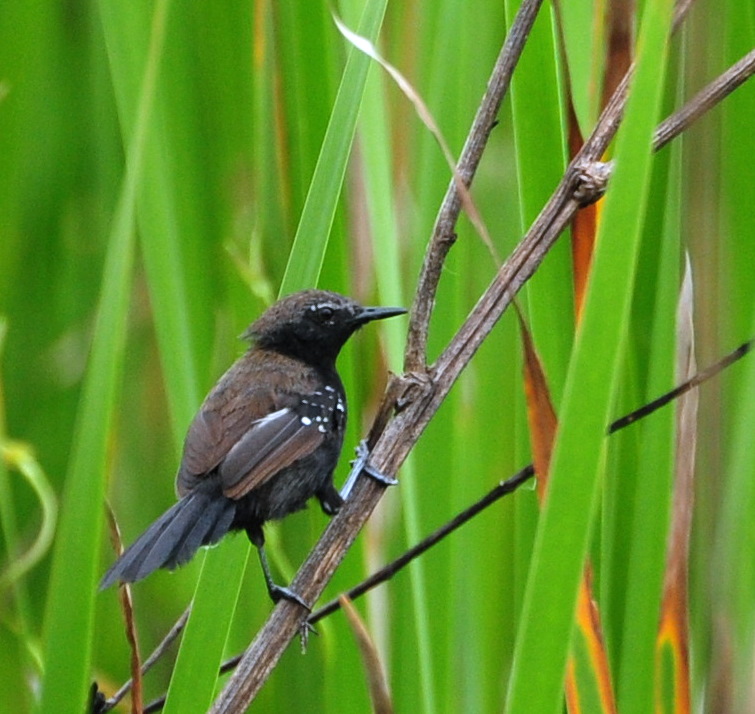
Adult Parana Antwrens exhibit a distinctive plumage that aids in their identification. Males typically have a dark gray upper body with subtle white streaks and a contrasting white underpart. In contrast, females display a browner hue on their upper body with similar streaking but have a paler underbelly. Both sexes possess the sharp, pointed bill characteristic of the species, aiding in their insectivorous diet. Juvenile Parana Antwrens are generally duller in coloration, lacking the pronounced contrast seen in adults.
Differences between males and females are subtle but noticeable on close inspection. Males tend to have a slightly more pronounced contrast between their upper and lower body colors, while females may appear more uniform. When perched, the Parana Antwren maintains a horizontal posture, often flicking its wings and tail in short, rapid movements.
In flight, the Parana Antwren's silhouette is compact, with rounded wings and a short tail, which can lead to confusion with other small passerines. However, its distinct vocalizations and preference for dense marsh vegetation make it easier to identify by behavior and habitat rather than by sight alone.
Having trouble telling birds apart? Upload a photo to our bird identification tool for an instant species match.
Parana Antwren Habitat and Range
Preferred Habitat
The Parana Antwren is predominantly found in the dense marsh vegetation of Brazil's Atlantic coastal regions. These marshes are characterized by a mix of tall grasses, reeds, and shrubs, providing both cover and abundant food resources. This bird prefers lowland areas with elevations typically below 100 meters, where the marshland is most prevalent.
Unlike many other species, the Parana Antwren does not exhibit significant seasonal habitat shifts, remaining in these marshes year-round. It is absent from urban areas, as its habitat requirements are not met in developed environments. Conservation of its habitat is crucial, as marshland degradation poses a significant threat.
Although primarily restricted to natural marshlands, the Parana Antwren can occasionally be found in adjacent areas with similar vegetation, especially during periods of excessive rainfall when the marshes expand. This adaptability, however, is limited, reinforcing its dependence on intact marsh ecosystems.
Geographic Range
The Parana Antwren's range is restricted to the coastal marshes of southern Brazil, specifically within the states of Paraná and Santa Catarina. It does not migrate, making it a year-round resident of its range. This limited distribution underscores its vulnerability to habitat loss and environmental changes.
Within its range, the Parana Antwren is most commonly observed in dense marsh vegetation, where it maintains its territory throughout the year. Population density is highest in regions where marshland is well-preserved, such as the protected reserves within its range.
The bird's presence outside these core areas is rare, as its specific habitat requirements are not met elsewhere. Conservation efforts focus on these key regions, aiming to preserve and restore the marsh habitats critical for its survival.
Want to know which birds visit your area? Browse our backyard birds by location guides for region-specific species lists.
What Does the Parana Antwren Eat?
The Parana Antwren primarily feeds on insects, employing a variety of foraging techniques to capture its prey. Its diet consists mainly of small arthropods, including ants, beetles, and spiders. During the rainy season, when insect activity increases, the Parana Antwren's feeding rate intensifies to take advantage of the abundance of prey.
Foraging behavior includes gleaning insects from foliage and capturing prey in mid-air with agile maneuvers. The sharp bill of the Parana Antwren is well-suited for probing into crevices and extracting hidden insects. Its feeding schedule is most active during the morning and late afternoon, coinciding with peak insect activity.
Seasonal changes in diet are minimal, as the Parana Antwren remains in its marshland habitat year-round. However, slight variations may occur based on prey availability, with occasional consumption of small fruits or seeds when insects are scarce.
Parana Antwren Behavior and Social Structure
The Parana Antwren exhibits a complex social structure, often forming small family groups or joining mixed-species flocks. These flocks provide mutual benefits, such as increased protection from predators and enhanced foraging efficiency. Within these groups, the Parana Antwren maintains a territorial nature, defending its feeding grounds from intruders.
Courtship displays are subtle, involving vocalizations and synchronized movements between pairs. The Parana Antwren is monogamous, with pairs forming strong bonds that last through multiple breeding seasons. During the breeding season, males may engage in more conspicuous displays to deter rivals and reinforce pair bonds.
Though generally quiet, the Parana Antwren becomes more vocal in response to predators, using alarm calls to alert group members. Its daily activity patterns revolve around foraging and territorial defense, with peak activity occurring during cooler parts of the day.
Parana Antwren Nesting and Reproduction
The Parana Antwren constructs its nest in dense marsh vegetation, typically choosing sites well-concealed by tall grasses and reeds. Its nest is a delicate cup-shaped structure made from plant fibers, lined with softer materials for insulation. The location preference for nesting sites includes areas with minimal human disturbance, ensuring the safety of the eggs and chicks.
The typical clutch size is two to three eggs, with both parents sharing incubation duties over a period of approximately 14 days. Once hatched, the chicks receive care and feeding from both parents until they fledge, usually around 12-14 days after hatching.
Parana Antwrens may raise multiple broods per year if conditions are favorable, with the potential for two breeding cycles during the lengthy breeding season. Parental roles are shared equally, with both male and female contributing to nest building, incubation, and chick rearing.
Parana Antwren Sounds and Vocalizations
The primary song of the Parana Antwren is a series of sharp, staccato notes delivered in a rapid sequence. The song's rhythm is consistent, with a slightly rising pitch that distinguishes it from other marshland birds. Call notes are short and sharp, often used for communication between mates and group members.
Alarm calls are more urgent and repetitive, used to warn of potential threats. During the dawn chorus, the Parana Antwren's song blends into the symphony of marshland birdcalls, providing an atmospheric backdrop to the morning soundscape.
Compared to more melodious songbirds, the Parana Antwren's vocalizations are more functional than aesthetic, serving primarily as a means of communication and territory defense.
Interesting Facts About the Parana Antwren
- 1The Parana Antwren was only discovered in 1995, highlighting the ongoing importance of ornithological exploration.
- 2Despite its rarity, the Parana Antwren is crucial in controlling insect populations within its marshland habitat.
- 3Its sharp bill is not only a key identifier but also an essential tool for its insectivorous diet.
- 4The Parana Antwren is one of the few bird species endemic to the Atlantic coastal marshes of Brazil.
- 5This bird's presence in mixed-species flocks exemplifies its adaptive social behavior for survival.
- 6The Parana Antwren is often used as an indicator species for the health of marshland ecosystems.
- 7Its vocalizations, though functional, are distinct enough to aid birdwatchers in identifying its presence.
Parana Antwren Conservation Status
The Parana Antwren is currently listed as Vulnerable on the IUCN Red List due to its limited range and habitat dependency. Its population trend is declining, primarily due to habitat loss from agricultural expansion and urban development. Marshland drainage and pollution further exacerbate the threats to its survival. Conservation efforts focus on habitat protection and restoration, with several protected areas established within its range to safeguard critical marshland habitats. These efforts include reforestation projects and land management practices aimed at preserving the unique wetland ecosystems. Historically, the Parana Antwren population faced fluctuations due to environmental changes, but recent conservation actions offer hope for stabilization. Continued efforts are essential to ensure the long-term survival of this rare and valuable species.
Other Thamnophilidae Species



Birds Similar to the Parana Antwren
These species are often confused with the Parana Antwren due to similar appearance or overlapping range.

