
Russet Antshrike
Thamnistes anabatinus
Order: Passeriformes / Family: Thamnophilidae
Wikimedia Commons
About the Russet Antshrike
The Russet Antshrike, known scientifically as Thamnistes anabatinus, inhabits the lush tropical and subtropical regions of Central America, from southern Mexico through Panama. This bird is a member of the antbird family, Thamnophilidae, and plays a crucial ecological role within its habitat. As an insectivorous bird, it contributes to the control of insect populations, which helps maintain a balanced ecosystem. The Russet Antshrike is often observed foraging in mixed-species flocks, a behavior that enhances feeding efficiency and offers protection from predators.
The Russet Antshrike exhibits a preference for mid-level to upper canopy layers in its forested environment. This bird thrives in both primary and secondary forests, demonstrating adaptability to habitat changes. Despite this adaptability, the species relies heavily on the availability of dense, continuous forest cover for nesting and feeding. The decline in such habitats due to deforestation and agricultural expansion poses a significant threat to its population.
Seasonally, the Russet Antshrike displays specific behaviors that align with its reproductive cycle. During the breeding season, which typically occurs in the wet season, the bird's activity levels increase as it engages in courtship displays and territorial defense. Outside the breeding season, the bird maintains its role in the ecosystem by continuing its foraging activities, albeit with a slight shift in diet composition to accommodate seasonal variations in insect availability. This seasonal adaptability underscores the Russet Antshrike's resilience and its importance within its ecological niche.
The Russet Antshrike belongs to the family Thamnophilidae, within the order Passeriformes. These birds typically live average 5-7 years, with a maximum recorded of 9 years..
How to Identify a Russet Antshrike
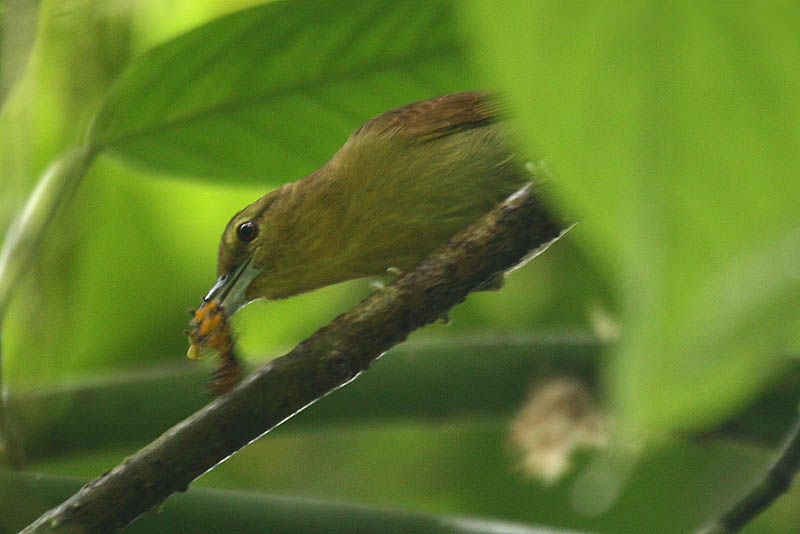
The Russet Antshrike is a small bird, approximately 14 cm in length, with a distinctive russet-colored plumage that serves as its primary identifying feature. The adult bird displays a rich, reddish-brown coloration across its back, wings, and tail, with a slightly paler hue on the underparts. The head is adorned with a subtle crest that can be raised during displays or when alarmed.
Juvenile Russet Antshrikes appear duller than adults, with a more muted brown coloration and less pronounced crest. Male and female Russet Antshrikes exhibit similar plumage, making gender differentiation challenging without closer behavioral observation during the breeding season when specific roles are more apparent.
In terms of field identification, the Russet Antshrike can be confused with other small brown birds in its range, such as the Plain Antvireo. However, the Russet Antshrike's more vibrant plumage and distinctive vocalizations help distinguish it in the field. Its perching posture is upright, often seen in the middle to upper canopy where it flits between branches with a characteristic flicking motion of its tail.
Having trouble telling birds apart? Upload a photo to our bird identification tool for an instant species match.
Russet Antshrike Habitat and Range
Preferred Habitat
The Russet Antshrike predominantly occupies humid tropical and subtropical forests, making its home in both primary and secondary growth areas. It can be found at elevations ranging from sea level to about 1500 meters, favoring mid-elevation forests that offer dense canopy cover.
These birds display considerable adaptability, inhabiting both lowland rainforests and cloud forests. While they can occasionally be found in fragmented forests, they are less common in heavily disturbed areas or near urban environments. The Russet Antshrike's dependency on forested habitats underscores the importance of conservation efforts to preserve these ecosystems.
During seasonal shifts, the Russet Antshrike may adjust its microhabitat preferences slightly, seeking out areas with increased insect availability to sustain its dietary needs. However, significant habitat changes pose challenges to this species, emphasizing the need for habitat connectivity.
Geographic Range
The Russet Antshrike's range extends from southern Mexico, through the entirety of Central America, reaching as far south as western Panama. This bird is most prevalent in countries such as Guatemala, Costa Rica, and Honduras, where suitable forest habitats are abundant.
Unlike some migratory species, the Russet Antshrike is considered a year-round resident within its range. It does not undertake long-distance migrations, although local movements may occur in response to variations in food availability or breeding requirements.
Within its range, population densities can vary significantly, with higher concentrations typically found in well-preserved forested regions. The stability of the Russet Antshrike's population is closely tied to the health of these habitats, which are increasingly threatened by human activities such as logging and land conversion for agriculture.
Want to know which birds visit your area? Browse our backyard birds by location guides for region-specific species lists.
What Does the Russet Antshrike Eat?
The Russet Antshrike primarily feeds on insects, making it an important insectivore in its ecosystem. Its diet consists of small arthropods, including ants, beetles, and caterpillars, which it skillfully extracts from foliage and bark.
During the wet season, when insect populations are at their peak, the Russet Antshrike takes advantage of the abundance to feed more actively and support its breeding activities. In the dry season, the bird may broaden its dietary intake slightly, incorporating other invertebrates such as spiders to compensate for the reduced availability of some insect species.
Foraging typically occurs in the middle to upper layers of the forest canopy, where the bird employs a methodical gleaning technique. It moves through vegetation with agility, using its sharp beak to probe leaves and twigs for hidden prey. This feeding behavior not only provides sustenance but also helps regulate insect populations within its habitat.
Russet Antshrike Behavior and Social Structure
The Russet Antshrike displays a range of social behaviors, often seen participating in mixed-species flocks that include other insectivorous birds. These flocks provide increased foraging efficiency and reduced predation risk, illustrating the antshrike's cooperative nature.
Territorial behavior is prominent during the breeding season, with pairs defending their chosen nesting areas vigorously against intruders. Courtship displays involve subtle vocalizations and physical displays, such as crest raising and wing flicking, to attract mates and establish pair bonds.
Daily activity for the Russet Antshrike peaks during the cooler morning and late afternoon hours, aligning with the availability of prey. Its response to predators includes swift retreats into dense foliage and reliance on its cryptic plumage for concealment. The Russet Antshrike's adaptability in social and territorial interactions showcases its dynamic role within the forest ecosystem.
Russet Antshrike Nesting and Reproduction
The nesting behavior of the Russet Antshrike involves constructing a small, cup-shaped nest made from twigs, grasses, and leaves. These nests are typically situated in the fork of a tree branch, well-concealed by foliage to protect against predators.
The breeding season generally coincides with the wet season, when food resources are abundant. A typical clutch consists of two to three eggs, which both parents take turns incubating over a period of about 14-16 days. After hatching, the chicks remain in the nest for an additional 10-12 days before fledging.
Both male and female Russet Antshrikes share in the responsibilities of feeding and protecting the young, demonstrating a strong parental partnership. The cooperative nature of their nesting behavior contributes to the survival and success of their offspring.
Russet Antshrike Sounds and Vocalizations
The Russet Antshrike's vocalizations are distinct, consisting of a series of sharp, clear whistles that rise and fall in pitch. These calls serve various functions, from territory defense to communication between mates and within flocks.
Its primary song can be described as a repetitive, rhythmic series of notes that carry well through the dense forest canopy. Alarm calls are shorter and more abrupt, alerting other birds to potential threats. During the dawn chorus, the Russet Antshrike's song adds to the rich tapestry of forest sounds, helping establish its presence and territorial boundaries.
Interesting Facts About the Russet Antshrike
- 1The Russet Antshrike is known to join mixed-species flocks, enhancing its foraging efficiency by up to 30%.
- 2Despite its small size, around 14 cm, the Russet Antshrike's crest can make it appear larger when alarmed.
- 3These birds often use their sharp beaks to pry insects from tree bark, demonstrating remarkable dexterity.
- 4The Russet Antshrike's song pattern is so recognizable that it helps ornithologists track territorial boundaries.
- 5They play a critical role in their ecosystem by controlling insect populations, crucial for forest health.
- 6The Russet Antshrike can be distinguished from similar species by its unique vocalizations, a key field mark for birders.
- 7Their nests are well-camouflaged, often built at heights ranging from 1.5 to 5 meters above ground.
Russet Antshrike Conservation Status
The Russet Antshrike currently holds a conservation status of Least Concern according to the IUCN. However, the species' reliance on forest habitats makes it vulnerable to deforestation and habitat degradation. Despite a relatively stable population trend, continued habitat loss poses a significant threat to long-term viability. Conservation efforts focus on preserving and restoring forest habitats, as well as promoting sustainable land use practices in regions where the antshrike is found. Historical population changes are not well-documented, but ongoing monitoring is essential to ensure the Russet Antshrike remains a thriving component of its ecosystem. Conservation strategies must address both habitat protection and the broader environmental challenges impacting the species.
Other Thamnophilidae Species



Birds Similar to the Russet Antshrike
These species are often confused with the Russet Antshrike due to similar appearance or overlapping range.
