
Silvered Antbird
Sclateria naevia
Order: Passeriformes / Family: Thamnophilidae

Wikimedia Commons
About the Silvered Antbird
The Silvered Antbird (Sclateria naevia) is a fascinating member of the Thamnophilidae family, notable for its adaptation to the dense undergrowth of tropical forests. This species is predominantly found in the Amazon Basin, extending into the Orinoco Basin and reaching as far north as Venezuela and Colombia. The Silvered Antbird plays a significant ecological role as an insectivore, actively participating in the control of insect populations within these ecosystems. Its presence in the rainforest contributes to the intricate web of life, as it often follows army ant swarms to capture prey flushed by the ants. This behavior not only impacts its prey but also indirectly influences the distribution and abundance of other insectivorous species within its habitat. Throughout the year, the Silvered Antbird exhibits variations in its behavior and habitat use. During the breeding season, which usually coincides with the onset of the rainy season, these birds become more territorial. Males establish and defend their territories through vocalizations and displays, ensuring access to optimal nesting sites and food resources. Outside of the breeding season, the Silvered Antbird may exhibit more flexible habitat use, sometimes venturing into slightly less dense forest areas. As a resident species, it does not partake in long migratory movements, yet its local seasonal movements are influenced by resource availability and the dynamics of the rainforest environment. The Silvered Antbird is an integral part of its ecosystem, contributing to both the balance and the biodiversity of the rainforest through its feeding habits and its interactions with other species. Its reliance on specific habitats underscores the importance of rainforest conservation in maintaining not only this species but also the broader ecological processes that sustain these complex environments.
The Silvered Antbird belongs to the family Thamnophilidae, within the order Passeriformes. These birds typically live average 3-4 years with a maximum recorded of 7 years..
How to Identify a Silvered Antbird
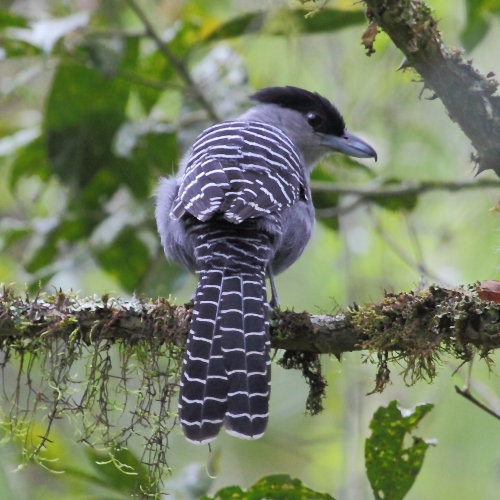
Identifying the Silvered Antbird requires attention to its distinctive features. Adult birds showcase a striking combination of gray and white plumage, with a contrasting white belly and a subtle silver sheen on their upperparts. The males and females appear similar in plumage, making sex differentiation challenging in the field. Juvenile Silvered Antbirds, however, can be distinguished by their slightly duller and less defined plumage. They lack the full silver gloss that characterizes the adults, appearing more subdued in coloration. When observing the Silvered Antbird in its natural habitat, its posture and behavior can aid in identification. This bird often perches low in dense vegetation, rarely ascending above eye level. It demonstrates a distinctive skulking behavior, moving methodically and quietly through the underbrush. A key field mark is its relatively short tail and rounded wings, which provide a compact silhouette in flight. Confusion with other antbird species can occur, given the Silvered Antbird's preference for similar habitats. However, its unique combination of coloration and behavior, along with vocalizations, aids in distinguishing it from related species. Its call, a series of clear, melodious notes, serves as a reliable clue when visual confirmation is difficult.
Having trouble telling birds apart? Upload a photo to our bird identification tool for an instant species match.
Silvered Antbird Habitat and Range
Preferred Habitat
The Silvered Antbird inhabits tropical lowland rainforests with a particular preference for dense and humid undergrowth. These birds thrive in areas where the forest floor is rich in leaf litter and fallen branches, providing ample cover and feeding opportunities. They are commonly found in regions like the Amazon Basin, which spans countries including Brazil, Peru, and Ecuador, as well as the Orinoco Basin. These habitats are characterized by their high humidity, dense foliage, and proximity to water sources such as streams and rivers. The Silvered Antbird is predominantly a lowland species, typically residing at elevations below 500 meters. Its affinity for dense vegetation means it is rarely seen in open or urban areas, as it relies on the cover and food resources provided by the rainforest. Unlike some other bird species, the Silvered Antbird does not exhibit significant seasonal habitat shifts, maintaining its presence in suitable forested areas year-round. However, it may adjust its exact location within the forest in response to seasonal changes in food availability and habitat conditions.
Geographic Range
The range of the Silvered Antbird encompasses a substantial portion of South America, primarily within the Amazon and Orinoco Basins. This bird is resident in countries such as Brazil, Venezuela, Colombia, Peru, and Ecuador. Its distribution is closely tied to the presence of suitable rainforest habitats, which provide the dense understory that the species favors. Within its range, the Silvered Antbird is considered a non-migratory species, although it may undertake local movements in response to environmental factors such as food availability and habitat changes. Population densities tend to be higher in areas with extensive stretches of intact rainforest, where the ecological conditions align with the bird's habitat requirements. The Silvered Antbird's range does not extend into high-altitude regions or arid environments, reflecting its specialized adaptation to humid forest ecosystems. Despite its relatively broad range, the species is dependent on the conservation of tropical rainforest habitats, which are increasingly threatened by deforestation and habitat fragmentation.
Want to know which birds visit your area? Browse our backyard birds by location guides for region-specific species lists.
What Does the Silvered Antbird Eat?
The diet of the Silvered Antbird consists primarily of insects and other arthropods, reflecting its role as an insectivore within the forest ecosystem. It feeds on a diverse array of prey, including ants, beetles, spiders, and caterpillars. The bird's feeding technique involves foraging close to the ground, often following swarms of army ants. This behavior allows the antbird to capitalize on insects that are disturbed and flushed out by the advancing ants. The Silvered Antbird employs a methodical approach to foraging, moving slowly and deliberately through the underbrush as it searches for prey. Its diet may exhibit some seasonal variation, with the abundance and diversity of prey items fluctuating in response to changes in the forest environment. During the breeding season, the energy demands of raising young may lead to increased foraging activity and a broader diet to meet nutritional needs. The bird is most active in its feeding during the early morning and late afternoon when insects tend to be more active, aligning its behavior with the daily rhythms of its prey.
Silvered Antbird Behavior and Social Structure
The Silvered Antbird exhibits a range of behaviors that reflect its adaptation to life in dense forest environments. Socially, these birds are typically solitary or found in pairs, especially during the breeding season when territoriality is pronounced. Males establish and defend territories through vocalizations, marking their presence with a series of melodious calls. During courtship, the Silvered Antbird may engage in display behaviors, including wing flicking and tail fanning, as part of its mating rituals. These displays are often accompanied by vocalizations, serving to attract and bond with a mate. Outside of the breeding season, the bird may exhibit less territorial behavior, occasionally associating with mixed-species flocks that roam the forest. The Silvered Antbird displays a cautious demeanor, often skulking through the underbrush to avoid detection by predators. Its response to threats involves remaining motionless and relying on its cryptic coloration for camouflage. The bird's daily activity pattern includes periods of heightened activity during the cooler hours of the day, with a tendency to retreat to dense cover during the hottest parts of the afternoon.
Silvered Antbird Nesting and Reproduction
The nesting habits of the Silvered Antbird are closely tied to its forest habitat. Nests are typically constructed low to the ground, often within dense vegetation that provides concealment and protection. The nest itself is a cup-shaped structure, built with materials such as leaves, twigs, and plant fibers, creating a sturdy yet camouflaged platform. The Silvered Antbird typically lays a clutch of two eggs, which are incubated by both parents. The incubation period lasts approximately 14 to 16 days, during which time the adults take turns maintaining the temperature and safety of the eggs. Once hatched, the chicks are cared for by both parents, who share responsibilities in feeding and protecting the young. The fledging period extends for about two weeks, after which the juveniles continue to receive parental care until they are fully independent. The Silvered Antbird usually raises one brood per year, although favorable conditions may occasionally allow for a second. Parental roles are well defined, with both adults contributing to the success of the breeding effort.
Silvered Antbird Sounds and Vocalizations
The vocalizations of the Silvered Antbird are a distinctive aspect of its presence in the forest. Its primary song consists of a series of clear, melodious notes that are repeated with a rhythmic cadence. This song serves both as a means of territory advertisement and a tool for attracting a mate. In addition to its song, the Silvered Antbird produces a variety of call notes, including sharp, short chips that function as communication between individuals. Alarm calls are typically more abrupt and harsh, designed to alert conspecifics to potential threats. During the dawn chorus, the Silvered Antbird's song contributes to the rich tapestry of sounds that characterize the rainforest mornings. Its vocalizations, while not as varied as some other songbirds, are an integral part of its behavioral repertoire, reflecting its ecological niche and social interactions.
Interesting Facts About the Silvered Antbird
- 1The Silvered Antbird often follows army ant swarms, a behavior seen in many antbird species, to catch prey flushed by the ants.
- 2Despite its small size, the Silvered Antbird plays a significant role in controlling insect populations in its rainforest habitat.
- 3The Silvered Antbird is a non-migratory species, residing year-round in the same tropical forest areas, unlike many other birds.
- 4Both male and female Silvered Antbirds participate in incubating the eggs and feeding the chicks, sharing parental duties equally.
- 5The bird's song, a series of clear and melodious notes, is used to establish territory and attract mates during the breeding season.
- 6The Silvered Antbird's habitat preference for dense undergrowth makes it less visible, often heard before it is seen in the wild.
- 7The species' reliance on rainforest environments underscores the importance of conservation efforts to protect these vital ecosystems.
Silvered Antbird Conservation Status
The Silvered Antbird is currently listed as a species of Least Concern by the IUCN, with its population considered stable. However, the primary threat to this bird stems from habitat destruction, particularly the deforestation and fragmentation of tropical rainforests. Conservation efforts are crucial in preserving the integrity of the bird's habitat, as large-scale logging and agricultural expansion continue to threaten these ecosystems. While the Silvered Antbird appears resilient within its range, ongoing habitat loss could impact local populations. Historical population changes have been closely tied to habitat availability, emphasizing the importance of protected areas and sustainable land-use practices in the bird's range. Conservation initiatives aimed at preserving rainforest habitats will not only benefit the Silvered Antbird but also a myriad of other species that depend on these rich and diverse ecosystems.
Other Thamnophilidae Species



Birds Similar to the Silvered Antbird
These species are often confused with the Silvered Antbird due to similar appearance or overlapping range.

