
Spot-backed Antshrike
Hypoedaleus guttatus
Order: Passeriformes / Family: Thamnophilidae

Wikimedia Commons
About the Spot-backed Antshrike
The Spot-backed Antshrike (Hypoedaleus guttatus) is a remarkable bird endemic to the Atlantic Forest of southeastern Brazil. This species belongs to the family Thamnophilidae, known for their active foraging behavior and distinctive vocalizations. The Spot-backed Antshrike is an essential component of its ecosystem, playing a vital role in controlling insect populations. It occupies dense forest habitats, particularly favoring areas with substantial understory vegetation. These birds are primarily found in lowland forests, although they may occasionally venture into montane regions.
Spot-backed Antshrikes are non-migratory, residing year-round in their preferred habitats. They exhibit a preference for primary and well-preserved secondary forests, indicating their sensitivity to habitat degradation. The species thrives in areas where human impact is minimal, highlighting the importance of conservation efforts in preserving these pristine environments. The Spot-backed Antshrike contributes to the ecological complexity of the Atlantic Forest by participating in food webs as both predator and prey, maintaining the balance of its ecosystem.
During the breeding season, Spot-backed Antshrikes display increased vocal activity. Their songs and calls are often heard as they establish territories and attract mates. The breeding season coincides with the rainy months, suggesting that the availability of resources influences their reproductive timing. The presence of this antshrike signifies a healthy, biodiverse forest, as it relies on intact habitats to sustain its populations. Conservation of the Atlantic Forest is thus crucial not only for the Spot-backed Antshrike but for countless other species that share this unique environment.
The Spot-backed Antshrike belongs to the family Thamnophilidae, within the order Passeriformes. These birds typically live average 5 years with max recorded 8 years.
How to Identify a Spot-backed Antshrike
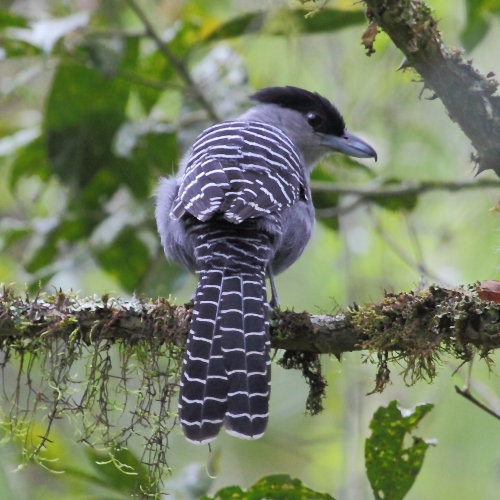
The Spot-backed Antshrike is a medium-sized bird, measuring about 20 cm in length. Both males and females feature a distinctive pattern of white spots on a dark back, which gives the species its common name. The males typically exhibit a more contrasting plumage, with a blackish head and upperparts adorned with striking white spots, while the underparts are lighter with fine barring. Females, on the other hand, have a slightly browner tinge on their upperparts, but still display the characteristic spotting.
Juveniles resemble adults but tend to have a less pronounced contrast in their plumage. Over time, their spots become more defined as they mature. The Spot-backed Antshrike can be confused with other antshrike species in its range, such as the Tufted Antshrike or the Giant Antshrike. However, its size and specific spot pattern help distinguish it from these relatives.
In flight, the Spot-backed Antshrike appears robust and short-winged, typical of birds that prefer dense foliage. When perched, it often adopts an upright posture, using its strong legs to navigate through the understory. This posture, coupled with its distinctive vocalizations, can aid birders in identifying the species even in the thickest forest habitats.
Having trouble telling birds apart? Upload a photo to our bird identification tool for an instant species match.
Spot-backed Antshrike Habitat and Range
Preferred Habitat
The Spot-backed Antshrike inhabits the Atlantic Forest, a biodiversity hotspot in southeastern Brazil. It prefers dense, humid forests with a substantial understory, favoring primary forests but also residing in well-preserved secondary growths. These birds are typically found at low to mid-elevations, although they can occasionally be seen in higher montane forests. Seasonal changes do not significantly affect their habitat preferences, as they remain year-round residents of these environments.
Unlike some other antbird species, the Spot-backed Antshrike does not frequently venture into open areas or heavily disturbed habitats. Its presence in pristine forest areas underscores the importance of protecting these ecosystems. While urban areas encroach upon many parts of the Atlantic Forest, the Spot-backed Antshrike remains a predominantly forest-dwelling species, relying on the dense canopy and understory to thrive.
Geographic Range
The Spot-backed Antshrike is endemic to southeastern Brazil, with its range primarily restricted to the Atlantic Forest biome. Its distribution spans several Brazilian states, including Rio de Janeiro, São Paulo, Minas Gerais, Espírito Santo, and Paraná. Within these regions, the species is a resident breeder, maintaining year-round territories in suitable habitats.
Due to its specific habitat requirements, the Spot-backed Antshrike is not found outside its native range, making it a species of particular interest to conservationists. The bird's range does not extend beyond Brazil, and it does not partake in long-distance migrations. However, local movements within its range may occur in response to seasonal food availability or habitat conditions.
Population densities of the Spot-backed Antshrike can vary, with higher concentrations found in undisturbed, protected forest areas. Conservation efforts in regions such as the Serra do Mar and the Serra da Mantiqueira are critical for maintaining viable populations of this species.
Want to know which birds visit your area? Browse our backyard birds by location guides for region-specific species lists.
What Does the Spot-backed Antshrike Eat?
The Spot-backed Antshrike primarily feeds on insects and other small arthropods, playing a crucial role in controlling insect populations within its habitat. Its diet includes a variety of prey such as ants, beetles, spiders, and caterpillars. The bird forages actively in the forest understory, often joining mixed-species flocks to exploit feeding opportunities.
Foraging behavior involves methodical searching through leaves and branches, using its strong bill to uncover hidden insects. The Spot-backed Antshrike employs a technique known as "sit-and-wait," where it pauses intermittently to scan for movement before striking quickly at prey. This method is particularly effective in the dense foliage of the Atlantic Forest.
Seasonal variations in food availability can influence the diet of the Spot-backed Antshrike, with certain prey types becoming more prevalent during the rainy season when insect activity peaks. Despite these changes, the bird remains a consistent predator of forest arthropods, contributing to the ecological balance of its environment.
Spot-backed Antshrike Behavior and Social Structure
The Spot-backed Antshrike is a territorial and generally solitary bird, although it can sometimes be seen in pairs, particularly during the breeding season. Males maintain and defend territories through vocalizations and displays, ensuring access to resources and suitable nesting sites. This territorial behavior is most pronounced during the breeding season, when competition for mates and nesting sites intensifies.
Courtship displays involve a combination of vocalizations and visual displays, with males often performing a series of calls and postures to attract females. Once a pair bond is established, the pair remains together for the breeding season, working cooperatively to raise their young.
Spot-backed Antshrikes are diurnal, with peak activity occurring during the early morning and late afternoon. This pattern aligns with periods of high insect activity, optimizing their foraging success. In response to predators, these birds rely on their cryptic plumage and the dense forest canopy to evade detection. Their ability to blend seamlessly into their surroundings offers them protection from avian and terrestrial predators.
Spot-backed Antshrike Nesting and Reproduction
Spot-backed Antshrikes construct cup-shaped nests, usually placed low in the dense understory vegetation. Nests are crafted from twigs, leaves, and plant fibers, with careful attention to camouflage to avoid detection by predators. The nests are typically positioned in a fork of a shrub or small tree, providing stability and concealment.
The typical clutch size for the Spot-backed Antshrike is two to three eggs. Both parents share the responsibility of incubating the eggs, which usually hatch after approximately two weeks. Once hatched, the chicks are altricial, requiring considerable parental care. Both parents participate in feeding and protecting the young, ensuring their survival in the competitive forest environment.
Fledging occurs about two to three weeks after hatching, with the young remaining under parental care for several more weeks as they develop the skills necessary for independent survival. The Spot-backed Antshrike generally raises one brood per year, although favorable conditions may allow for a second.
Spot-backed Antshrike Sounds and Vocalizations
The primary song of the Spot-backed Antshrike is a series of rhythmic, repetitive whistles, each note delivered with a distinct pause. The pitch is medium, and the quality is clear and penetrating, often described as a "whip-whip-whip" sound. These vocalizations are most prominent at dawn and dusk, when the birds are actively establishing territories and communicating with mates.
Apart from their song, Spot-backed Antshrikes produce various call notes, including sharp "chip" sounds used for communication between mates and alerting to danger. Their alarm calls are more abrupt and can trigger a response from other forest inhabitants, signaling the presence of a predator.
The Spot-backed Antshrike's vocalizations are a key aspect of its behavior, providing important information about territory, mating status, and environmental threats. Birders often rely on these sounds to locate and identify the species in the dense forest habitat.
Interesting Facts About the Spot-backed Antshrike
- 1The Spot-backed Antshrike is one of the largest members of the Thamnophilidae family, measuring about 20 cm in length.
- 2Despite its striking appearance, the Spot-backed Antshrike is notoriously elusive, often remaining hidden in dense foliage.
- 3The scientific name, Hypoedaleus guttatus, refers to the bird's spotted back, with "guttatus" meaning 'spotted' in Latin.
- 4Spot-backed Antshrikes are often heard before they are seen, thanks to their distinctive and far-reaching calls.
- 5These birds play a crucial role in their ecosystem by controlling insect populations, particularly ants and beetles.
- 6The Atlantic Forest, home to the Spot-backed Antshrike, is one of the most endangered rainforests in the world.
- 7Spot-backed Antshrikes have been observed participating in mixed-species foraging flocks, increasing their foraging efficiency.
Spot-backed Antshrike Conservation Status
The Spot-backed Antshrike is currently listed as Least Concern by the IUCN, but its population is decreasing due to habitat loss. The primary threat to this species is deforestation, driven by agriculture, urban expansion, and logging. The Atlantic Forest, its only habitat, has been reduced to a fraction of its original size, putting pressure on all forest-dependent wildlife. Conservation efforts focus on protecting and restoring the remaining forest fragments, with several protected areas established to conserve biodiversity in this region. Initiatives such as reforestation projects and the establishment of biological corridors aim to connect isolated populations and enhance genetic diversity. Historically, the Spot-backed Antshrike's range was much more extensive, but human activities have significantly restricted its distribution. Continued conservation action is vital to ensure this species remains a vibrant part of the Atlantic Forest ecosystem.
Other Thamnophilidae Species



Birds Similar to the Spot-backed Antshrike
These species are often confused with the Spot-backed Antshrike due to similar appearance or overlapping range.

