
Starred Wood-Quail
Odontophorus stellatus
Order: Galliformes / Family: Odontophoridae

Wikimedia Commons
About the Starred Wood-Quail
The Starred Wood-Quail (Odontophorus stellatus) is a striking bird native to South America, recognized for its vibrant plumage and elusive nature. Found primarily in the Amazon Basin, it inhabits the dense understories of tropical rainforests in countries such as Brazil, Peru, and Ecuador. Its presence in these diverse ecosystems highlights its ecological significance as both a consumer of forest-floor vegetation and a source of prey for larger predators. This bird contributes to the complex food web that sustains the biodiversity of these regions. The Starred Wood-Quail's ecological role extends beyond its immediate environment. By foraging on the forest floor, it aids in seed dispersal, an essential process for maintaining the health and regeneration of tropical forests. Its diet consists largely of seeds, fruits, and small invertebrates, making it a critical player in the nutrient cycle of its habitat. As a forest-dwelling species, the Starred Wood-Quail is particularly sensitive to habitat changes. Deforestation and habitat fragmentation pose significant threats to its populations. Conservation efforts aim to preserve the remaining forested areas of the Amazon Basin, ensuring that this quail, along with countless other species, can continue to thrive. During the breeding season, which coincides with the rainy months, the Starred Wood-Quail becomes more vocal, using its calls to establish territory and attract mates. Outside of this period, it remains relatively quiet, relying on the dense foliage for protection from predators. Its elusive nature makes it a challenging yet rewarding species for birders and researchers alike.
The Starred Wood-Quail belongs to the family Odontophoridae, within the order Galliformes. These birds typically live average 5-7 years, with a maximum recorded of 10 years..
How to Identify a Starred Wood-Quail
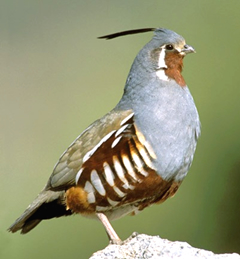
The Starred Wood-Quail exhibits a unique and vivid plumage that aids in its identification. Adults display a striking combination of red and white speckles covering their upperparts, lending them a starry appearance, which is the basis for their common name. Their underparts are generally a warm brown, a coloration that provides camouflage against the forest floor. Males and females are similar in appearance, though the male may exhibit slightly brighter and more distinct markings. Juveniles differ from adults, showing a more subdued pattern with less contrast, aiding in their concealment as they mature. In flight, the Starred Wood-Quail presents a compact silhouette, characterized by rounded wings and a short tail. This flight profile is typical of quails, built for quick bursts of speed rather than sustained flight. When perched, this bird often adopts a crouched posture, blending seamlessly into its surroundings. Confusion with other species, such as the Rufous-breasted Wood-Quail, can occur, but the Starred Wood-Quail's distinctive star-like markings and slightly larger size serve as distinguishing features.
Having trouble telling birds apart? Upload a photo to our bird identification tool for an instant species match.
Starred Wood-Quail Habitat and Range
Preferred Habitat
The Starred Wood-Quail primarily inhabits the lowland tropical rainforests of the Amazon Basin, thriving in the dense undergrowth that characterizes these regions. It favors areas with thick foliage and ample leaf litter, providing both food resources and cover from predators. This bird occupies elevations from sea level up to 1,500 meters, although it is most commonly found in the lower elevations. Seasonal habitat shifts are minimal, as it remains within the forest throughout the year, relying on the consistent climate of the tropics. Unlike some quail species that adapt to suburban or agricultural environments, the Starred Wood-Quail is strictly a forest dweller, rarely venturing into open areas or human-altered landscapes. Its dependence on intact forest ecosystems makes it particularly vulnerable to deforestation and habitat fragmentation.
Geographic Range
The range of the Starred Wood-Quail extends across the vast expanse of the Amazon Basin, with populations distributed throughout Brazil, Peru, Ecuador, and Colombia. This bird is a year-round resident, exhibiting no significant migratory behavior. Within its range, the highest population densities are found in remote areas where the forest remains largely undisturbed by human activity. In Brazil, the states of Amazonas and Acre host significant populations, while in Peru, it can be observed in the Manu National Park. The bird's range does not extend significantly beyond the Amazon Basin, as it requires the specific habitat conditions found within these tropical forests. Despite its relatively stable presence in these regions, localized declines have been noted due to habitat loss.
Want to know which birds visit your area? Browse our backyard birds by location guides for region-specific species lists.
What Does the Starred Wood-Quail Eat?
The diet of the Starred Wood-Quail is diverse, reflecting its role as both a seed disperser and a consumer of invertebrates. Primary food sources include seeds and fruits, which it forages from the forest floor. In addition to plant material, it consumes a variety of insects and small invertebrates, providing essential protein and other nutrients. Seasonal variations in food availability influence its diet, with a greater reliance on fruits during the wet season when they are most abundant. The quail forages in small groups, using its strong legs to scratch through leaf litter and uncover hidden morsels. It feeds primarily during the early morning and late afternoon, avoiding the midday heat.
Starred Wood-Quail Behavior and Social Structure
Socially, the Starred Wood-Quail often forms small coveys, consisting of family groups that forage and travel together. These groups maintain a degree of territoriality, defending their chosen area from rival coveys with vocalizations and displays. Courtship involves the male performing a series of displays, including puffing up his plumage and calling to attract a mate. Once paired, the bond between mates is strong, with both parents playing a role in raising their young. Flocking behavior is most evident outside of the breeding season, as the birds gather to forage more efficiently and protect against predators. In the face of danger, the Starred Wood-Quail relies on its camouflage and the dense forest to escape detection, resorting to flight only as a last measure. Typically diurnal, it is most active during the cooler parts of the day, retreating to cover during the hottest hours.
Starred Wood-Quail Nesting and Reproduction
Nesting for the Starred Wood-Quail occurs on the ground, where it constructs a simple nest hidden among dense vegetation. The nest consists of a shallow depression lined with leaves and other plant materials, providing insulation and camouflage. Clutch size varies but typically consists of 4 to 6 eggs, which are incubated by both parents. The incubation period lasts approximately 18 to 21 days, after which the chicks hatch. Fledging occurs relatively quickly, with young quails leaving the nest within a week of hatching, though they remain dependent on their parents for several weeks. Typically, the Starred Wood-Quail raises one brood per year, although in favorable conditions, a second clutch may be attempted.
Starred Wood-Quail Sounds and Vocalizations
The vocal repertoire of the Starred Wood-Quail is varied, with the primary song being a series of clear, whistled notes that rise and fall in a rhythmic pattern. This song serves to establish territory and attract mates during the breeding season. In addition to its song, the quail produces a range of call notes, including soft clucks and whistles used for communication within the covey. Alarm calls are sharp and urgent, designed to alert family members to potential threats. The dawn chorus is a particularly active time for vocalizations, as the quail greets the new day and reaffirms social bonds. Comparatively, its calls are clear and penetrating, reminiscent of a referee's whistle.
Interesting Facts About the Starred Wood-Quail
- 1Starred Wood-Quails are known for their elusive nature, making them a rare sight for even experienced birders.
- 2These quails are monogamous, often forming lifelong pair bonds with their mates, which is relatively unusual among birds.
- 3Despite their vibrant plumage, Starred Wood-Quails rely heavily on camouflage to avoid predators in their dense forest habitats.
- 4Their distinctive calls can carry long distances through the forest, making them easier to hear than to see.
- 5The Starred Wood-Quail's diet adaptation allows it to thrive in the nutrient-poor soils of the Amazon, aiding in seed dispersal.
Starred Wood-Quail Conservation Status
The Starred Wood-Quail is currently classified as Near Threatened on the IUCN Red List, with populations showing signs of decline due to habitat loss. Deforestation for agriculture and logging poses the most significant threat to its survival, as it results in the fragmentation of the forest habitat it depends on. Conservation efforts focus on preserving large tracts of forest within its range, particularly in protected areas like national parks. Historical data indicate that while the species was once more widespread, its range has contracted due to human encroachment. Community engagement and sustainable land-use practices are crucial for the long-term conservation of this species.
Other Odontophoridae Species


Birds Similar to the Starred Wood-Quail
These species are often confused with the Starred Wood-Quail due to similar appearance or overlapping range.

