
Thamnophilus strigilatus
Thamnophilus strigilatus
Order: Passeriformes / Family: Thamnophilidae

Wikimedia Commons
About the Thamnophilus strigilatus
The barred antshrike, scientifically known as Thamnophilus strigilatus, is an intriguing member of the Thamnophilidae family found predominantly in the northern regions of South America. This bird is a classic example of the adaptive success of antbirds, thriving in various forested environments from Venezuela and Colombia to the northern reaches of Brazil, as well as parts of Peru and the eastern regions of Ecuador. The barred antshrike plays a significant role in its ecosystem by maintaining insect populations, thus contributing to the ecological balance within its habitat.
The barred antshrike is a small to medium-sized bird characterized by its striking plumage. The bird is often spotted in the understory and mid-story of tropical and subtropical forests, as well as in secondary growth and scrubby areas. It is particularly adept at navigating dense foliage, which it uses to its advantage during foraging activities. This species exhibits a marked preference for lowland regions, although it can occasionally be found at moderate elevations up to 1200 meters.
Ecologically, the barred antshrike is vital for controlling insect populations. Its diet consists primarily of insects and other arthropods, which it deftly gleans from leaves and branches. This feeding behavior not only regulates insect populations but also aids in the prevention of pest outbreaks that could otherwise damage the flora of its habitat. Additionally, the barred antshrike plays a role in seed dispersal through its ingestion of small fruits, albeit to a lesser extent compared to its insectivorous diet. During the breeding season, males engage in elaborate displays to attract mates, showcasing their vivid baring and emitting their characteristic calls to establish and defend territories.
The Thamnophilus strigilatus belongs to the family Thamnophilidae, within the order Passeriformes. These birds typically live average 5-7 years, with a maximum recorded of 10 years..
How to Identify a Thamnophilus strigilatus
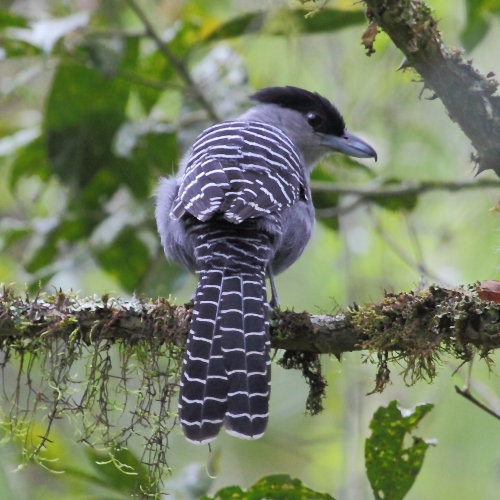
The adult barred antshrike is unmistakable due to its distinctive black and white barred pattern. Males exhibit more pronounced barring, with alternating bands of black and white extending from the crown to the tail. Females, while also barred, display more muted colors with brownish tones replacing the stark black, providing a degree of sexual dimorphism that assists in field identification. The species has a robust build, with a body length of approximately 16 to 18 centimeters and a weight ranging from 25 to 35 grams.
Juveniles resemble females but often show less distinct barring and a more subdued overall coloration. The barred antshrike's stout bill, typical of the Thamnophilidae family, is dark with a slightly hooked tip, adapted for capturing insects. In flight, the barred antshrike demonstrates a flitting, somewhat erratic pattern, often moving in short bursts through the underbrush.
Perched, it maintains an upright posture, with its tail often flicking slightly as it surveys its surroundings. The barred antshrike can be confused with other members of the Thamnophilus genus, particularly in areas where ranges overlap. However, its unique plumage patterns and vocalizations are reliable differentiators.
Having trouble telling birds apart? Upload a photo to our bird identification tool for an instant species match.
Thamnophilus strigilatus Habitat and Range
Preferred Habitat
The barred antshrike thrives in a variety of habitats, ranging from dense tropical rainforests to secondary growth areas. It prefers humid lowland environments but can adapt to subtropical and tropical moist lowland forests. Commonly found in regions with thick underbrush, the barred antshrike frequents areas where it can easily maneuver through dense foliage.
This species is typically found at elevations below 1200 meters, although it is most abundant at lower elevations where vegetation is lush and insect prey is plentiful. The barred antshrike shows remarkable adaptability to human-altered landscapes, often inhabiting forest edges, plantations, and areas of regrowth following deforestation.
Despite its presence in urbanized areas, the barred antshrike remains primarily a forest-dwelling bird, favoring regions where natural vegetation is preserved. Seasonal habitat shifts are minimal, as the species is non-migratory and maintains consistent territory throughout the year.
Geographic Range
The barred antshrike boasts a geographical range that spans several countries in northern South America. Its distribution includes vast areas of Venezuela, Colombia, and the Amazon basin in Brazil. It also inhabits parts of eastern Ecuador and northern Peru, making it a widespread species in these regions.
Primarily a resident bird, the barred antshrike does not engage in long-distance migrations. Instead, it occupies permanent territories where it remains year-round, benefiting from the stable climate and abundant food resources of tropical and subtropical zones. Within its range, the bird is considered fairly common, though population densities can vary based on habitat quality and availability.
In regions where dense forest cover is available, such as the Amazon basin, the barred antshrike is particularly abundant. Conversely, in areas where deforestation has reduced habitat options, local populations may experience declines in density. The bird's adaptability to both primary and secondary forests helps maintain its widespread distribution across its range.
Want to know which birds visit your area? Browse our backyard birds by location guides for region-specific species lists.
What Does the Thamnophilus strigilatus Eat?
The diet of the barred antshrike primarily consists of insects and other arthropods, making it a crucial insectivore within its habitat. It feeds on a variety of prey, including beetles, ants, spiders, and caterpillars, which it captures using a methodical foraging technique known as 'gleaning.' This involves carefully inspecting leaves and branches to find hidden prey.
During the wet season, when insect populations are at their peak, the barred antshrike's diet remains heavily insect-focused. However, during drier periods, when insect numbers may decline, it supplements its diet with small fruits and seeds, although these constitute a minor portion of its overall intake.
The barred antshrike typically forages alone or in pairs, rarely joining mixed-species flocks. Its feeding schedule is diurnal, with peak activity occurring during the early morning and late afternoon when temperatures are cooler and prey is more active.
Thamnophilus strigilatus Behavior and Social Structure
The barred antshrike exhibits a fascinating array of behaviors, characterized by its territorial nature and distinct social structures. It typically forms monogamous pairs that maintain and defend territories year-round. Both males and females participate in territory defense, often with vocal displays and physical posturing to deter rivals.
During the breeding season, courtship involves males performing elaborate displays that highlight their plumage and vocal abilities. These displays include wing-fluttering and tail-fanning, accompanied by the bird's distinctive vocalizations. The barred antshrike is not known to form large flocks, preferring instead to remain within its pair bond or occasionally joining small family groups.
In response to predators, the barred antshrike employs a variety of defensive strategies, including vocal alarms and evasive flight. It maintains a consistent daily activity pattern, with peak periods of foraging and vocalization occurring in the early morning and late afternoon. During midday, when temperatures are highest, the bird often retreats to shaded areas to rest.
Thamnophilus strigilatus Nesting and Reproduction
The barred antshrike constructs a simple, yet effective nest, typically located in dense underbrush or low trees. The nest is a small cup, woven together with twigs, grasses, and leaves, providing camouflage and protection from potential predators. It is usually positioned at heights ranging from 1 to 3 meters above the ground.
Clutch size generally consists of two to three eggs, which are incubated by both parents. The incubation period lasts approximately 14 to 16 days, during which the pair remains vigilant against threats. Upon hatching, both parents partake in feeding and caring for the chicks, ensuring their safety and nourishment.
Fledging occurs around 12 to 14 days post-hatching, when young birds leave the nest but remain dependent on parental care for several additional weeks. The barred antshrike typically raises one brood per year, though in optimal conditions, it may occasionally produce a second.
Thamnophilus strigilatus Sounds and Vocalizations
The barred antshrike is known for its distinctive vocalizations, which serve as a key identifier for birders. Its primary song consists of a series of rapid, sharp notes that rise in pitch and then fall, often described as a 'staccato whistle.' This song is used primarily for territory establishment and mate attraction.
Apart from its song, the barred antshrike also produces a range of call notes, including harsh, chattering sounds used to communicate with its mate or signal alarm. When threatened, it emits a sharp, piercing alarm call that alerts nearby birds to potential danger.
During the dawn chorus, the barred antshrike's calls are especially prominent, contributing a lively and rhythmic element to the soundscape of its habitat. Its vocalizations are similar to, yet distinguishable from, those of other antbird species, aiding in identification.
Interesting Facts About the Thamnophilus strigilatus
- 1The barred antshrike's striking plumage serves as effective camouflage, allowing it to blend into dappled forest light and avoid predators.
- 2Both male and female barred antshrikes participate in aggressive territory defense, using vocal displays to ward off intruders.
- 3Barred antshrikes are often observed in pairs, reflecting their strong monogamous pair bonds which they maintain throughout the year.
- 4Despite their preference for dense forest, barred antshrikes are surprisingly adaptable and can thrive in degraded habitats with sufficient cover.
- 5The barred antshrike's diet primarily consists of insects, but it will opportunistically consume fruits, especially during periods of food scarcity.
- 6Their nests are often well-hidden in dense foliage, a strategy that reduces the risk of predation from tree-dwelling predators.
- 7Barred antshrikes have a distinctive song pattern that can travel long distances through the dense forest, aiding in territory establishment.
Thamnophilus strigilatus Conservation Status
According to the International Union for Conservation of Nature (IUCN), the barred antshrike is currently listed as a species of Least Concern. Its population trend is considered stable, with no major widespread threats identified at present. However, habitat loss due to deforestation and land conversion for agriculture poses localized threats, particularly in areas of rapid environmental change. Conservation efforts focus on preserving forest habitats and promoting sustainable land-use practices to ensure the continued survival of this species. Historically, the barred antshrike has maintained relatively stable population levels, benefiting from its adaptability to secondary growth and modified landscapes. Continued monitoring and habitat protection are essential to maintain its status, particularly in regions experiencing significant ecological pressures.
Other Thamnophilidae Species



Birds Similar to the Thamnophilus strigilatus
These species are often confused with the Thamnophilus strigilatus due to similar appearance or overlapping range.

