
Venezuelan Wood-Quail
Odontophorus columbianus
Order: Galliformes / Family: Odontophoridae

Wikimedia Commons
About the Venezuelan Wood-Quail
The Venezuelan Wood-Quail (Odontophorus columbianus) is a striking galliform bird found primarily in the montane forests of Venezuela. This species belongs to the family Odontophoridae and is often sought after by birdwatchers for its vibrant appearance and secretive habits. These wood-quails play a significant ecological role as they help control insect populations and disperse seeds, contributing to forest regeneration. Their habitat ranges from 1000 to 2400 meters in elevation, typically within the cloud forests and dense undergrowth of the Andes. Seasonally, the Venezuelan Wood-Quail may exhibit slight altitudinal movements in response to food availability, but these shifts are minimal, reflecting their largely sedentary nature.
In terms of significance, the Venezuelan Wood-Quail is an indicator species for healthy forest ecosystems. Its presence signifies a balanced habitat with abundant resources and minimal human disturbance. The species' distribution is limited to specific regions, including the Cordillera de Mérida and parts of the Sierra de Perijá. These areas are known for their rich biodiversity and relatively untouched landscapes, making them ideal for the Venezuelan Wood-Quail's survival and breeding needs.
The ecological role of this bird extends beyond its immediate environment. By preying on various insects, the Venezuelan Wood-Quail contributes to pest control, which benefits both plant and animal communities alike. Additionally, through its foraging habits, it inadvertently assists in the dispersion of seeds, thus promoting the spread of plant species across its native range. This symbiotic relationship underscores the bird's importance within its ecosystem and highlights the need for its conservation. As the global climate continues to change, the Venezuelan Wood-Quail's restricted range makes it particularly vulnerable to habitat loss and fragmentation, emphasizing the need for targeted conservation efforts to ensure its continued existence.
The Venezuelan Wood-Quail belongs to the family Odontophoridae, within the order Galliformes. These birds typically live average 5 years with a maximum recorded of 10 years..
How to Identify a Venezuelan Wood-Quail
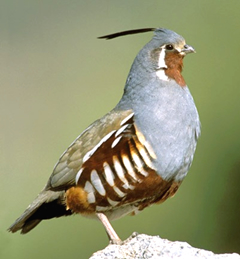
The Venezuelan Wood-Quail exhibits a distinctive plumage that aids in its identification among other forest-dwelling birds. Adults have a rich, chestnut-brown body with intricate black barring on the flanks and back, which provides effective camouflage in their dense, shadowy habitats. The face is marked with a striking pattern of white and black, including a white throat and eye stripe, contrasted by a black crown. Males and females display similar plumage, making sex differentiation challenging in the field.
Juveniles resemble adults but have slightly duller plumage and less pronounced barring, which develops as they mature. The Venezuelan Wood-Quail's robust body and short tail are typical of ground-dwelling birds, adaptations that facilitate their terrestrial lifestyle. In flight, they present a compact silhouette with rapid wingbeats, although they prefer running to flying when escaping threats.
Confusion with similar species can occur, especially with the Black-fronted Wood-Quail (Odontophorus atrifrons), which shares parts of its range. However, the Venezuelan Wood-Quail's distinctive facial markings and overall chestnut hue provide reliable identification features. Observers should note its tendency to remain well-hidden within the underbrush, often revealing its presence through its calls rather than visual cues.
Having trouble telling birds apart? Upload a photo to our bird identification tool for an instant species match.
Venezuelan Wood-Quail Habitat and Range
Preferred Habitat
The Venezuelan Wood-Quail inhabits humid montane forests characterized by thick undergrowth and abundant leaf litter, which provide both food and cover. These forests are typically located at elevations between 1000 and 2400 meters, with the bird favoring areas rich in ferns, mosses, and epiphytes. Such habitats are predominantly found in the Andean regions of Venezuela, including the Cordillera de Mérida and the Sierra de Perijá.
Seasonal habitat shifts are minimal, as the species tends to remain within its preferred altitude range throughout the year. However, slight movements may occur in response to changes in food availability or breeding requirements. The Venezuelan Wood-Quail is rarely found in urban or heavily disturbed areas, as it relies heavily on the dense, continuous canopy and ground cover provided by mature forests.
Unlike some other galliform birds, the Venezuelan Wood-Quail is not typically associated with agricultural landscapes or open areas. Its reliance on intact forest ecosystems underscores the importance of preserving its natural habitat, particularly in light of increasing deforestation and land-use changes in the region.
Geographic Range
The Venezuelan Wood-Quail's range is primarily restricted to the montane forests of northern Venezuela. It is most commonly found in the Cordillera de Mérida, a region known for its diverse avian community and rich biodiversity. Additionally, populations exist within the Sierra de Perijá, a lesser-known yet equally important habitat for this bird.
Unlike many other quail species, the Venezuelan Wood-Quail does not undertake long-distance migrations. Instead, it remains resident within its preferred habitat, with only minor local movements to accommodate seasonal changes in food availability and breeding conditions. The bird's range does not extend into the lowland areas of Venezuela, as it is highly adapted to the cooler, more humid environments of the highlands.
Population density hotspots are primarily centered around protected areas and national parks, where conservation efforts have helped maintain suitable habitats. These include the Sierra Nevada National Park and the Sierra de Perijá National Park, both of which offer critical refuge for the quail and numerous other endemic species.
Want to know which birds visit your area? Browse our backyard birds by location guides for region-specific species lists.
What Does the Venezuelan Wood-Quail Eat?
The diet of the Venezuelan Wood-Quail consists primarily of seeds, fruits, and a variety of insects, reflecting its role as both a forager and seed disperser. During the wet season, when insect activity peaks, the quail's diet shifts to include a higher proportion of invertebrates such as beetles and caterpillars. This opportunistic feeding strategy allows the bird to maintain a balanced diet throughout the year.
In the dry season, seeds and fruits become more prevalent in the quail's diet, as these food sources remain abundant even when insect numbers decline. The Venezuelan Wood-Quail forages primarily on the forest floor, using its strong legs and short tail to efficiently overturn leaf litter and uncover hidden prey.
Prey size varies, but the Venezuelan Wood-Quail typically targets small to medium-sized insects and arthropods. Its feeding schedule is largely diurnal, with peak activity occurring during the early morning and late afternoon when temperatures are cooler and the forest floor is most active with invertebrate life.
Venezuelan Wood-Quail Behavior and Social Structure
The Venezuelan Wood-Quail exhibits complex social behavior, often forming small family groups or coveys, particularly outside the breeding season. These groups typically consist of a dominant breeding pair and their offspring, although larger aggregations may form in areas with abundant food resources.
Territorial behavior is most pronounced during the breeding season, with males engaging in vocal displays and physical confrontations to defend their chosen territories. Courtship displays involve elaborate calls and posturing, with males often puffing up their chests and fanning their feathers to attract females.
In terms of daily activity patterns, the Venezuelan Wood-Quail is primarily diurnal, becoming most active during the cooler parts of the day. It spends much of its time foraging on the forest floor, using its strong bill to move debris and uncover food. When faced with predators, the quail relies on its cryptic plumage and dense habitat to avoid detection, often freezing in place or making a rapid escape on foot.
Flocking patterns vary throughout the year, with larger groups forming during non-breeding periods when birds benefit from increased vigilance and foraging efficiency. Despite this, the species remains relatively elusive, preferring the cover of dense vegetation to open spaces.
Venezuelan Wood-Quail Nesting and Reproduction
The nesting behavior of the Venezuelan Wood-Quail is characterized by its preference for concealed ground nests, often located under dense vegetation or within fallen logs. These nests are typically shallow depressions lined with leaves, grasses, and other plant materials, providing both camouflage and insulation.
Clutch sizes range from 4 to 8 eggs, with incubation carried out solely by the female. The incubation period lasts approximately 22 to 24 days, during which time the female remains on the nest for extended periods, leaving only briefly to feed.
Upon hatching, chicks are precocial, meaning they are relatively mature and mobile, capable of following their parents shortly after birth. Both parents participate in rearing the young, providing protection and guidance as they learn to forage independently.
The fledging timeline is relatively short, with juveniles gaining independence within several weeks of hatching. The Venezuelan Wood-Quail typically raises one brood per year, although favorable conditions may occasionally allow for a second. Parental investment is high, with both adults committed to the survival of their offspring.
Venezuelan Wood-Quail Sounds and Vocalizations
The call of the Venezuelan Wood-Quail is a resonant, rhythmic series of whistles, often described as 'whi-whi-whi' rising in pitch and intensity. This primary song serves both as a territorial marker and a means of communication between covey members.
Call notes vary, with quieter clucks and chirps used for close-range communication within family groups. Alarm calls are sharp and abrupt, designed to alert other quails to potential threats, often triggering a rapid dispersal into dense cover.
The dawn chorus of the Venezuelan Wood-Quail is particularly notable, with males calling to establish territories and attract mates as the forest awakes. Compared to other forest birds, the quail's song is distinct, lacking the melodic complexity of passerines but compensating with a powerful, far-reaching cadence.
Interesting Facts About the Venezuelan Wood-Quail
- 1The Venezuelan Wood-Quail is one of the few quail species that prefers dense, humid montane forests over open grasslands.
- 2Unlike many quail, the Venezuelan Wood-Quail rarely flies, relying on its strong legs to navigate the forest floor.
- 3This quail's diet includes over 50% insects during the wet season, showcasing its adaptability in foraging.
- 4The Venezuelan Wood-Quail's vocalizations can be heard over 100 meters away, a testament to their power and clarity.
- 5Both male and female Venezuelan Wood-Quails participate in caring for their young, demonstrating strong parental cooperation.
- 6The bird's plumage provides such effective camouflage that it's often easier to hear than to see in its forest habitat.
- 7Venezuelan Wood-Quails rarely venture into urban areas, reflecting their strong preference for undisturbed natural environments.
Venezuelan Wood-Quail Conservation Status
The IUCN currently lists the Venezuelan Wood-Quail as Near Threatened, with its population trend showing signs of decline due to habitat loss and fragmentation. Primary threats include deforestation for agriculture and urban development, which have led to a reduction in suitable forest habitats. Conservation efforts focus on protecting remaining forest areas and establishing new reserves to secure the bird's habitat. Initiatives such as the creation of national parks and nature reserves in the Andes have contributed to stabilizing some populations, yet continued vigilance is necessary. Historically, the Venezuelan Wood-Quail has experienced fluctuations in population size, influenced by both natural and anthropogenic factors. The increasing demand for land and resources poses ongoing challenges to conservationists striving to safeguard this species for future generations.
Other Odontophoridae Species


Birds Similar to the Venezuelan Wood-Quail
These species are often confused with the Venezuelan Wood-Quail due to similar appearance or overlapping range.
