
Myrmornis campanisona
Myrmornis campanisona
Order: Passeriformes / Family: Thamnophilidae
About the Myrmornis campanisona
The Myrmornis campanisona, commonly known as the Wing-banded Antbird, is a captivating species within the Thamnophilidae family. This bird is notably found in the dense, humid understory of tropical forests across northern South America. Its presence spans countries such as Brazil, Peru, Ecuador, Colombia, and Venezuela. The Wing-banded Antbird plays a significant ecological role as both a predator and a participant in mixed-species flocks, where it often follows army ant swarms to capture insects flushed by the ants. This behavior aids in controlling insect populations, which benefits the forest ecosystem. During the wet season, these antbirds are particularly active, capitalizing on the abundance of insects. Their unique foraging behavior, often observed in low light conditions, is a testament to their adaptability and critical role within their habitat. As insectivores, they help maintain ecological balance by keeping pest populations in check. Besides their ecological contributions, Wing-banded Antbirds are of significant interest to ornithologists and birdwatchers due to their elusive nature and the challenges of observing them in their natural habitat. Their presence is often an indicator of a healthy, undisturbed forest ecosystem. Seasonal behaviors of the Wing-banded Antbird include heightened vocal activity during the breeding season, which aids in establishing territories and attracting mates. The bird's calls and songs reverberate through the forests, adding to the auditory tapestry of the tropical biome. The Myrmornis campanisona is a vital species for understanding the complexities of avian life in tropical forests and serves as a focal point for conservation efforts aimed at preserving these rich ecosystems.
The Myrmornis campanisona belongs to the family Thamnophilidae, within the order Passeriformes. These birds typically live average 5-8 years with a maximum recorded of 10 years..
How to Identify a Myrmornis campanisona
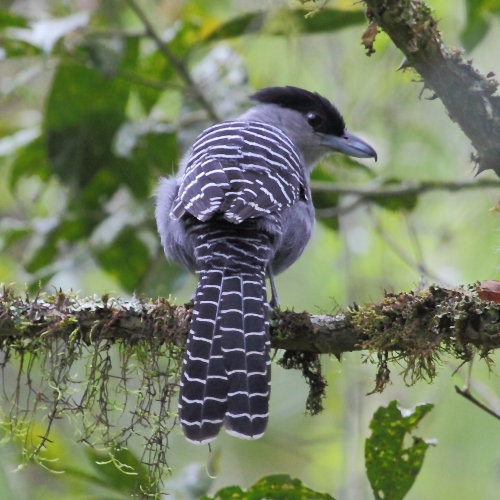
The Wing-banded Antbird is a medium-sized bird, measuring approximately 14-15 cm in length. It has a distinctive plumage pattern that aids in its identification, with males showcasing a striking combination of black and white wing bands. These bands are especially visible when the bird is perched or in flight. The body feathers are primarily brown, offering camouflage against the forest floor. Females tend to be slightly duller, with less pronounced wing markings but maintain similar overall coloration. Juveniles resemble females but often exhibit more muted tones, which gradually develop into adult plumage. One might confuse the Wing-banded Antbird with other antbirds due to overlapping habitats, but its unique wing pattern serves as a key differentiator. In flight, the Wing-banded Antbird displays a rapid, fluttering motion typical of many forest-dwelling birds. Its perching posture is usually horizontal, allowing it to maintain a low profile while scanning for prey. This posture, coupled with its distinct wing markings, helps distinguish it from other similar-sized understory birds.
Having trouble telling birds apart? Upload a photo to our bird identification tool for an instant species match.
Myrmornis campanisona Habitat and Range
Preferred Habitat
The Wing-banded Antbird is predominantly found in the humid, evergreen forests of the Amazon Basin. Its preferred habitat includes the dense understory of primary and secondary forests, where it thrives in the shade and humidity. These birds are often located at elevations up to 1,000 meters, although they are most common in lowland areas. The bird's affinity for dense foliage provides it with the cover necessary to avoid predators and efficiently hunt for insects. Seasonal habitat shifts are minimal for the Myrmornis campanisona, as it tends to remain in similar forested environments year-round. Unlike some bird species, it rarely ventures into urban or heavily disturbed areas, highlighting its reliance on intact forest ecosystems for survival.
Geographic Range
The geographical range of the Myrmornis campanisona spans the tropical regions of South America, with a concentration in the Amazon Basin. It is present in countries such as Brazil, Peru, Ecuador, Colombia, and Venezuela, where it inhabits vast tracts of uninterrupted rainforest. Unlike many migratory birds, the Wing-banded Antbird does not undertake significant seasonal migrations, remaining instead within its established range throughout the year. Population density is highest in areas of pristine forest, where human disturbance is minimal. This bird's presence in a given area often indicates a healthy environment, free from the pressures of deforestation and habitat fragmentation common in other parts of the continent.
Want to know which birds visit your area? Browse our backyard birds by location guides for region-specific species lists.
What Does the Myrmornis campanisona Eat?
The diet of the Wing-banded Antbird primarily consists of insects and other small invertebrates. It exhibits a keen specialization for following army ant swarms, capitalizing on the insects and small creatures flushed out by these swarms. This foraging technique is both efficient and effective, allowing the bird to capture a wide variety of prey without expending significant energy. Prey items typically include beetles, spiders, and caterpillars. Seasonal variations in diet are minimal, although during the wet season, the abundance of insects allows for greater feeding opportunities. The bird employs a watchful and patient hunting strategy, often remaining still until it spots movement before making a swift capture. Its feeding schedule is most active during dawn and dusk, when its prey is most abundant.
Myrmornis campanisona Behavior and Social Structure
Socially, the Wing-banded Antbird is primarily solitary or seen in pairs, especially during the breeding season. It exhibits territorial behavior, with males often engaging in vocal displays to establish dominance and defend territories. During courtship, males perform elaborate displays, which include wing flicking and vocalizations to attract females. The bird's response to predators is cautious, relying on its cryptic plumage to remain undetected. Flocking patterns are uncommon for this species outside of occasional participation in mixed-species flocks, where it benefits from the collective vigilance against predators. Daily activities peak during the early morning and late afternoon, aligning with the activity cycles of their prey.
Myrmornis campanisona Nesting and Reproduction
The Wing-banded Antbird constructs a cup-shaped nest, typically situated low to the ground in dense vegetation. The nest is made from twigs, leaves, and other plant materials, carefully woven to ensure stability and concealment. Females usually lay two eggs per clutch, with both parents sharing incubation duties over a period of approximately 16-18 days. Upon hatching, the fledglings remain in the nest for a further 14-16 days before venturing out, albeit under the watchful eye of their parents. Parental roles are evenly shared, with both adults providing food and protection to the young. The species typically raises one brood per year, although favorable conditions can lead to a second brood.
Myrmornis campanisona Sounds and Vocalizations
The primary song of the Wing-banded Antbird is a series of clear, melodious whistles that rise and fall in pitch, often described as a 'pwee-pwee-pwee' sequence. This song is most commonly heard during the early morning hours as part of the dawn chorus, serving territorial and mate-attraction purposes. In addition to its song, the bird emits sharp call notes as alarm signals or to communicate with its mate. These call notes are shorter and more abrupt than the song, resembling a 'chit-chit' sound. The vocalizations of the Wing-banded Antbird add a unique element to the soundscape of tropical forests, and its song can often be a key indicator of its presence in dense habitats.
Interesting Facts About the Myrmornis campanisona
- 1The Wing-banded Antbird often follows army ant swarms, a behavior known as ant-following, to catch flushed prey.
- 2Despite its elusive nature, the Wing-banded Antbird plays a crucial role in controlling insect populations in tropical forests.
- 3The bird's distinct wing bands are not just for show; they help in species identification and mate attraction.
- 4Myrmornis campanisona can be an indicator species for healthy, undisturbed tropical forests.
- 5The antbird's diet changes minimally, relying heavily on the availability of insects year-round.
- 6Both male and female Wing-banded Antbirds participate equally in the incubation of their eggs.
- 7The species' song, characterized by a series of melodious whistles, is a highlight of the dawn chorus in its habitat.
Myrmornis campanisona Conservation Status
The Wing-banded Antbird is currently listed as Least Concern by the IUCN, with populations considered stable across its range. However, the primary threat to this species is habitat loss due to deforestation in the Amazon Basin. Conservation efforts focus on maintaining and protecting large tracts of primary rainforest to ensure the survival of this species. While historical population changes have been minimal, continued vigilance is necessary to prevent future declines. Conservation organizations prioritize the protection of key habitats and increasing awareness of the bird's ecological role.
Other Thamnophilidae Species



Birds Similar to the Myrmornis campanisona
These species are often confused with the Myrmornis campanisona due to similar appearance or overlapping range.
