
Fasciated Antshrike
Cymbilaimus lineatus
Order: Passeriformes / Family: Thamnophilidae

Wikimedia Commons
About the Fasciated Antshrike
The Fasciated Antshrike (Cymbilaimus lineatus) is a captivating bird species in the Thamnophilidae family, known for its distinctive black-and-white striped appearance. This bird is native to the humid tropical forests of Central and South America, where it plays a crucial role in the ecosystem as a predator of insects and small invertebrates. The Fasciated Antshrike typically inhabits lowland and foothill forests, thriving in areas with dense understory vegetation that provides ample foraging opportunities.
With a range extending from southern Mexico through Central America and into the northern regions of South America, the Fasciated Antshrike exhibits fascinating adaptations to its environment. As a member of the understory bird community, it often participates in mixed-species flocks, a behavior that enhances its foraging efficiency and provides protection from predators. This species exhibits a permanent residency pattern, with individuals remaining within their territories year-round, although some altitudinal movements may occur in response to seasonal changes in food availability.
The ecological significance of the Fasciated Antshrike cannot be understated. By preying on a variety of insects, it helps regulate insect populations, thus maintaining the health of the forest ecosystem. Additionally, its presence in diverse habitats across its range highlights its adaptability and resilience, traits that are essential for its survival amid the changing environmental conditions in its native regions. During the breeding season, typically from March to August, the Fasciated Antshrike demonstrates territorial behavior, with pairs engaging in vocal duets to establish and defend their territory, an intriguing aspect of its ecological role and social structure.
The Fasciated Antshrike belongs to the family Thamnophilidae, within the order Passeriformes. These birds typically live average 5 years with a maximum recorded of 8 years..
How to Identify a Fasciated Antshrike
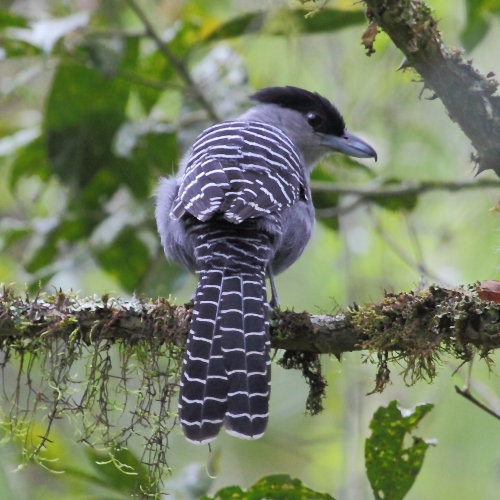
The Fasciated Antshrike is distinguished by its striking black-and-white barred plumage, which gives it a unique and recognizable appearance. Adult males and females share this barred pattern, though males typically exhibit more vibrant and contrasting plumage. The male's head, back, and wings are predominantly black with white bars, while the underparts are white with black barring. Females, though similar in pattern, often have a slightly browner tone to their plumage, especially on the back and wings.
Juvenile Fasciated Antshrikes resemble adults but have a more subdued coloration, with less distinct barring and a generally duller appearance. This provides them with better camouflage in the dense understory where they dwell. When observing these birds, one may notice their short, stout bills, which are well-suited for their insectivorous diet.
In flight, the Fasciated Antshrike displays a distinctive silhouette with broad, rounded wings and a relatively short tail. Its perching posture is often horizontal, and it moves deliberately through the vegetation, pausing to scan for prey. While the Fasciated Antshrike shares its habitat with other antbird species, its bold pattern and unique vocalizations help distinguish it from others, such as the larger and more uniformly colored Barred Antshrike.
Having trouble telling birds apart? Upload a photo to our bird identification tool for an instant species match.
Fasciated Antshrike Habitat and Range
Preferred Habitat
The Fasciated Antshrike thrives in tropical lowland and foothill forests, with a preference for dense understory vegetation. These habitats provide the cover and resources necessary for their insectivorous lifestyle. Commonly found in primary and secondary growth forests, the Fasciated Antshrike can also inhabit forest edges and areas recovering from disturbance, provided there is sufficient understory.
Typically occupying elevations from sea level to around 1,200 meters, the Fasciated Antshrike demonstrates some flexibility in habitat choice. However, it remains strongly associated with humid, densely vegetated environments. Unlike some other bird species, the Fasciated Antshrike is not commonly found in urban settings, as it relies heavily on the forest's complex structure for survival.
Seasonal shifts in habitat are generally minimal for this species, given its non-migratory nature. However, minor altitudinal movements might occur in response to food availability, particularly during periods of resource scarcity at lower elevations. This adaptability to different forest types underscores its resilience and ecological versatility.
Geographic Range
The Fasciated Antshrike's range extends across several countries in Central and South America. In Central America, it can be found from southern Mexico through Belize, Guatemala, Honduras, Nicaragua, Costa Rica, and Panama. Its South American range includes Colombia, Venezuela, Ecuador, Peru, Bolivia, and parts of Brazil.
This bird is a year-round resident in its range, with no significant long-distance migrations observed. Instead, it maintains its territory throughout the year, engaging in altitudinal movements if necessary to adapt to seasonal changes in food resources. Such movements are typically limited to relatively short distances within its established range.
Population density hotspots for the Fasciated Antshrike are often found in regions with rich, undisturbed tropical forests, where the dense understory supports a diverse community of insects and other prey. Areas like the Amazon Basin and the Chocó biogeographical region are particularly important for this species, offering the ideal habitat conditions for its foraging and breeding activities.
Want to know which birds visit your area? Browse our backyard birds by location guides for region-specific species lists.
What Does the Fasciated Antshrike Eat?
The Fasciated Antshrike primarily feeds on insects and small arthropods, playing a vital role in controlling insect populations within its habitat. Its diet includes a variety of ants, beetles, caterpillars, and spiders, with occasional consumption of small vertebrates such as lizards and frogs, especially in nutrient-rich environments.
Foraging behavior is characterized by slow, deliberate movements through the understory, where it examines leaves, branches, and bark for hidden prey. The Fasciated Antshrike often joins mixed-species foraging flocks, which increases its chances of locating food while reducing the risk of predation.
Dietary preferences may shift slightly with the seasons, as the availability of certain prey items fluctuates. During the wet season, when insect populations typically increase, the Fasciated Antshrike may expand its dietary range to include a greater variety of prey. This opportunistic feeding strategy ensures a stable food supply throughout the year, contributing to the bird's ecological success.
Fasciated Antshrike Behavior and Social Structure
The Fasciated Antshrike exhibits a range of intriguing behaviors that reflect its social structure and environmental adaptations. As a territorial bird, it defends its space vigorously, particularly during the breeding season. Pairs often engage in vocal duets, broadcasting their presence and deterring intruders from encroaching on their territory.
In terms of social interaction, the Fasciated Antshrike is known to participate in mixed-species flocks, a behavior that enhances foraging success and offers protection from predators. This cooperation allows the bird to exploit a wider range of prey items and habitats than it might alone.
During courtship, males perform displays that include a combination of vocalizations and visual signals, such as fluffing their feathers and flicking their tails. These displays serve to strengthen pair bonds and ensure reproductive success. Daily activity patterns include periods of active foraging interspersed with resting and preening, typically timed to coincide with peak prey activity during the cooler parts of the day.
Response to predators is primarily evasive, with the Fasciated Antshrike relying on its agility and the dense forest cover to escape threats. Alarm calls are occasionally used to warn conspecifics of nearby danger, contributing to the overall safety and cohesion of the flock.
Fasciated Antshrike Nesting and Reproduction
The Fasciated Antshrike constructs a cup-shaped nest, typically located in the dense undergrowth or low shrubs. The nest is made from twigs, leaves, and other plant materials, often lined with finer fibers for added comfort. These nests are well-camouflaged within the foliage, providing protection from predators.
Clutch size generally consists of two to three eggs, with both parents sharing incubation duties over a period of approximately 14-16 days. This cooperative parental care extends to the feeding and protection of the chicks, which fledge about 12-15 days after hatching.
The Fasciated Antshrike usually produces one to two broods per year, depending on environmental conditions and food availability. During the breeding season, territory defense becomes particularly intense, with pairs actively repelling intruders to ensure a safe environment for their offspring.
Parental roles are generally shared, with both male and female participating in feeding and nurturing the young. This biparental strategy enhances chick survival rates, increasing the likelihood of successful fledging in the challenging forest environment.
Fasciated Antshrike Sounds and Vocalizations
The Fasciated Antshrike's primary song consists of a series of rapid, harsh notes delivered in a descending sequence. The rhythm is somewhat staccato, with each note distinct from the next, creating a characteristic sound that carries well through the dense forest.
Call notes are shorter and softer than the primary song, often used for communication between mates or within foraging flocks. Alarm calls are sharper and more urgent, designed to alert others to the presence of predators.
During the dawn chorus, the Fasciated Antshrike's song is a prominent feature, contributing to the vibrant tapestry of sounds that herald the start of a new day in the tropical forest. Its vocalizations can be compared to the rattle of a small percussion instrument, providing a useful auditory cue for birdwatchers seeking to identify this elusive species.
Interesting Facts About the Fasciated Antshrike
- 1The Fasciated Antshrike's bold black-and-white plumage is an excellent example of disruptive coloration, which helps it blend into the dappled light of the forest understory.
- 2Despite its name, the Fasciated Antshrike does not primarily feed on ants, although it will consume them opportunistically.
- 3The Fasciated Antshrike often joins mixed-species flocks, which can include up to 20 different bird species, enhancing its foraging efficiency and safety.
- 4This species exhibits sexual monomorphism, meaning males and females look very similar, a trait not common in many bird species.
- 5Fasciated Antshrikes are known to follow army ant swarms, taking advantage of the insects and small prey flushed out by the moving ants.
- 6The Fasciated Antshrike's vocal duets are not only for territory defense but also serve to strengthen pair bonds between mates.
- 7The bird's scientific name, Cymbilaimus lineatus, refers to its striped (lineatus) appearance, a defining feature of its identity.
Fasciated Antshrike Conservation Status
The Fasciated Antshrike is currently listed as Least Concern by the IUCN, with a stable population trend across its range. However, habitat destruction poses a significant threat, particularly in regions undergoing rapid deforestation due to agricultural expansion and logging. Conservation efforts focus on preserving large tracts of intact forest, which are essential for the survival of the Fasciated Antshrike and countless other species. Protected areas and national parks play a crucial role in safeguarding these habitats, providing a refuge from human encroachment. Historically, the Fasciated Antshrike has maintained a relatively stable population, thanks in part to its adaptability to a range of forest habitats. Nonetheless, continued monitoring and habitat conservation initiatives remain vital to ensure the long-term survival of this striking bird.
Other Thamnophilidae Species



Birds Similar to the Fasciated Antshrike
These species are often confused with the Fasciated Antshrike due to similar appearance or overlapping range.

