
Scaly-throated Honeyguide
Indicator variegatus
Order: Piciformes / Family: Indicatoridae

Wikimedia Commons
About the Scaly-throated Honeyguide
The Scaly-throated Honeyguide, scientifically known as Indicator variegatus, is a fascinating species within the family Indicatoridae and order Piciformes. This intriguing bird primarily inhabits the subtropical and tropical forests of sub-Saharan Africa, with a range extending from Guinea in the west to Ethiopia in the east, and as far south as South Africa. The species thrives in various forest environments, including lowland rainforests, montane forests, and even in mixed woodland areas where their primary food sources, beeswax and insects, are abundant. Indicator variegatus plays a unique ecological role due to its mutualistic relationship with humans and other animals. The species is named for its guiding behavior, where it leads humans or other animals to wild bee nests. This behavior is not merely anecdotal; it contributes significantly to the bird's survival strategy. By guiding larger animals to bee nests, they gain access to the wax and larval bees left behind after the honey is harvested. Such interactions highlight the Scaly-throated Honeyguide's ecological significance and its role in facilitating interactions between different species. Seasonally, the Scaly-throated Honeyguide is relatively stable in its habitat, with little evidence of long-distance migration. However, seasonal movements may occur locally in response to the availability of bee nests and flowering plants that attract bees. These movements ensure that the bird can maintain a steady diet throughout the year. The Scaly-throated Honeyguide is a species that has adapted well to its environment, utilizing its unique behavior to thrive in various forested regions across Africa. Its ability to exploit niche food resources like beeswax, combined with its clever use of mutualistic behaviors, underscores its adaptability and ecological importance.
The Scaly-throated Honeyguide belongs to the family Indicatoridae, within the order Piciformes. These birds typically live average 6-8 years with max recorded at 12 years..
How to Identify a Scaly-throated Honeyguide
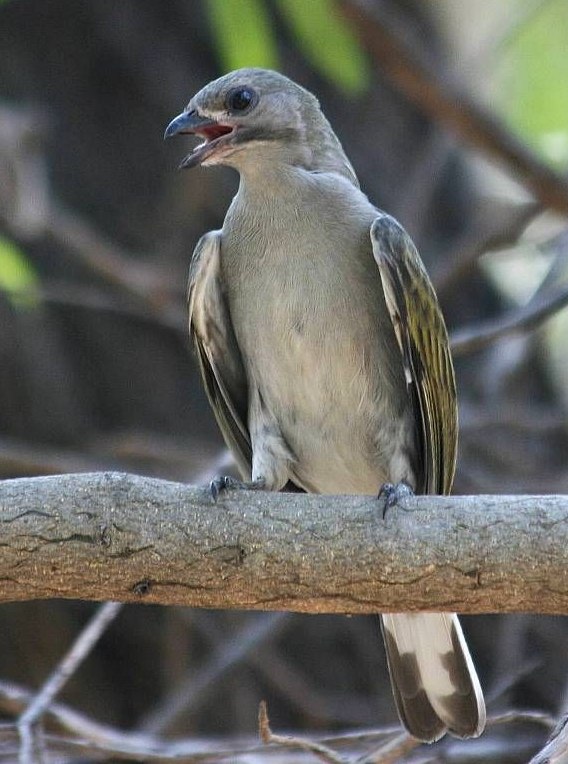
The Scaly-throated Honeyguide is a medium-sized bird, distinguished primarily by its striking throat pattern. Adults possess a distinctive scaly appearance on their throats, created by light-colored feather edges against darker feather bases. This feature is particularly noticeable in good lighting and serves as a key field mark when identifying the species. Overall, the plumage is a muted mix of olive-green and grey, providing excellent camouflage in the forest understory. Juveniles, in contrast, display a more mottled brown appearance, lacking the well-defined scaly pattern seen in adults. This difference in plumage allows for easier differentiation between age groups. Male and female Scaly-throated Honeyguides exhibit similar plumage, making it challenging to distinguish them based solely on appearance. However, subtle differences in size, with males being marginally larger, can sometimes aid in identification. The bird's silhouette in flight is characterized by broad, rounded wings and a short tail, typical of many honeyguide species. When perched, the Scaly-throated Honeyguide maintains an upright posture, often tilting its head slightly upwards as it surveys its surroundings. Confusion with other honeyguide species can occur, particularly with the Lesser Honeyguide (Indicator minor), which shares a similar range. However, the Scaly-throated Honeyguide's distinct throat pattern and slightly larger size generally set it apart when observed closely.
Having trouble telling birds apart? Upload a photo to our bird identification tool for an instant species match.
Scaly-throated Honeyguide Habitat and Range
Preferred Habitat
Scaly-throated Honeyguides primarily inhabit a range of forest types in sub-Saharan Africa. These include lowland rainforests, montane forests, and mixed woodlands, where they find their preferred food sources. The species thrives at elevations ranging from sea level up to about 2,500 meters, demonstrating significant adaptability in habitat selection. While the bird is predominantly associated with forested environments, it can occasionally be found in savanna woodlands, particularly where trees are dense enough to support bee populations. Seasonal habitat shifts are minimal, as the species does not undertake long migrations. However, local movements in response to the availability of bee nests and food resources are common, ensuring the bird remains within favorable habitats year-round. Urban presence is rare, as the Scaly-throated Honeyguide prefers more secluded, natural areas where bee populations are robust. This preference for undisturbed habitats makes them less visible in heavily populated or agricultural regions.
Geographic Range
The Scaly-throated Honeyguide's range spans across the vast expanse of sub-Saharan Africa. Its breeding and year-round presence are noted in countries such as Nigeria, Cameroon, the Democratic Republic of the Congo, Uganda, Kenya, Tanzania, and into southern Africa, including Zimbabwe and South Africa. The bird is primarily non-migratory, with little evidence of long-distance movements. However, it may exhibit localized seasonal shifts within its range to capitalize on the availability of bee nests and flowering plants. Population density varies across its range, with higher concentrations found in regions where forests are dense and bee populations are abundant. Such areas include the Congo Basin and the montane forests of East Africa. While the Scaly-throated Honeyguide occupies a broad geographic range, its specific habitat preferences and reliance on bee nests can make it less common in areas where these resources are scarce. Despite this, the species remains widespread across suitable habitats within its range.
Want to know which birds visit your area? Browse our backyard birds by location guides for region-specific species lists.
What Does the Scaly-throated Honeyguide Eat?
The Scaly-throated Honeyguide has a highly specialized diet, primarily consisting of beeswax and the larvae and pupae within bee nests. This unique dietary preference sets it apart from most other birds. To access these resources, the honeyguide often engages in its namesake behavior, leading humans or animals to bee nests. Once the larger animal breaks open the nest, the honeyguide consumes the wax and any remaining bee larvae. During periods when bee nests are less available, the Scaly-throated Honeyguide supplements its diet with various insects, which it gleans from foliage and tree bark. This dietary flexibility is crucial for survival during lean times. Foraging techniques include gleaning and occasional aerial sallies to capture flying insects, although these are secondary to its primary wax-based diet. The bird's feeding schedule aligns with periods of bee activity, typically early morning and late afternoon, when bees are most active. This schedule ensures the honeyguide remains in proximity to its food sources and optimizes its chances of finding active bee nests.
Scaly-throated Honeyguide Behavior and Social Structure
The Scaly-throated Honeyguide exhibits a range of fascinating behaviors, most notably its guiding behavior, which involves leading larger animals to bee nests. This behavior is both a survival strategy and a means to access food, as the bird benefits from the aftermath of a bee nest being disturbed. Socially, the Scaly-throated Honeyguide is generally solitary, though interactions occur during the breeding season. Territorial behavior is evident, with individuals defending their feeding territories from other honeyguides. This territoriality ensures access to local bee nests and food sources. Courtship displays involve vocalizations and aerial chases, with males showcasing their agility to attract females. Once paired, the birds engage in mutual preening and close physical contact. In terms of predator response, the Scaly-throated Honeyguide relies on its excellent camouflage and secretive nature. When threatened, it remains motionless, blending into its surroundings. Daily activity patterns are diurnal, with peak activity aligning with bee foraging times. The bird spends its day traversing its territory, listening for potential bee activity, and resting during midday heat.
Scaly-throated Honeyguide Nesting and Reproduction
Unlike many birds, the Scaly-throated Honeyguide does not build its own nests. Instead, it is a brood parasite, laying eggs in the nests of other bird species. Preferred hosts include barbets and woodpeckers, whose nesting habits align with the honeyguide's requirements. The female honeyguide surreptitiously lays a single egg in the host's nest, often removing one of the host's eggs in the process. Clutch size is typically one egg per host nest, but females may lay in multiple nests to increase reproductive success. The incubation period is managed by the host species, lasting approximately 14-16 days. Once hatched, the young honeyguide often eliminates competition by ejecting host nestlings, ensuring it receives the full attention and resources of the host parents. Fledging occurs after about 21-24 days, with the young honeyguide fully dependent on its foster parents until it achieves independence. The species typically raises one brood per year, capitalizing on synchronized breeding with its host species to optimize survival.
Scaly-throated Honeyguide Sounds and Vocalizations
The Scaly-throated Honeyguide's vocalizations are not as melodious as those of songbirds, but they are distinctive. The primary song consists of a series of sharp, high-pitched 'cheep-cheep' notes, repeated in quick succession. This song serves both as a territorial call and a means of communication between mates. In addition to its primary song, the bird emits a range of call notes, including harsh 'churr' and 'click' sounds used during interactions with rivals or predators. Alarm calls are less frequent but consist of rapid, repetitive notes that alert other honeyguides to potential threats. During the dawn chorus, the Scaly-throated Honeyguide's song can be heard intermingled with the calls of other forest species, adding to the rich tapestry of sounds within its habitat. While not as elaborate as other birds' songs, the honeyguide's vocalizations play a crucial role in its social and territorial behavior.
Interesting Facts About the Scaly-throated Honeyguide
- 1The Scaly-throated Honeyguide's guiding behavior is a rare instance of mutualism in the bird world, benefiting both the bird and the larger animals.
- 2Indicator variegatus can consume beeswax thanks to specialized enzymes in their digestive system, a trait uncommon among birds.
- 3The species' diet is so specialized that it often relies on humans or animals to break open bee nests, showcasing its unique ecological niche.
- 4Scaly-throated Honeyguides have a remarkable ability to locate bee nests by sound, honing in on the buzzing of bees to find food.
- 5Despite being a brood parasite, the honeyguide's young develop rapidly, fledging within about three weeks, a fast timeline for bird species.
- 6The species' vocalizations, though not musical, are crucial for territory establishment and mate attraction, underscoring the importance of sound in its life.
- 7Scaly-throated Honeyguides are found across various elevations, from sea level to mountain forests, highlighting their adaptability.
Scaly-throated Honeyguide Conservation Status
The Scaly-throated Honeyguide is currently classified as Least Concern on the IUCN Red List, reflecting a stable population trend across its extensive range. Despite this, localized threats exist, primarily due to habitat loss from deforestation and human encroachment. Conservation efforts focus on preserving forest habitats and promoting sustainable land-use practices in regions where the species is present. Historical population changes are difficult to quantify, as the bird's secretive nature and reliance on specific habitats complicate long-term monitoring. However, the species' adaptability to a range of forest environments has likely contributed to its resilience. Continued habitat protection and awareness of its ecological role are essential for maintaining stable populations. As with many forest-dependent species, the Scaly-throated Honeyguide's future hinges on the conservation of its natural habitats and the delicate ecosystems they support.
Other Indicatoridae Species



Birds Similar to the Scaly-throated Honeyguide
These species are often confused with the Scaly-throated Honeyguide due to similar appearance or overlapping range.